


Safety and Efficacy of Upadacitinib in Patients with Rheumatoid Arthritis Refractory to Biologic DMARDs: Results Through Week 216 from the SELECT-CHOICE Study
- PMID: 39031276
- PMCID: PMC11422392
- DOI: 10.1007/s40744-024-00694-x
Safety and Efficacy of Upadacitinib in Patients with Rheumatoid Arthritis Refractory to Biologic DMARDs: Results Through Week 216 from the SELECT-CHOICE Study
Abstract
Introduction: The safety and efficacy of upadacitinib 15 mg (UPA15) through week 216 was evaluated in patients with rheumatoid arthritis (RA) from the long-term extension (LTE) of the phase 3 SELECT-CHOICE study.
Methods: Patients with RA refractory to biologic disease-modifying antirheumatic drugs (bDMARDs) were randomized to UPA15 or abatacept (ABA) for 24 weeks. During the open-label LTE, patients on ABA switched to UPA15 at week 24, and those on UPA15 continued treatment. The safety and efficacy of continuous UPA15, and ABA to UPA15, are summarized through week 216.
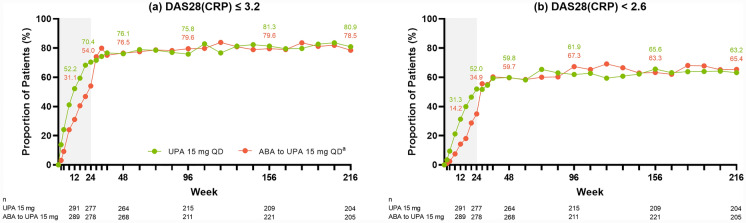
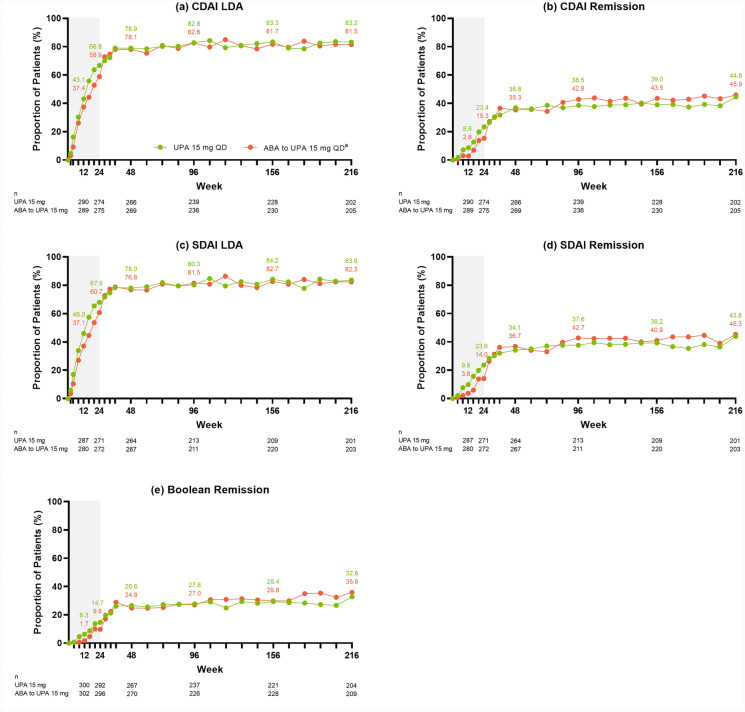
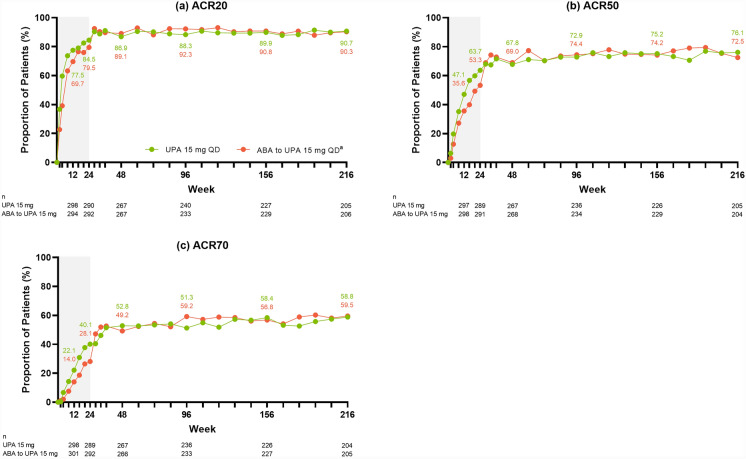
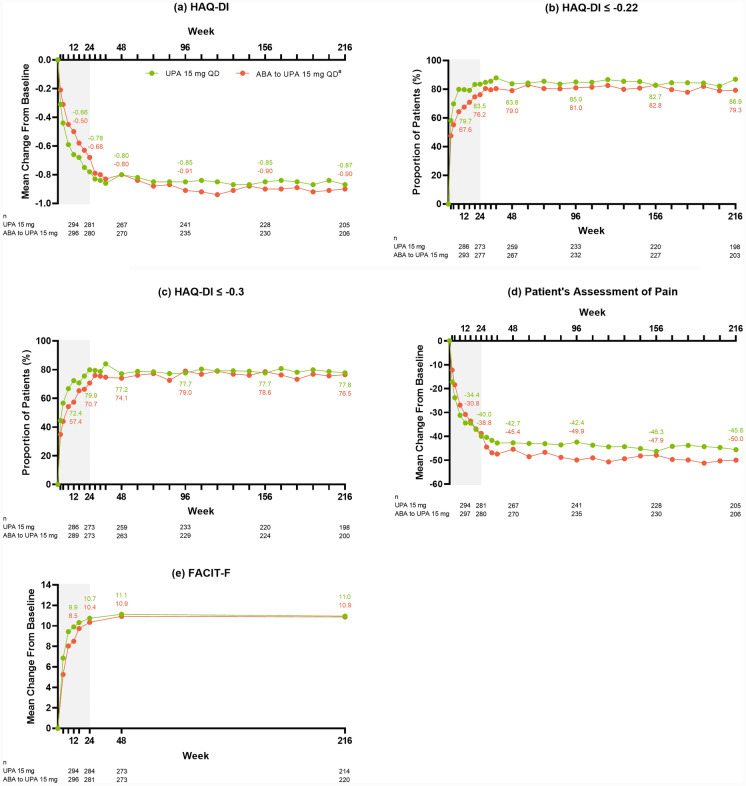
Results: The LTE was comprised of 91.4% (n = 277/303) of patients that initially received UPA15, and 89.6% (n = 277/309) that initially received ABA. Of patients on UPA15 in the LTE (n = 547), 28.3% (n = 155/547) discontinued the study drug by week 216. Relative to other adverse events of special interest, and largely consistent with previous findings at week 24, higher rates of serious infection, COVID-19, herpes zoster, and elevated creatine phosphokinase were reported, while rates of malignancy excluding nonmelanoma skin cancer (NMSC), NMSC, major adverse cardiovascular event (MACE), and venous thromboembolism (VTE) were low. Long-term safety data with UPA through week 216 aligned with previous observations and no new safety risks were identified, including in patients who switched from ABA to UPA15. Proportions of patients achieving 28-joint disease activity score based on C-reactive protein (DAS28[CRP]) < 2.6/ ≤ 3.2, clinical disease activity index (CDAI) and simple disease activity index (SDAI) low disease activity/remission, ≥ 20%/50%/70% improvement in the American College of Rheumatology (ACR20/50/70) response criteria, and Boolean remission were maintained or improved with UPA15 through week 216. Improvements in the Health Assessment Questionnaire-Disability Index (HAQ-DI), patient's assessment of pain, and Functional Assessment of Chronic Illness Therapy-Fatigue (FACIT-F) were also maintained or improved with UPA15 through week 216. Across all efficacy endpoints, similar results were observed in patients who switched from ABA to UPA15 versus continuous UPA15. Patients with an inadequate response to ≥ 1 prior tumor necrosis factor (TNF) inhibitor (UPA15: n = 263/303, 86.8%; ABA to UPA15: n = 273/309, 88.3%) showed similar responses to the total population.
Conclusions: The long-term safety profile of UPA was consistent with previous findings and the broader RA clinical program. Compared to the primary analyses at week 24, efficacy responses were maintained or further improved with UPA15 through week 216 in patients with RA. Trial registration, ClinicalTrials.gov identifier: NCT03086343.
Keywords: Abatacept; Biologic disease-modifying antirheumatic drug inadequate response (bDMARD-IR); Efficacy; Janus kinase (JAK) inhibitor; Patient-reported outcomes (PROs); Rheumatoid arthritis (RA); SELECT-CHOICE; Safety; Upadacitinib.
Plain language summary
A long-term study looked at a drug named upadacitinib to treat people with rheumatoid arthritis (RA), a disease that causes joint pain and damage. The study included patients whose RA was not improved by other injectable medicines. The study compared upadacitinib with another drug called abatacept. After 24 weeks, patients who were taking abatacept switched to upadacitinib, and patients taking upadacitinib continued on upadacitinib treatment for over 4 years. The researchers looked at how well the treatments worked over the long-term and if there were any side effects. The side effects with upadacitinib treatment in this long-term study were similar to side effects reported in previous studies with upadacitinib. The researchers also found that upadacitinib helped to lessen the symptoms of RA over time and helped patients complete their daily activities and reduced their pain and tiredness. This was true for patients who switched from abatacept to upadacitinib after 24 weeks and for patients who took upadacitinib from the start of the study. Patients who had not responded to other medicines also had similar improvements with upadacitinib. In conclusion, upadacitinib can help people with RA over the long term and no new safety risks were found.
© 2024. The Author(s).
Conflict of interest statement
Financial arrangements of the authors with companies whose products may be related to the present manuscript are listed, as declared by the authors. Andrea Rubbert-Roth has received honoraria for lectures and consulting from AbbVie, Amgen, BMS, Eli Lilly, Gilead, Janssen, Novartis, Pfizer, Roche, and Sanofi. Koji Kato is an employee of AbbVie and may hold stock or options. Boulos Haraoui has received speaker and/or consulting fees, and/or research grants, from AbbVie, Amgen, BMS, Celgene, Eli Lilly, Janssen, Merck, Novartis, Pfizer, and UCB. Maureen Rischmueller has received grant/research support from AbbVie, BMS, GSK, Janssen Global Services, Eli Lilly, Novartis, Servier, and UCB Biosciences, and consultant/speaker fees from AbbVie, Amgen, Boehringer Ingelheim, Janssen Global Services, Novartis, and Pfizer. Yanxi Liu is an employee of AbbVie and may hold stock or options. Nasser Khan is a former employee of AbbVie and may hold stock or options. Heidi S. Camp is an employee of AbbVie and may hold stock or options. Ricardo M. Xavier has received research grants from AbbVie, Eli Lilly, Janssen, UCB and Pfizer, and consultant/speaker fees from AbbVie, Sandoz, Janssen, Novartis, Pfizer, and UCB.
Figures
References
-
- Nam JL, Ramiro S, Gaujoux-Viala C, Takase K, Leon-Garcia M, Emery P, et al. Efficacy of biological disease-modifying antirheumatic drugs: a systematic literature review informing the 2013 update of the EULAR recommendations for the management of rheumatoid arthritis. Ann Rheum Dis. 2014;73:516–28. - DOI - PubMed
Associated data
LinkOut - more resources
Full Text Sources
Medical
Research Materials
Miscellaneous
