. 2024 Jul 13;6(4):fcae228.
doi: 10.1093/braincomms/fcae228. eCollection 2024.

Spontaneous cortical activity is altered in persons with HIV and related to domain-specific cognitive function

Affiliations

Spontaneous cortical activity is altered in persons with HIV and related to domain-specific cognitive function

Nathan M Petro et al. Brain Commun. .

Abstract

Whilst the average lifespan of persons with HIV now approximates that of the general population, these individuals are at a much higher risk of developing cognitive impairment with ∼35-70% experiencing at least subtle cognitive deficits. Previous works suggest that HIV impacts both low-level primary sensory regions and higher-level association cortices. Notably, multiple neuroHIV studies have reported elevated levels of spontaneous cortical activity during the pre-stimulus baseline period of task-based experiments, but only a few have examined such activity during resting-state conditions. In the current study, we examined such spontaneous cortical activity using magnetoencephalography in 79 persons with HIV and 83 demographically matched seronegative controls and related this neural activity to performance on neuropsychological assessments of cognitive function. Consistent with previous works, persons with HIV exhibited stronger spontaneous gamma activity, particularly in inferior parietal, prefrontal and superior temporal cortices. In addition, serostatus moderated the relationship between spontaneous beta activity and attention, motor and processing speed scores, with controls but not persons with HIV showing stronger beta activity with better performance. The current results suggest that HIV predominantly impacts spontaneous activity in association cortices, consistent with alterations in higher-order brain function, and may be attributable to deficient GABAergic signalling, given its known role in the generation of gamma and beta oscillations. Overall, these effects align with previous studies showing aberrant spontaneous activity in persons with HIV and provide a critical new linkage to domain-specific cognitive dysfunction.

Keywords: MEG; cognitive domains; magnetoencephalography; neuroHIV; resting state.


Conflict of interest statement

The authors report no competing interests.

Figures

Graphical Abstract
Graphical Abstract
Figure 1
Figure 1
CONSORT diagram. Of the 187 participants enrolled in the study, 162 remained following exclusion for current substance use, MEG incompatibility, failure to return for the MEG session, opting out of the MEG session and failure to follow instructions during neuropsychological assessment.
Figure 2
Figure 2
Group differences in the composite scores for neuropsychological assessments.  Z-scores for each domain of cognitive assessment for both controls and PWH. Dots represent the Z-score for each participant. The box plots illustrate the mean, first and third quartiles, and the whiskers indicate the minima and maxima. The violin plots illustrate the probability density. As revealed in independent samples t-tests, controls scored higher on the attention (t160 = 4.34, Pfdr < 0.001), memory (t160 = 3.22, Pfdr < 0.01), learning (t160 = 3.05, Pfdr < 0.01) and motor (t158 = 3.01, Pfdr < 0.01) domains relative to PWH (**Pfdr < 0.001, *Pfdr < 0.01, #P = 0.069). Controls and PWH did not differ in the executive function, language or processing speed domains.
Figure 3
Figure 3
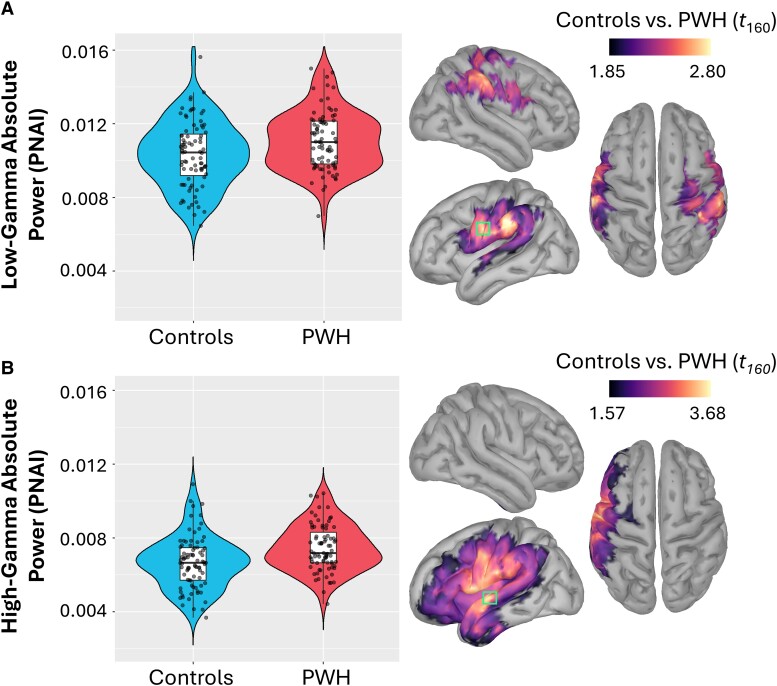
Group differences in resting spontaneous gamma power. Cortical surface maps (right) display the vertex-wise t-values from independent samples t-tests of the group comparison of spontaneous power for low-gamma (A) and high-gamma (B) power. The green box indicates the vertex containing the strongest difference. For illustrative purposes, each participant's absolute power at the peak is plotted (left) separately for controls and PWH. The box plots illustrate the mean, first and third quartiles, and the whiskers indicate the minima and maxima. The violin plots illustrate the probability density. PWH had stronger power for both low-gamma (t160 = 2.80, Pfwe < 0.05) and high-gamma (t160 = 3.68, Pfwe < 0.05) compared with controls, with differences being generally confined to inferior parietal, prefrontal and superior temporal cortices.
Figure 4
Figure 4
The moderating effect of serostatus on the relationship between resting-state spontaneous beta power and cognitive composite scores. Cortical surface maps (top) display the vertex-wise F-values representing the moderating effect of HIV on the relationship between spontaneous beta activity and the attention (A), motor (B) and processing speed (C) domains. Each of these moderating effects was calculated using a multiple regression. The green box indicates the vertex containing the strongest effect. For illustrative purposes, each participant's absolute power is plotted against the Z-scores for each cognitive domain (bottom), separately for controls and PWH. The least squares line is plotted in black, and the shaded region illustrates the 95% confidence interval. For attention, the moderation effect was particularly strong in the anterior cingulate cortex (F1,158 = 9.38, Pfwe < 0.01). For motor, this effect was strongest in the superior parietal lobule (F1,156 = 9.84, Pfwe < 0.01), whilst the strongest effects for processing speed were seen in the anterior temporal and prefrontal cortices (F1,154 = 12.02, Pfwe < 0.01).

References

    1. Sabin CA. Do people with HIV infection have a normal life expectancy in the era of combination antiretroviral therapy? BMC Med. 2013;11(1):251. - PMC - PubMed
    1. Samji H, Cescon A, Hogg RS, et al. Closing the gap: Increases in life expectancy among treated HIV-positive individuals in the United States and Canada. PLoS One. 2013;8(12):e81355. - PMC - PubMed
    1. Robertson KR, Smurzynski M, Parsons TD, et al. The prevalence and incidence of neurocognitive impairment in the HAART era. AIDS. 2007;21(14):1915–1921. - PubMed
    1. Antinori A, Arendt G, Becker JT, et al. Updated research nosology for HIV-associated neurocognitive disorders. Neurology. 2007;69(18):1789–1799. - PMC - PubMed
    1. Heaton RK, Clifford DB, Franklin DR, et al. HIV-associated neurocognitive disorders persist in the era of potent antiretroviral therapy: CHARTER study. Neurology. 2010;75(23):2087–2096. - PMC - PubMed

LinkOut - more resources