. 2024 Jul 22;12(7):e008837.
doi: 10.1136/jitc-2024-008837.

Subcutaneous checkpoint inhibition is equivalent to systemic delivery when combined with nelitolimod delivered via pressure-enabled drug delivery for depletion of intrahepatic myeloid-derived suppressor cells and control of liver metastases

Affiliations

Subcutaneous checkpoint inhibition is equivalent to systemic delivery when combined with nelitolimod delivered via pressure-enabled drug delivery for depletion of intrahepatic myeloid-derived suppressor cells and control of liver metastases

Chandra C Ghosh et al. J Immunother Cancer. .

Abstract

Background: Toll-like receptor 9 (TLR9) agonists induce inflammatory responses that promote the killing of infectious micro-organisms, cancer cells and develop adaptive immune responses. Their ability as immunomodulators to enhance the activity of checkpoint inhibitors (CPI) in treating liver tumors is limited in part by the distinctive biology of intrahepatic myeloid-derived suppressor cells (MDSC) and challenges with tumor-specific therapeutic delivery. We have shown that the regional delivery of type C TLR9 agonist via pressure-enabled drug delivery (PEDD) system improves delivery to the tumor, enhances depletion of MDSCs and overall, stimulates the immune system in combination with or without CPI. Currently, CPIs are delivered intravenously, although there is a growing interest in its subcutaneous (SQ) administration. We compared nelitolimod formerly known as SD-101 administered using PEDD in combination with systemic (Sys) or SQ CPI in murine liver metastases (LM).

Methods: The LM model was developed by injecting MC38-Luc cells via the spleen of 8-12 week old male C57/BL6 mice followed by splenectomy. After a week, fluorescently labeled nelitolimod (10 µg/mouse) was delivered via PEDD and co-administered anti-programmed cell death-1 (α-PD-1) either via Sys or SQ. Tumor burden was monitored by in vivo imaging system. Serum cytokine levels were analyzed by Luminex. Tissues were harvested on Day 3 (D3) or Day 10 (D10) post-PEDD to enrich CD45+ cells and were analyzed via NanoString targeted transcriptomics (D3) or flow cytometry (FC, D10) to interrogate immune cell populations (D10). For NanoString analysis, the innate immune panels were selected, and for FC, MDSCs (CD11b+Gr1+), B cells (B220+), dendritic cells (DC, CD11c+), T (CD3+) cells, and M1-like macrophages (F4/80+CD38+Egr2-) were quantified.

Results: Nelitolimod delivered via PEDD resulted in changes in innate and adaptive immune cells within LM, including depletion of liver MDSC and increased M1-like macrophages in the liver, which are supportive of antitumor immunity. While CPI monotherapy failed to control tumor progression, nelitolimod and CPI combination improved LM control, survival and antitumor immunity beyond the nelitolimod monotherapy effect, irrespective of CPI delivery route.

Conclusion: The SQ route of CPI delivery was equivalent to Sys in combination with nelitolimod, suggesting SQ-CPI may be a rational choice in combination with PEDD of nelitolimod for liver tumor treatment.

Keywords: Immune Checkpoint Inhibitor; Myeloid-derived suppressor cell - MDSC; Toll-like receptor - TLR; Tumor microenvironment - TME.


Conflict of interest statement

Competing interests: CCG, YL, AB, JL, MM, KF, BFC, PG, SCK are employee of Trisalus Life Sciences. LC, IBL, SP, EY, DOT, TM have no conflict of interest. Conflict of interests of DD are: Grants/Research Support (institutional): Arcus, CellSight Technologies, Immunocore, Merck, Regeneron Pharmaceuticals, Tesaro/GSK. Consultant: ACM Bio, Ascendis Pharma, Clinical Care Options (CCO), Gerson Lehrman Group (GLG), Merck, Medical Learning Group (MLG), Xilio Therapeutics. CE Speakers’ Bureau: Castle Biosciences. Intellectual Property: US Patent 63/124,231, “Compositions and Methods for Treating Cancer”, December 11, 2020 US Patent 63/208,719, “Compositions and Methods For Responsiveness to Immune Checkpoint Inhibitors (ICI), Increasing Effectiveness of ICI and Treating Cancer”, June 9, 2021.

Figures
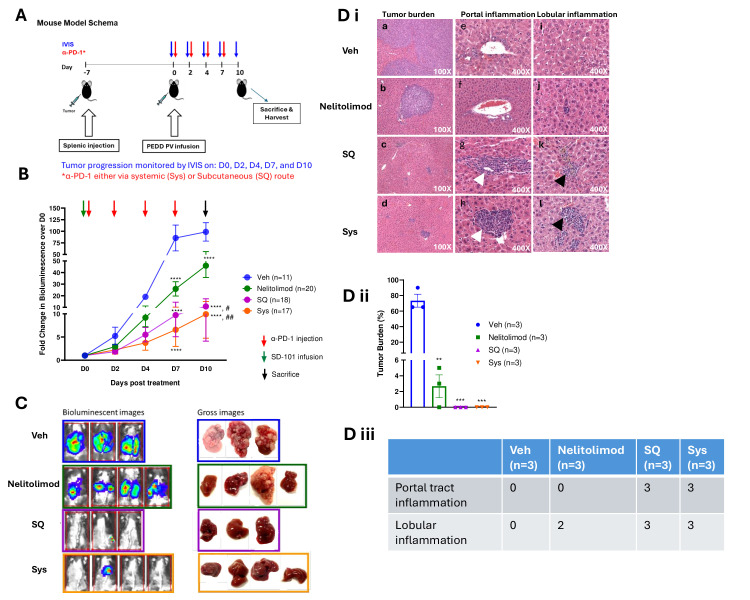
Figure 1
Figure 1. Antitumor activity of PEDD of nelitolimod on LM was enhanced by checkpoint inhibitors irrespective of delivery route. (A) Schematic representation of the experimental procedures. 8–12-week-old C57/BL6 mice were challenged with 106 MC38-Luc cells/mouse and delivered via spleen followed by splenectomy. After 7 days mice were treated with nelitolimod via PEDD in combination with α-PD-1 administered Sys or SQ on days mentioned in the schema. (B) Bioluminescence values were determined by IVIS on D0, D2, D4, D7 and D10. Phosphate-buffered saline delivered via PV (Portal Vein) using PEDD served as Veh control. Fold change of the tumor burden was calculated based on D0 baseline bioluminescence (total flux/sec). Two-way ANOVA with Tukey’s multiple comparison test was performed to compare the tumor progression among the groups. (C) Mice were sacrificed on D10, and representative images (n=3–4 per group) depicting the bioluminescence at D10 and gross images of the harvested livers. (D) i Representative H&E images show (a–d) the morphology of tumor-bearing liver tissue followed by treatment (n=3); (e–h) depicting portal tract inflammation (white arrowheads) (n=3); (i–l) demonstrating lobular inflammation (black arrowheads) (n=3). ii Graphical representation of tumor burden data, iii table showing the presence or absence of portal tract or lobular inflammations within tumor-bearing liver treated with nelitolimod±α-PD-1, respectively. One-way ANOVA was performed to determine statistical differences among multiple groups. Data presented as the presence and absence of inflammation in the tissue obtained from representative mice per group are mentioned in the figure. Results are representative of at least three independent experiments with the cumulative n reported in the respective figures. Data is presented as mean±SEM; and p value is mentioned in the graph. ANOVA, analysis of variance; IVIS, in vivo imaging system; PEDD, pressure-enabled drug delivery; PD-1, programmed cell death-1; Veh, vehicle.
Figure 2
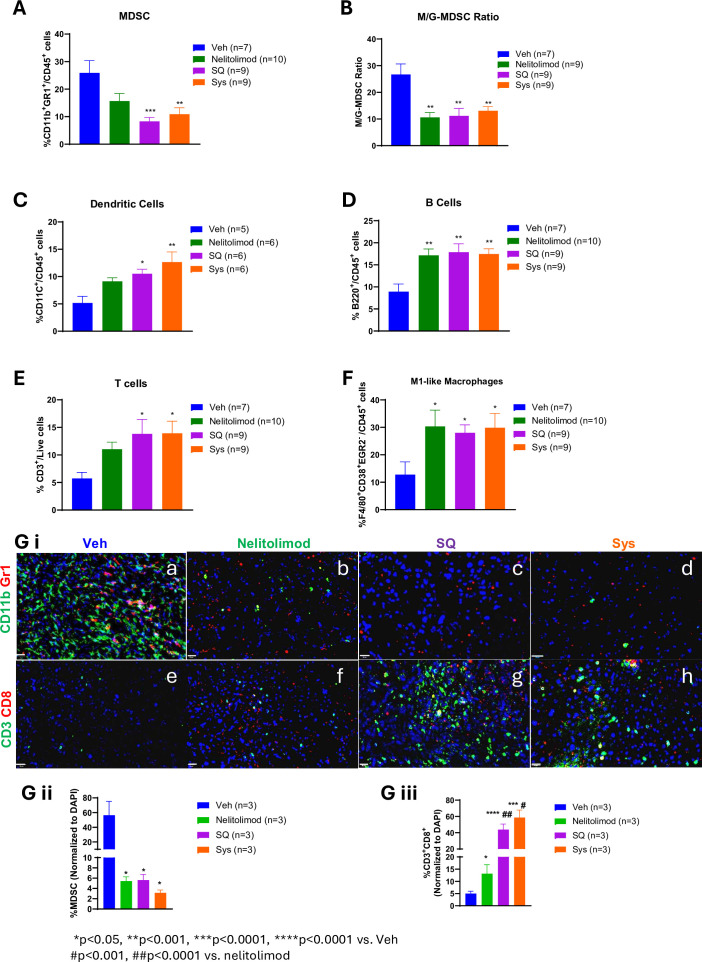
Figure 2. Modulation of liver myeloid and lymphoid compartments by nelitolimod via pressure-enabled drug delivery was preserved in combination with Sys or SQ checkpoint inhibitor. Liver of tumor-bearing mice were harvested 10 days post-treatment. CD45+ cells were isolated from non-parenchymal cells. (A) MDSC cell population (CD11b+Gr1+), (B) monocytic MDSCs (M-MDSC; CD11b+Ly6C+/hiLy6G−/lo), (C) dendritic (CD11c+) cells, (D) B cells (B220+), (E) T cells (CD3+) and (F) M1-like macrophage (F/4/80+CD38+EGR2) were quantified by flow cytometry. (G) i (a–h) Tumors were isolated from each group, OCT-mounted tissues were sectioned, fixed, and stained for CD3 (green), CD8 (red), CD11b (green), and Gr1 (red). (G) ii–iii Quantification of CD11b+Gr1+ MDSCs and CD3+CD8+T cells and from tumors of mice were performed across five fields/mouse and n=3 mice were used per group. Scale (20 µm). Animal data were presented as mean±SEM from and n was mentioned in the individual graph. One-way analysis of variance was performed to determine statistical differences among multiple groups. MDSC, myeloid-derived suppressor cells; M-MDSC, monocytic MDSC; G-MDSC, granulocytic MDSC; OCT, Optimal temperature cutting compound; DAPI, 4′,6-Diamidino-2-phenylindole; SQ, subcutaneous; Sys, systemic; Veh, vehicle.
Figure 3
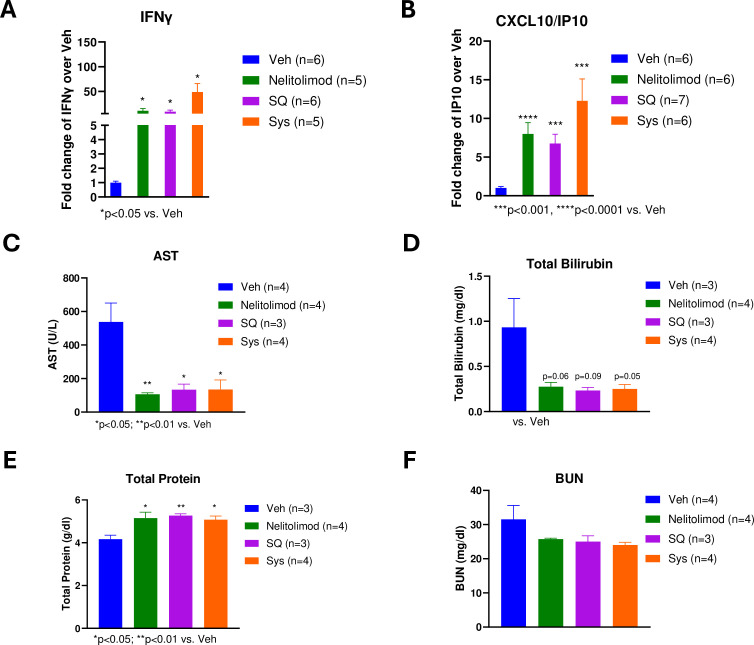
Figure 3. Peripheral effects of pressure-enabled drug delivery of nelitolimod in combination with Sys or SQ α-programmed cell death-1. The serum collected on D3 was analyzed for (A) IFN-γ and (B) CXCL10 (IP-10) were measured by Luminex and reported as fold change compared with Veh. Liver function tests were performed to monitor the level of (C) AST, (D) total bilirubin, (E) total protein, and (F) BUN. Normal ranges for C57/Bl6 AST: 46–221 U/L, bilirubin: 0.5–1.1 mg/dL, total protein: 4.6–7.3 g/dL and BUN: 2–71 mg/dL. Animal data were presented as mean±SEM and n was mentioned in the individual graph. One-way analysis of variance and multiple t-test was performed to determine statistical differences among multiple groups. CXCL10, C-X-C motif chemokine ligand 10; IP-10, Interferon-gamma-induced protein 10; AST, aspartate aminotransferase; IFN, interferon; SQ, subcutaneous; Sys, systemic; Veh, vehicle.
Figure 4
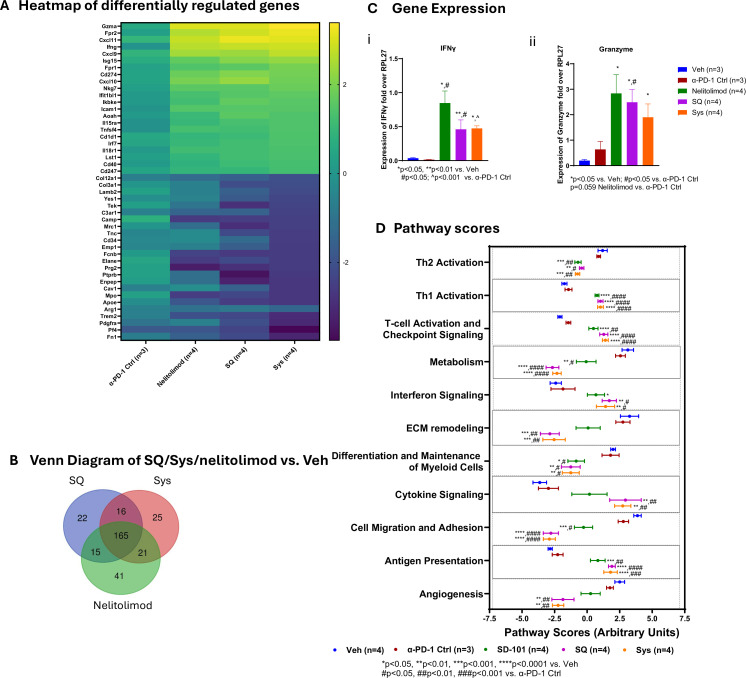
Figure 4. PEDD-nelitolimod in combination with Sys or SQ α-PD-1 promoted transcriptomic changes consistent with enhancement of antitumor immunity in the liver tumor microenvironment. Total RNA was isolated from the CD45+ cells of liver metastases, and nCounter analysis was performed using myeloid and innate panel. (A) Heat map of genes that were significantly upregulated/downregulated followed by α-PD-1 Ctrl, nelitolimod, Sys and SQ treatment compared with Veh control were plotted. (B) The Venn diagram compared genes significantly modulated by PEDD of nelitolimod/SQ/Sys compared with Veh. (C) i–ii Expression of Ifn-γ and granzyme were quantified by qRT PCR. (D) Pathways that were altered by nelitolimod, α-PD-1 monotherapy or combination therapy compared with Veh, evaluated by using nSolver advanced analysis module and plotted, respectively. Data presented as mean±SEM and n are mentioned in the individual graph. One-way analysis of variance was performed to determine statistical differences among multiple groups. qRT, quantitative reverse transcription; IFN, interferon; ECM, extracellular matrix; PEDD, pressure-enabled drug delivery; PD-1, programmed cell death-1; SQ, subcutaneous; Sys, systemic; Veh, vehicle.
Figure 5
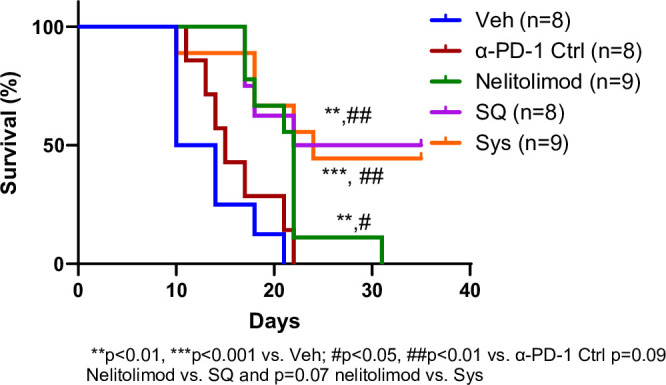
Figure 5. PEDD-nelitolimod in combination with α-PD-1 improved the survival of tumor-bearing mice irrespective of the route of administration. Kaplan-Meier survival curve of liver metastases-bearing mice followed by intravascular PEDD nelitolimod with α-PD-1 administered either Sys or SQ. n denotes the number of mice in each group. Log-rank test was performed to determine the statistical differences among groups. n is mentioned in the individual graph. PEDD, pressure-enabled drug delivery; PD-1, programmed cell death-1; SQ, subcutaneous; Sys, systemic; Veh, vehicle.

References

    1. Brunet JF, Denizot F, Luciani MF, et al. A new member of the immunoglobulin superfamily--CTLA-4. Nature New Biol. 1987;328:267–70. doi: 10.1038/328267a0. - DOI - PubMed
    1. Dong H, Zhu G, Tamada K, et al. B7-H1, a third member of the B7 family, co-stimulates T-cell proliferation and Interleukin-10 secretion. Nat Med. 1999;5:1365–9. doi: 10.1038/70932. - DOI - PubMed
    1. Freeman GJ, Long AJ, Iwai Y, et al. Engagement of the PD-1 Immunoinhibitory receptor by a novel B7 family member leads to negative regulation of lymphocyte activation. J Exp Med. 2000;192:1027–34. doi: 10.1084/jem.192.7.1027. - DOI - PMC - PubMed
    1. Zou W, Wolchok JD, Chen L. PD-L1 (B7-H1) and PD-1 pathway blockade for cancer therapy: mechanisms, response biomarkers, and combinations. Sci Transl Med. 2016;8:328rv4. doi: 10.1126/scitranslmed.aad7118. - DOI - PMC - PubMed
    1. Ai L, Chen J, Yan H, et al. Research status and outlook of PD-1/PD-L1 inhibitors for cancer therapy. Drug Des Devel Ther. 2020;14:3625–49. doi: 10.2147/DDDT.S267433. - DOI - PMC - PubMed

MeSH terms

Substances