. 2024 Jul 22;14(1):16812.
doi: 10.1038/s41598-024-66443-w.

Circular dichroism of relativistically-moving chiral molecules

Affiliations

Circular dichroism of relativistically-moving chiral molecules

Mitchell R Whittam et al. Sci Rep. .

Erratum in

Abstract

Understanding the impact of the relativistic motion of a chiral molecule on its optical response is a prime challenge for fundamental science, but it also has a direct practical relevance in our search for extraterrestrial life. To contribute to these significant developments, we describe a multi-scale computational framework that combines quantum chemistry calculations and full-wave optical simulations to predict the chiral optical response from molecules moving at relativistic speeds. Specifically, the effect of a relativistic motion on the transmission circular dichroism (TCD) of three life-essential biomolecules, namely, B-DNA, chlorophyll a, and chlorophyll b, is investigated. Inspired by previous experiments to detect interstellar chiral molecules, we assume that the molecules move between a stationary observer and a light source, and we study the rotationally averaged TCD as a function of the speed of the molecule.We find that the TCD spectrum that contains the signatures of the molecules shifts with increasing speed to shorter wavelengths, with the effects already being visible for moderate velocities.

Keywords: Chiral molecules; Circular dichroism; Multi–scale modelling; Quantum chemistry; Relativistic motion.


Conflict of interest statement

The authors declare no competing interests.

Figures
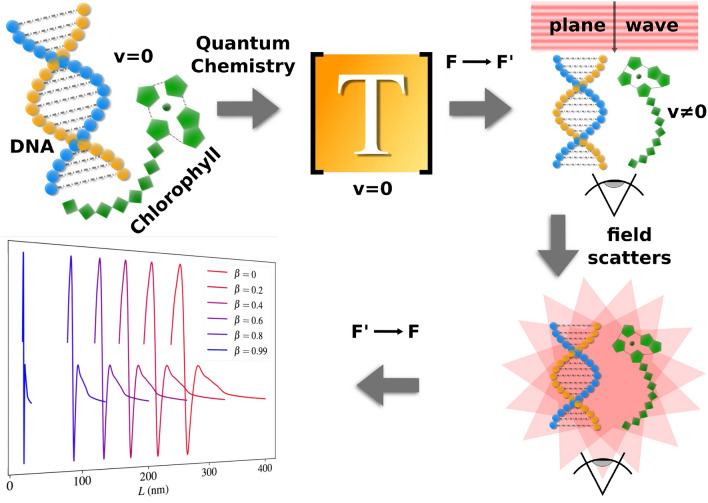
Figure 1
Figure 1
All steps required to obtain the CD in the reference frame F. Firstly, the molecules are constructed, and their T–matrices are computed using TURBOMOLE code. When describing the actual scattering process, the incident plane wave propagating in the -z–direction is first boosted to F, where the outgoing field is obtained by adding the contribution of the incoming field to the scattered field, which is present in and justified directly after Eq. (17). Finally, the outgoing field is inverse boosted back to F, where the CD is observed.
Figure 2
Figure 2
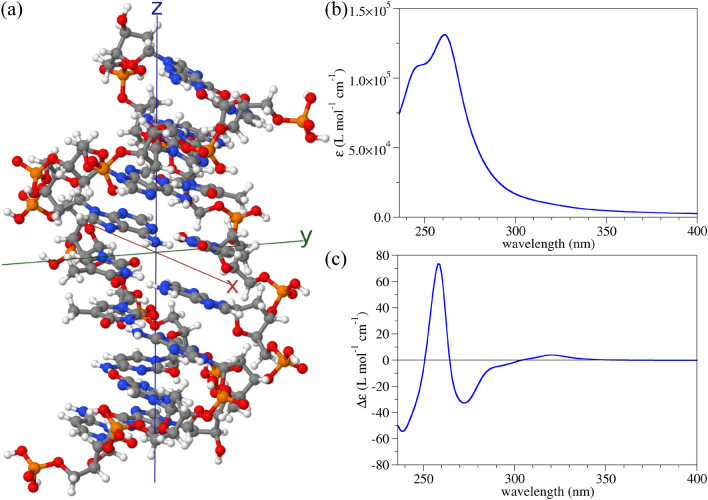
(a) A finite–size molecular model of B–DNA containing eight DNA base pairs. White, grey, blue, red, and orange balls represent hydrogen, carbon, nitrogen, oxygen, and phosphorus atoms, respectively. (b) UV molar absorption spectrum reconstructed from dynamic polarisabilities. A Lorentzian broadening of 0.15 eV at HWHM was used. (c) UV ACD molar spectrum reconstructed from dynamic polarisabilities. The same broadening as in (b) was used.
Figure 3
Figure 3
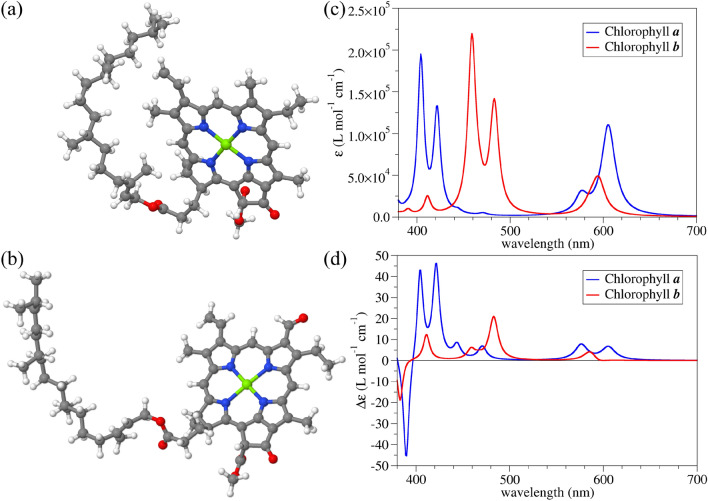
Optimised geometries of (a) chlorophyll a and (b) chlorophyll b in a COSMO model for water. White, grey, blue, red, and green balls represent hydrogen, carbon, nitrogen, oxygen, and magnesium atoms, respectively. (c) UV molar absorption spectra of both chlorophyll molecules reconstructed from dynamic polarisabilities. A Lorentzian broadening of 0.03 eV at HWHM was used. (d) UV ACD molar spectra of chlorophyll a and b reconstructed from dynamic polarisabilities. The same broadening as in (c) was used.
Figure 4
Figure 4
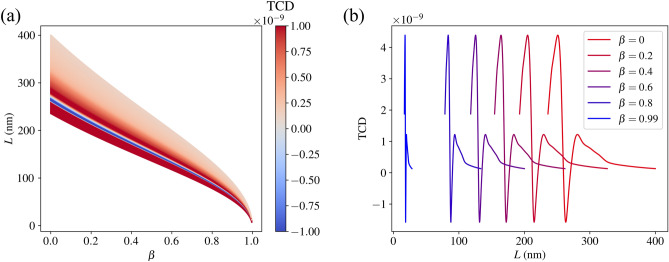
(a) The TCD (with arbitrary scaling) of the B–DNA molecule as a function of the speed parameter β and the incident wavelengths corresponding to the relevant T–matrices. (b) The TCD for selected speeds to illustrate the spectral shift.
Figure 5
Figure 5
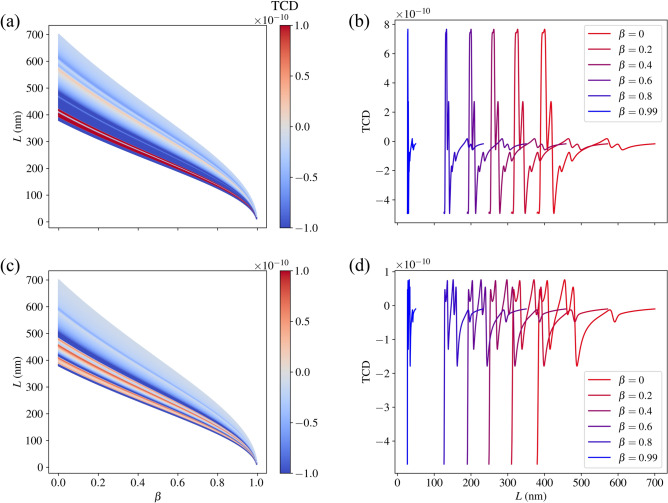
(a) The TCD (with arbitrary scaling) of the chlorophyll a molecule as a function of the speed parameter β and the incident wavelengths corresponding to the relevant T–matrices. (b) The TCD for selected speeds to illustrate the spectral shift. (c) and (d) Show the analogous plots for chlorophyll.b.

References

    1. Wu, Y., Huang, H. W. & Olah, G. A. Method of oriented circular dichroism. Biophys. J .57, 797–806 (1990). - DOI - PMC - PubMed
    1. Berova, N., Nakanishi, K. & Woody, R. W. Circular Dichroism: Principles and Applications (Wiley, 2000).
    1. Martin, S. R. & Schilstra, M. J. Circular dichroism and its application to the study of biomolecules. Methods Cell Biol.84, 263–293 (2008). - DOI - PubMed
    1. Nabedryk, E., Biaudet, P., Darr, S., Arntzen, C. J. & Breton, J. Conformation and orientation of chlorophyll-proteins in photosystem i by circular dichroism and polarized infrared spectroscopies. Biochim. Biophys. Acta (BBA)-Bioenerget.767, 640–647 (1984). - DOI
    1. Ranjbar, B. & Gill, P. Circular dichroism techniques: Biomolecular and nanostructural analyses-a review. Chem. Biol. Drug Des.74, 101–120 (2009). - DOI - PubMed

LinkOut - more resources