


Effects of protein restriction on insulin-like growth factor (IGF)-1 in men with prostate cancer: results from a randomized clinical trial
- PMID: 39039607
- PMCID: PMC11265162
- DOI: 10.1186/s40364-024-00613-w
Effects of protein restriction on insulin-like growth factor (IGF)-1 in men with prostate cancer: results from a randomized clinical trial
Abstract
Background: Insulin-like growth factor (IGF)-1 and its binding proteins are important in cancer growth, especially in prostate cancer. Observational studies suggest that protein restriction can lower IGF-1 levels. However, it is unclear whether an isocaloric protein-restricted diet affects IGF-1 and IGFBPs in men with prostate cancer.
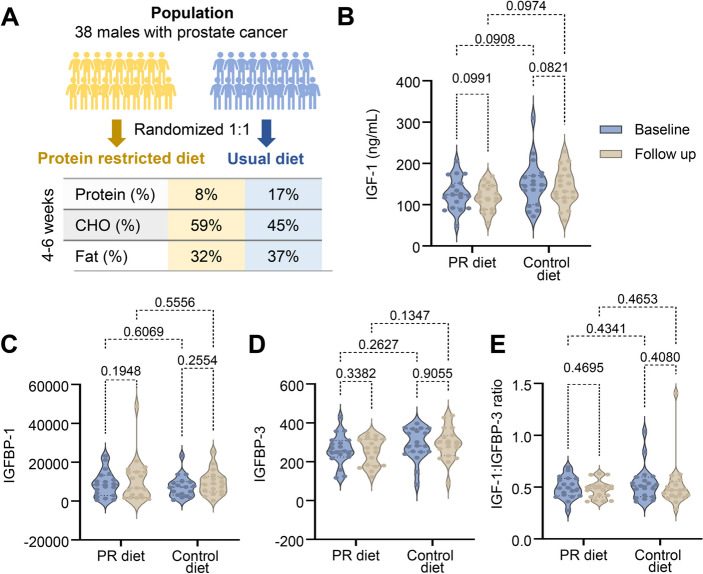
Methods: In this academic, single-center, parallel-group, prospective, randomized, open-label, blinded end-point trial, 38 consenting overweight (BMI 30.5 ± 5.5 kg/m2) men with localized prostate cancer, aged 43-72 years, were randomized (1:1) with permuted blocks to 4-6 weeks of customized isocaloric PR diets (0.8 g protein/kg lean body mass) or their usual diet. Biomarkers influencing cancer biology, including serum IGF-1 and its binding proteins were measured longitudinally.
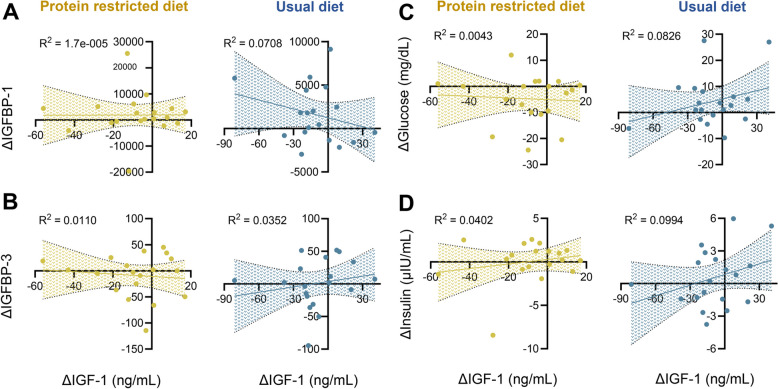
Results: Contrary to our hypothesis, feeding individuals an isocaloric protein-restricted diet did not result in a significant reduction in serum IGF-1. Moreover, there was no observed increase in serum IGFBP-1 or IGFBP-3 concentration.
Conclusion: These findings demonstrate that protein restriction without calorie restriction does not reduce serum IGF-1 concentration or increase IGFBP-1 and IGFBP-3 in men with localized prostate cancer. Further research is needed to identify dietary interventions for safely and effectively reducing IGF-1 in this patient group.
© 2024. The Author(s).
Conflict of interest statement
The authors report no conflicts of interest.
Figures
References
-
- Basu R, Kopchick JJ. GH and IGF1 in cancer therapy resistance. Endocr Relat Cancer. 2023;30(9):e220414. - PubMed
-
- Fontana L, Villareal DT, Das SK, Smith SR, Meydani SN, Pittas AG, et al. Effects of 2-year calorie restriction on circulating levels of IGF-1, IGF-binding proteins and cortisol in nonobese men and women: a randomized clinical trial. Aging Cell. 2016;15(1):22–7. 10.1111/acel.12400 - DOI - PMC - PubMed
Publication types
Grants and funding
LinkOut - more resources
Full Text Sources
Research Materials
Miscellaneous
