. 2024 Aug;30(8):1599-1608.
doi: 10.3201/eid3008.240529.

Metagenomic Detection of Bacterial Zoonotic Pathogens among Febrile Patients, Tanzania, 2007-20091

Metagenomic Detection of Bacterial Zoonotic Pathogens among Febrile Patients, Tanzania, 2007-20091

Robert J Rolfe et al. Emerg Infect Dis. 2024 Aug.

Abstract

Bacterial zoonoses are established causes of severe febrile illness in East Africa. Within a fever etiology study, we applied a high-throughput 16S rRNA metagenomic assay validated for detecting bacterial zoonotic pathogens. We enrolled febrile patients admitted to 2 referral hospitals in Moshi, Tanzania, during September 2007-April 2009. Among 788 participants, median age was 20 (interquartile range 2-38) years. We performed PCR amplification of V1-V2 variable region 16S rRNA on cell pellet DNA, then metagenomic deep-sequencing and pathogenic taxonomic identification. We detected bacterial zoonotic pathogens in 10 (1.3%) samples: 3 with Rickettsia typhi, 1 R. conorii, 2 Bartonella quintana, 2 pathogenic Leptospira spp., and 1 Coxiella burnetii. One other sample had reads matching a Neoerhlichia spp. previously identified in a patient from South Africa. Our findings indicate that targeted 16S metagenomics can identify bacterial zoonotic pathogens causing severe febrile illness in humans, including potential novel agents.

Keywords: Bacteria; Bartonella; Coxiella; East Africa; Ehrlichia; Leptospira; Rickettsia; Tanzania; bacterial zoonoses; metagenomics; vector-borne diseases; zoonoses.


Figures
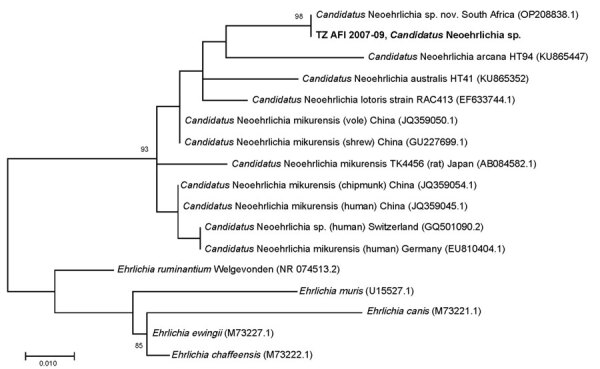
Figure 1
Figure 1
Phylogenetic tree for Candidatus Neoehrlichia spp. identified during metagenomic detection of bacterial zoonotic pathogens among febrile patients, Tanzania, 2007–2009. Bold text indicates the sequence from this study. Numbers in parentheses indicate GenBank accession numbers. A 1,467-bp 16S sequence amplified from a bone marrow aspirate from a patient from South Africa (GenBank accession no. OP208838) matched 100% over the 296-bp variable regions 1 and 2 target sequence amplified in this study (18). Scale bar indicates nucleotide substitutions per site.
Figure 2
Figure 2
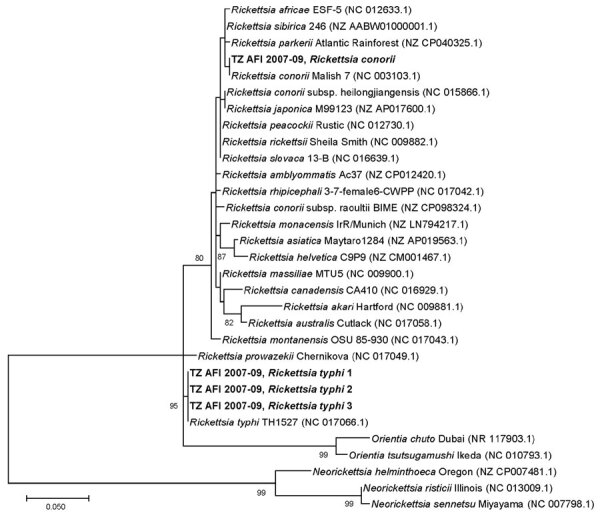
Phylogenetic tree of Rickettsia spp. sequences detected in metagenomic analysis of bacterial zoonotic pathogens among febrile patients, Tanzania, 2007–2009. The tree compares sequences from the 16S variable regions 1 and 2 (V1–V2) of the Rickettsia cohort from this study (bold text) to sequences from closely related Rickettsia species. Numbers in parentheses indicate GenBank accession numbers. The sequence from the study sample with R. conorii aligned 100% R. conorii strain Malish (accession no. NC003103.1) and was distinct from R. africae (accession no. NC012633.1). All 3 R. typhi strains from this study aligned 100% with R. typhi reference strain (accession no. NC017066.1) and were distinct from R. prowazekii (accession no. NC017049.1). The V1–V2 16S target is not sufficient to differentiate between R. conorii subsp. heilogjiangensis and R. japonica, or between R. rickettsia, R. peacockii, R. philipii, and R. slovaca. However, the V1–V2 16S target is sufficient to differentiate between R. conorii conorii and R. africae because 2 single-neucleotide differences would be expected between R. conorii conorii and R. africae and a TTT insertion in R. africae. Scale bar indicates nucleotide subsitutions per site.
Figure 3
Figure 3
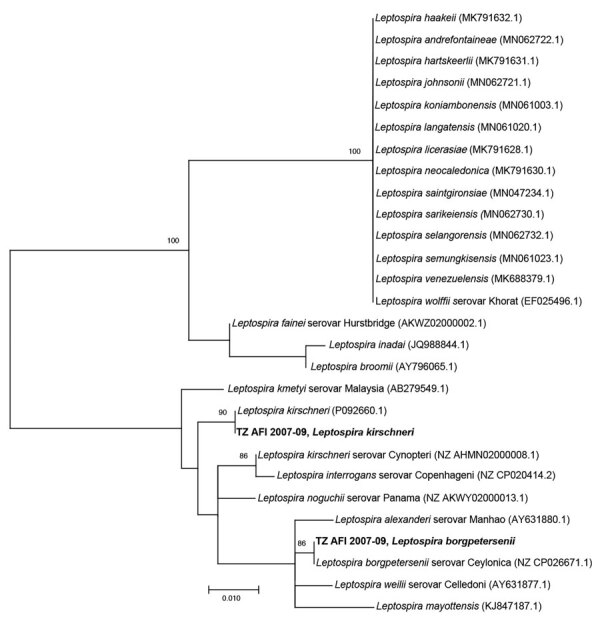
Phylogenetic tree of Leptospira sequences detected in metagenomic analysis of bacterial zoonotic pathogens among febrile patients, Tanzania, 2007–2009. The tree compares sequences from the 16S V1–V2 of the L. kerchnerii and L. borgpetersenii cohort from this study (bold text) to sequences from closely related Leptospira species. Numbers in parentheses indicate GenBank accession numbers. Scale bar indicates nucleotide subsitutions per site.

References

    1. Prasad N, Murdoch DR, Reyburn H, Crump JA. Etiology of severe febrile illness in low- and middle-income countries: a systematic review. PLoS One. 2015;10:e0127962. 10.1371/journal.pone.0127962 - DOI - PMC - PubMed
    1. Maina AN, Farris CM, Odhiambo A, Jiang J, Laktabai J, Armstrong J, et al. Q fever, scrub typhus, and rickettsial diseases in children, Kenya, 2011–2012. Emerg Infect Dis. 2016;22:883–6. 10.3201/eid2205.150953 - DOI - PMC - PubMed
    1. Dreyfus A, Dyal JW, Pearson R, Kankya C, Kajura C, Alinaitwe L, et al. Leptospira seroprevalence and risk factors in health centre patients in Hoima District, Western Uganda. PLoS Negl Trop Dis. 2016;10:e0004858. 10.1371/journal.pntd.0004858 - DOI - PMC - PubMed
    1. Prabhu M, Nicholson WL, Roche AJ, Kersh GJ, Fitzpatrick KA, Oliver LD, et al. Q fever, spotted fever group, and typhus group rickettsioses among hospitalized febrile patients in northern Tanzania. Clin Infect Dis. 2011;53:e8–15. 10.1093/cid/cir411 - DOI - PMC - PubMed
    1. Biggs HM, Bui DM, Galloway RL, Stoddard RA, Shadomy SV, Morrissey AB, et al. Leptospirosis among hospitalized febrile patients in northern Tanzania. Am J Trop Med Hyg. 2011;85:275–81. 10.4269/ajtmh.2011.11-0176 - DOI - PMC - PubMed

MeSH terms

Substances

LinkOut - more resources