Allergenic response induced by Pterobothrium crassicolle (Cestoda: Trypanorhyncha) extracts in murine model
- PMID: 39046076
- PMCID: PMC11340865
- DOI: 10.1590/S1984-29612024039
Allergenic response induced by Pterobothrium crassicolle (Cestoda: Trypanorhyncha) extracts in murine model
Abstract
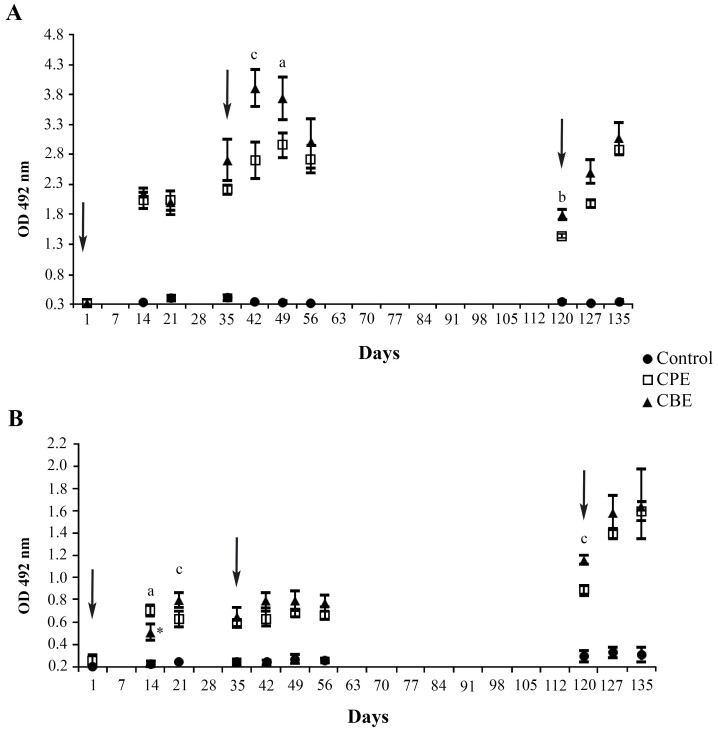
The aim of this study was to determine the allergenic activity of components present in crude extracts of Pterobothrium crassicolle plerocerci (CPE) and blastocysts (CBE) obtained from Micropogonias furnieri in a murine model. Two groups of seven animals each received 50 µg of CPE or CBE on days 1, 35 and 120. Serum samples were tested by ELISA and Immunoblotting. Specific IgG and IgE levels were detected by ELISA, showing specific humoral responses for the primary immunization for both immunoglobulins and continuously growing titers for IgE. Positive Passive Cutaneous Anaphylaxis tests in rats sensitized with anti-CBE sera and tested by CBE, showed biologically, the allergenic activity of the extracts. The CPE and CBE showed some different recognition regions but both experimental groups recognized all regions of the extracts when tested for cross reactions, showing that CPE and CBE could share antigenic recognition sites.
O objetivo deste estudo foi determinar a atividade alergênica de componentes presentes em extratos crus de plerocercos (CPE) e de blastocistos de Pterobothrium crassicolle (CBE), obtidos de Micropogonias furnieri, em modelo murino. Dois grupos de sete animais receberam cada um 50 µg de CPE ou CBE nos dias 1, 35 e 120. As amostras de soro foram testadas por ELISA e Imunoblot. Os níveis específicos de IgG e IgE foram detectados por ELISA, mostrando respostas humorais específicas para a imunização primária para ambas as imunoglobulinas e títulos crescentes de IgE. Testes positivos de Anafilaxia Cutânea Passiva em ratos sensibilizados com soros anti-CBE e testados por CBE, demonstraram biologicamente, a atividade alergênica dos extratos. O CPE e o CBE evidenciaram algumas regiões de reconhecimento diferentes, mas ambos os grupos experimentais reconheceram todas as regiões dos extratos, quando testados para reações cruzadas, mostrando que o CPE e o CBE poderiam compartilhar locais de reconhecimento antigênico.
Conflict of interest statement
Figures


References
-
- Al-Zubaidy AB, Mhaisen FT. Larval tapeworms (Cestoda: Trypanorhyncha) from some Red Sea fishes, Yemen. Mesop J Mar Sci. 2011;26(1):1–14. doi: 10.58629/mjms.v26i1.186. - DOI
-
- Antunes DMF, da Costa JP, Campos SMN, Paschoal PO, Garrido V, Siqueira M, et al. The serum D-xylose test as a useful tool to identify malabsorption in rats with antigen specific gut inflammatory reaction. Int J Exp Pathol. 2009;90(2):141–147. doi: 10.1111/j.1365-2613.2008.00627.x. - DOI - PMC - PubMed
-
- Beveridge I, Haseli M, Ivanov VA, Menoret A, Schaeffner BC. In: Planetary Biodiversity Inventory (2008–2017): Tapeworms from Vertebrate Bowels of the Earth. Caira JN, Jensen K, editors. Lawrence: The University of Kansas, Natural History Museum; 2017. Trypanorhyncha Diesing, 1863; pp. 401–429. (Special Publication).
MeSH terms
Substances
LinkOut - more resources
Full Text Sources
Research Materials
Miscellaneous