


A Prospective Evaluation of the Diagnostic Accuracy of the Point-of-Care VISITECT CD4 Advanced Disease Test in 7 Countries
- PMID: 39046150
- PMCID: PMC11793025
- DOI: 10.1093/infdis/jiae374
A Prospective Evaluation of the Diagnostic Accuracy of the Point-of-Care VISITECT CD4 Advanced Disease Test in 7 Countries
Abstract
Background: CD4 measurement is pivotal in the management of advanced human immunodeficiency virus (HIV) disease. VISITECT CD4 Advanced Disease (VISITECT; AccuBio, Ltd) is an instrument-free, point-of-care, semiquantitative test allowing visual identification of CD4 ≤ 200 cells/µL or >200 cells/ µL from finger-prick or venous blood.
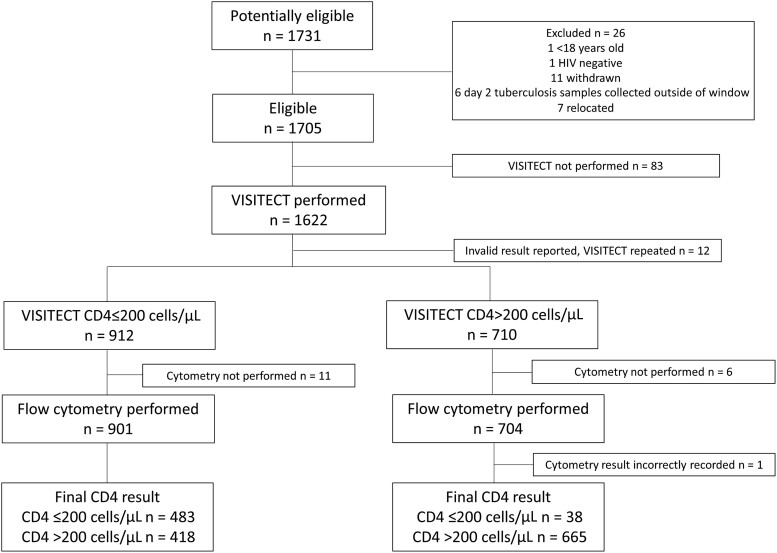
Methods: As part of a diagnostic accuracy study of FUJIFILM SILVAMP TB LAM, people with HIV ≥18 years old were prospectively recruited in 7 countries from outpatient departments if a tuberculosis symptom was present, and from inpatient departments. Participants provided venous blood for CD4 measurement using flow cytometry (reference standard) and finger-prick blood for VISITECT (index text), performed at point-of-care. Sensitivity, specificity, and positive and negative predictive values of VISITECT to determine CD4 ≤ 200 cells/ µL were evaluated.
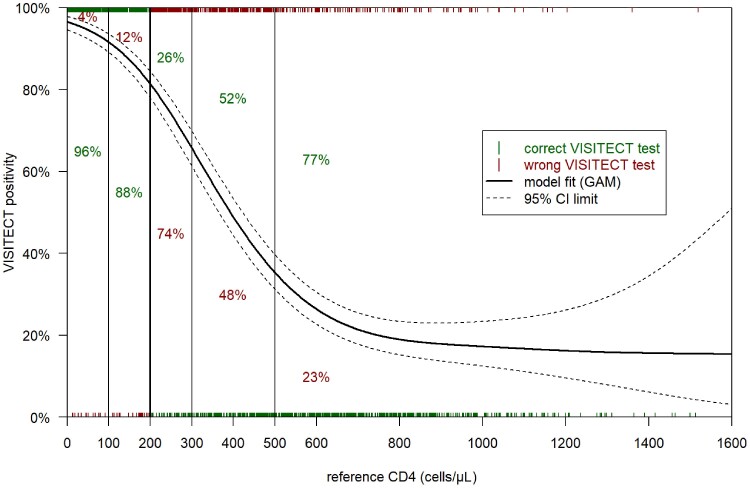
Results: Among 1604 participants, the median flow cytometry CD4 was 367 cells/µL (interquartile range, 128-626 cells/µL) and 521 (32.5%) had CD4 ≤ 200 cells/µL. VISITECT sensitivity was 92.7% (483/521; 95% confidence interval [CI], 90.1%-94.7%) and specificity was 61.4% (665/1083; 95% CI, 58.4%-64.3%). For participants with CD4 0-100, 101-200, 201-300, 301-500, and >500 cells/µL, VISITECT misclassified 4.5% (95% CI, 2.5%-7.2%), 12.5 (95% CI, 8.0%-18.2%), 74.1% (95% CI, 67.0%-80.5%), 48.0% (95% CI, 42.5%-53.6%), and 22.6% (95% CI, 19.3%-26.3%), respectively.
Conclusions: VISITECT's sensitivity, but not specificity, met the World Health Organization's minimal sensitivity and specificity threshold of 80% for point-of-care CD4 tests. VISITECT's quality needs to be assessed and its accuracy optimized. VISITECT's utility as CD4 triage test should be investigated. Clinical Trials Registration. NCT04089423.
Keywords: AIDS-related opportunistic infections; CD4 Antigens; HIV; point-of-care; sensitivity and specificity.
© The Author(s) 2024. Published by Oxford University Press on behalf of Infectious Diseases Society of America.
Conflict of interest statement
Potential conflicts of interest. R. S., A. M., C. M. D., and M. R. are or were employed by FIND, the global alliance for diagnostics at the time of the study. FIND is a not-for-profit foundation that supports the evaluation of publicly prioritized tuberculosis assays and the implementation of WHO-approved (guidance and prequalification) assays using donor grants. FIND has product evaluation agreements with several private sector companies that design diagnostics for tuberculosis and other diseases. These agreements strictly define FIND's independence and neutrality with regards to these private sector companies. All other authors report no potential conflicts. All authors have submitted the ICMJE Form for Disclosure of Potential Conflicts of Interest. Conflicts that the editors consider relevant to the content of the manuscript have been disclosed.
Figures

References
-
- World Health Organization . HIV treatment: guidelines for managing advanced HIV disease and rapid initiation of antiretroviral therapy: policy brief, 2017. https://apps.who.int/iris/handle/10665/255885. Accessed 6 May 2024. - PubMed
-
- Joint United Nations Program on HIV and AIDS . Global HIV & AIDS statistics—fact sheet, 2023. https://www.unaids.org/en/resources/fact-sheet. Accessed 6 June 2024.
-
- Brennan AT, Long L, Useem J, Garrison L, Fox MP. Mortality in the first 3 months on antiretroviral therapy among HIV-positive adults in low- and middle-income countries: a meta-analysis. J Acquir Immune Defic Syndr 2016; 73:1–10. - PubMed
-
- Kitenge MK, Fatti G, Eshun-Wilson I, Aluko O, Nyasulu P. Prevalence and trends of advanced HIV disease among antiretroviral therapy-naive and antiretroviral therapy-experienced patients in South Africa between 2010–2021: a systematic review and meta-analysis. BMC Infect Dis 2023; 23:549. - PMC - PubMed
Publication types
MeSH terms
Associated data
Grants and funding
LinkOut - more resources
Full Text Sources
Medical
Research Materials
Miscellaneous
