


A state-of-the-art systematic review of cancer in hidradenitis suppurativa
- PMID: 39046819
- PMCID: PMC11271124
- DOI: 10.1080/07853890.2024.2382372
A state-of-the-art systematic review of cancer in hidradenitis suppurativa
Abstract
Purpose: Hidradenitis suppurativa (HS) is a chronic inflammatory disease associated with an increased risk of malignancy. The aim of this systematic review was to investigate the prevalence of different malignancies in HS.
Methods: This review meets the PRISMA criteria. A data-driven approach was used to conduct the research, which involved a detailed keyword search. The study considered meta-analyses, experimental studies, case-control studies, cross-sectional studies, cohort studies, and recently published cases, published in English or German. Excluded were reviews, summaries, and letters to the editor, as well as studies, which are not based on the human population.
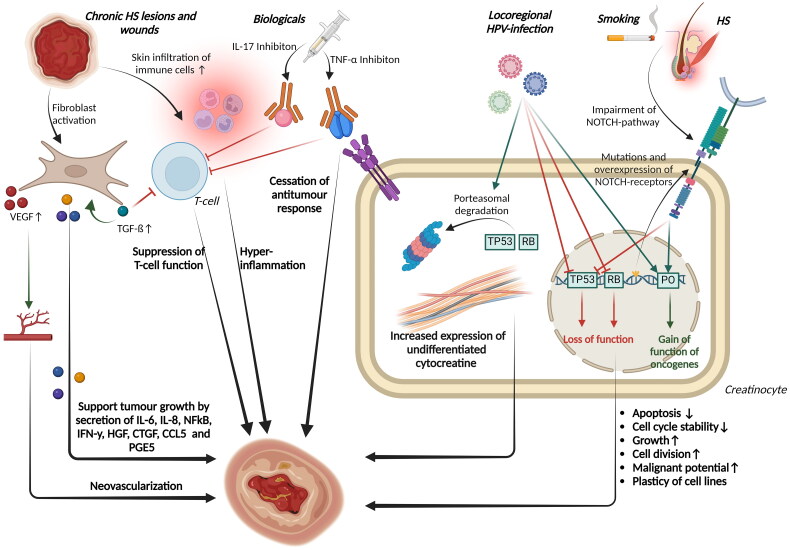
Results: Out of the initial 443 publications found, 25 met the inclusion criteria for this systematic review. Patients with HS have a significantly increased risk of cancer, up to 50%. Additionally, the risk of oropharyngeal, central nervous system, colorectal, prostate, vulvar and non-melanocytic skin cancers increase with the severity of HS. The likelihood of comorbid lymphoma in patients with HS is significantly higher compared to healthy controls. In severe cases of HS, malignant degeneration of lesions in the groin, perianal, perineal, and gluteal region can occur in up to 4.6% of cases. This leads to the development of cSCC, which often have a complicated course, are more refractory to treatment and associated with a poorer outcome. The pathogenic mechanisms responsible for the malignant transformation of HS are currently unknown.
Conclusions: Patients with HS have a higher risk of cancer compared to the general population. Untreated, long-standing HS lesions can lead to complicated malignant degeneration resulting in cutaneous squamous cell carcinoma. The mechanisms underlying this malignant degeneration are not fully understood. HS patients also have an increased risk of developing other cancers, including prostate, oral, pharyngeal and colorectal cancers of the central nervous system and lymphomas.
Keywords: HS; Hidradenitis suppurativa; colorectal carcinoma; cutaneous squamous cell carcinoma; lymphoma; malignancy; malignant diseases; oropharyngeal carcinoma.
Conflict of interest statement
Thilo Gambichler has received speakers and/or advisory board honoraria from BMS, Sanofi-Genzyme, MSD, Novartis Pharma, Roche, Abbvie, Almirall, Janssen, Lilly, Pfizer, Pierre Fabre, Merck-Serono, outside the submitted work. Falk G. Bechara has received honoraria for participation in advisory boards, in clinical trials, and/or as a speaker from AbbVie Inc., AbbVie Deutschland GmbH & Co. KG, Boehringer Ingelheim Pharma GmbH & Co. KG, Novartis Pharma GmbH, UCB Pharma, Incyte Corporation, and JanssenCilag GmbH, MoonLake. T.G. has received speakers and/or advisory board honoraria from BMS, Sanofi-Genzyme, MSD, Novartis Pharma, Roche, Abbvie, Almirall, Janssen, Lilly, Pfizer, Pierre Fabre, and Merck-Serono outside the submitted work All other authors declare no conflicts of interest.
Figures


References
Publication types
MeSH terms
LinkOut - more resources
Full Text Sources
Medical
Miscellaneous
