Review
. 2024 Oct 1;37(5):493-501.
doi: 10.1097/WCO.0000000000001300. Epub 2024 Jul 25.

Congenital myasthenic syndromes: increasingly complex

Affiliations
Review

Congenital myasthenic syndromes: increasingly complex

Sithara Ramdas et al. Curr Opin Neurol. .

Abstract

Purpose of review: Congenital myasthenia syndromes (CMS) are treatable, inherited disorders affecting neuromuscular transmission. We highlight that the involvement of an increasing number of proteins is making the understanding of the disease mechanisms and potential treatments progressively more complex.

Recent findings: Although early studies identified mutations of proteins directly involved in synaptic transmission at the neuromuscular junction, recently, next-generation sequencing has facilitated the identification of many novel mutations in genes that encode proteins that have a far wider expression profile, some even ubiquitously expressed, but whose defective function leads to impaired neuromuscular transmission. Unsurprisingly, mutations in these genes often causes a wider phenotypic disease spectrum where defective neuromuscular transmission forms only one component. This has implications for the management of CMS patients.

Summary: Given the widening nonneuromuscular junction phenotypes in the newly identified forms of CMS, new therapies need to include disease-modifying approaches that address not only neuromuscular weakness but also the multisystem involvement. Whilst the current treatments for CMS are highly effective for many subtypes there remains, in a proportion of CMS patients, an unmet need for more efficacious therapies.


Conflict of interest statement

S.R. served on advisory board for Novartis, Sarepta, Argenx and Roche; is an investigator in clinical trials for Sarepta, Roche, Wave, Genetx, Argenx, Inois and Santhera associated with CMS; has received speaker fees for educational meetings from Novartis and Roche. Only discussions with Argenx are associated with congenital myasthenic syndrome. Y.Y.D. holds MRC fellowship MR/S007180/1; was the holder of ArgenX grant number: ARGX-NC-173-SP; and undertook a project for AMPLO Biotechnology.

Figures

Box 1
Box 1
no caption available
FIGURE 1
FIGURE 1
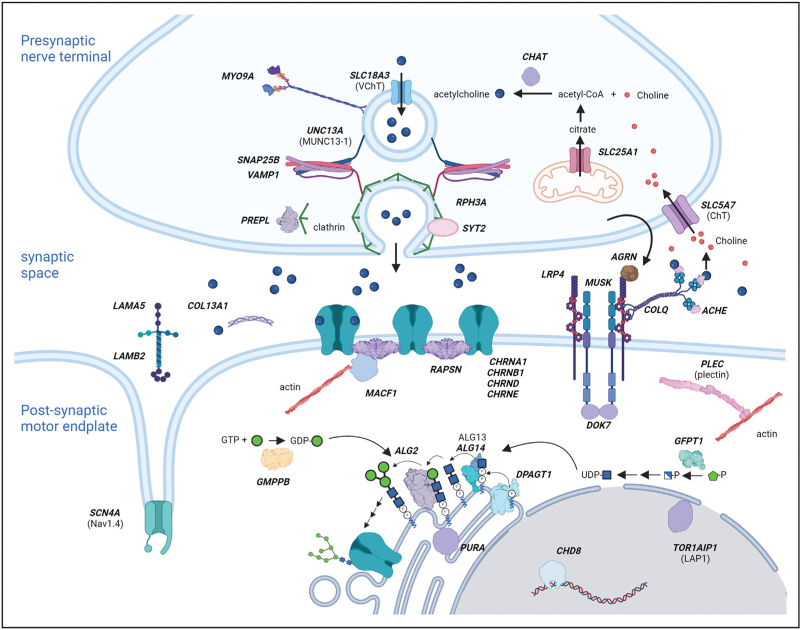
Schematic diagram of how the different congenital myasthenia syndromes-associated gene products are involved in neuromuscular junction biology, based on our current understanding. Gene names are in bold italicised capitals. Where the protein names are different to the gene names, they are in brackets beneath the gene name.
FIGURE 2
FIGURE 2
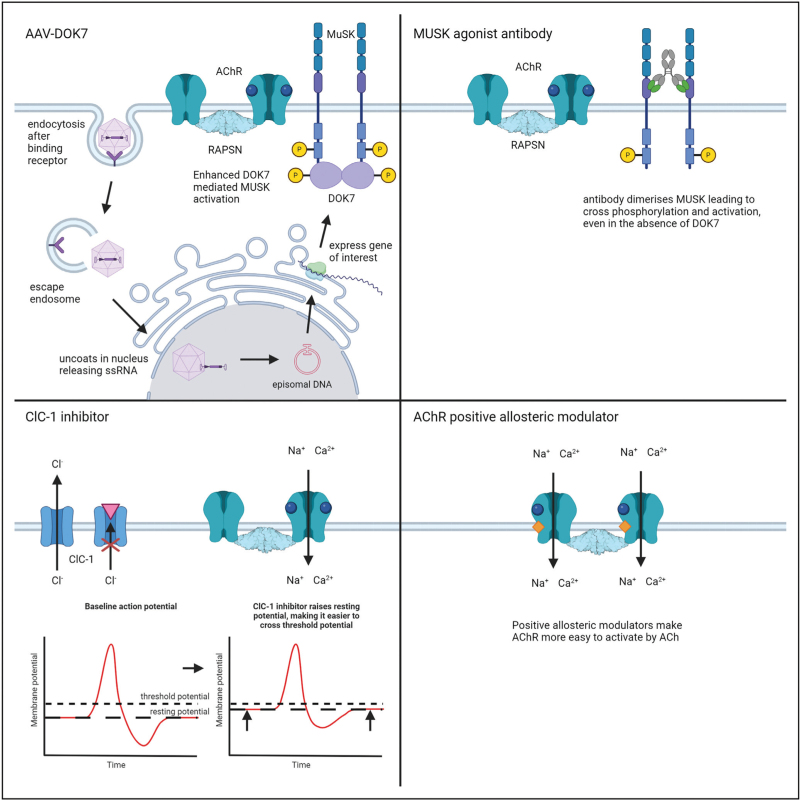
Therapeutic mechanisms of potential new treatments of congenital myasthenia syndromes – adenoassociated viral DOK7 replacement therapy, humanized MUSK agonist antibody therapy, ClC-1 chloride channel inhibitor treatment, muscle nicotinic acetylcholine receptor-positive allosteric modulator treatment.

References

    1. Ohno K, Ohkawara B, Shen X-M, et al. . Clinical and pathologic features of congenital myasthenic syndromes caused by 35 genes - a comprehensive review. Int J Mol Sci 2023; 24:3730. - PMC - PubMed
    2. A comprehensive review of CMS gene mutations, clinical phenotypes and treatment.

    1. Finsterer J. Prevelance in congenital myasthenic syndrome. Eur J Paediatr Neurol 2020; 26:5–6. - PubMed
    1. Zhao Y, Li Y, Bian Y, et al. . Congenital myasthenic syndrome in China: genetic and myopathological characterization. Ann Clin Transl Neurol 2021; 8:898–907. - PMC - PubMed
    1. Al Jabry T, Al-Hashmi N, Abdelhadi B, et al. . LRP4 site-specific variants in the third β-propeller domain causes congenital myasthenic syndrome type 17. Eur J Med Genet 2024; 67:104903. - PubMed
    1. Masingue M, Cattaneo O, Wolff N, et al. . New mutation in the β1 propeller domain of LRP4 responsible for congenital myasthenic syndrome associated with Cenani–Lenz syndrome. Sci Rep 2023; 13:14054. - PMC - PubMed

MeSH terms