


Definitions and symptoms of the post-COVID syndrome: an updated systematic umbrella review
- PMID: 39052056
- PMCID: PMC11799012
- DOI: 10.1007/s00406-024-01868-y
Definitions and symptoms of the post-COVID syndrome: an updated systematic umbrella review
Abstract
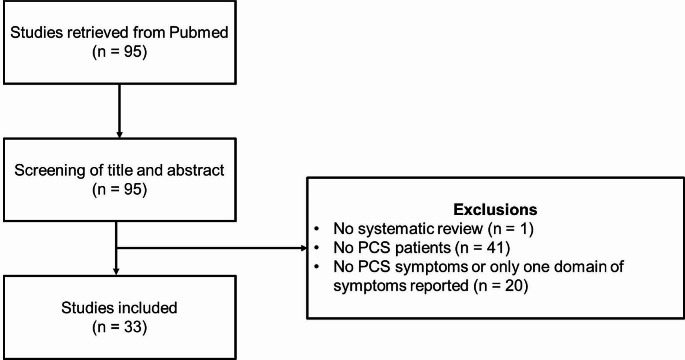
Post-COVID syndrome (PCS) describes a persistent complex of symptoms following a COVID-19 episode, lasting at least 4 to 12 weeks, depending on the specific criteria used for its definition. It is often associated with moderate to severe impairments of daily life and represents a major burden for many people worldwide. However, especially during the first two years of the COVID-19 pandemic, therapeutic and diagnostic uncertainties were prominent due to the novelty of the disease and non-specific definitions that overlooked functional deficits and lacked objective assessment. The present work comprehensively examines the status of PCS definitions as depicted in recent reviews and meta-analyses, alongside exploring associated symptoms and functional impairments. We searched the database Pubmed for reviews and meta-analysis evaluating PCS in the period between May 31, 2022, to December 31, 2023. Out of 95 studies, 33 were selected for inclusion in our analyses. Furthermore, we extended upon prior research by systematically recording the symptoms linked with PCS as identified in the studies. We found that fatigue, neurological complaints, and exercise intolerance were the most frequently reported symptoms. In conclusion, over the past eighteen months, there has been a notable increase in quantity and quality of research studies on PCS. However, there still remains a clear need for improvement, particularly with regard to the definition of the symptoms necessary for diagnosing this syndrome. Enhancing this aspect will render future research more comparable and precise, thereby advancing and understanding PCS.
Keywords: Diagnostic criteria; Fatigue; Long COVID; Neurological complaints; Post-COVID syndrome (PCS); Systematic review.
© 2024. The Author(s).
Conflict of interest statement
Declarations. Competing interests: JG receives funding from the Nationales Pandemie Kohorten Netz - Therapeutische Interventionsplattform (NAPKON-TIP) network, which is funded by the Federal Ministry of Education and Research. R.P. is supported by grants in the projects COMPASS and NAPKON. The COMPASS and NAPKON projects are part of the German COVID-19 Research Network of University Medicine (“Netzwerk Universitätsmedizin”), funded by the German Federal Ministry of Education and Research (funding reference 01KX2021). MW has nothing to disclose. CN has nothing to disclose. CL (University Hospital Jena) received institutional funding from Federal Joint Committee (G-BA) within the Innovationfond (WATCH, Grant numbers L01NVF22114), Editorial Board Member of ‘Physikalische Medizin, Rehabilitationsmedizin, Kurortmedizin’, Network University Medicine (NUM)/ German Federal Ministry of Education and Research (BMBF) - Speaker Physical and Rehabilitation Group (unpaid), board member of German Society of Physical and Rehabilitation Medicine (Deutsche Gesellschaft für Physikalische und Rehabilitative Medizin e.V. (DGPRM), unpaid). KA has nothing to disclose. EP has nothing to disclose. JPR reports grants from the German Ministry of Research and Education within NUM, CAEHR, RECAP; grants from Bavarian State (ministry for science and the arts, DigiOnko), grants from Federal Joint Committee (G-BA) within the Innovationfond (Peri-OP, StarkeR), grants from the German Center for Lung Research within PASSION, personal fees and fees for EBM Training Lecture from the Landesaerztekammer Hessen. CL (University of Cologne) has nothing to disclose. MPN has nothing to disclose. GH has nothing to disclose; JD is an investigator in the EU-Horizon-funded Predict Study of P1Vital and Co-Applicant with BioVariance in the InDepth Study funded by the Bavarian State Government. All other authors certify that they have no affiliations with or involvement in any organization or entity with any financial interest or non-financial interest in the subject matter or materials discussed in this manuscript, except for the Network University Medicine.
Figures


References
-
- World Health Organization. WHO COVID-19 dashboard. WHO COVID-19 dashboard. Published January 22 (2024) Accessed January 22, 2024. https://data.who.int/dashboards/covid19/cases
-
- Phillips N (2021) The coronavirus is here to stay — here’s what that means. Nature 590(7846):382–384. 10.1038/d41586-021-00396-2 - PubMed
-
- Lemhöfer C, Appel KS, Häuser W, Hettich N, Kohls M, Polidori MC (2022) Post-COVID: Alles Eine Frage Der Definition? DMW - Dtsch Med Wochenschr 147(21):1391–1397. 10.1055/a-1940-1222 - PubMed
Publication types
MeSH terms
LinkOut - more resources
Full Text Sources
Medical
Miscellaneous
