. 2024 Jul 25;230(1):15-27.
doi: 10.1093/infdis/jiae106.

Immunologic Predictors of Vaccine Responsiveness in Patients With Lymphoma and Chronic Lymphocytic Leukemia

Affiliations

Immunologic Predictors of Vaccine Responsiveness in Patients With Lymphoma and Chronic Lymphocytic Leukemia

Elise A Chong et al. J Infect Dis. .

Abstract

Patients with B-cell lymphomas have altered cellular components of vaccine responses due to malignancy and therapy, and the optimal timing of vaccination relative to therapy remains unknown. Severe acute respiratory syndrome coronavirus 2 vaccines created an opportunity for new insights in vaccine timing because patients were challenged with a novel antigen across multiple phases of treatment. We studied serologic messenger RNA vaccine response in retrospective and prospective cohorts with lymphoma and chronic lymphocytic leukemia, paired with clinical and research immune parameters. Reduced serologic response was observed more frequently during active treatment, but nonresponse was also common within observation and posttreatment groups. Total immunoglobulin A and immunoglobulin M correlated with successful vaccine response. In individuals treated with anti-CD19-directed chimeric antigen receptor-modified T cells, nonresponse was associated with reduced B and T follicular helper cells. Predictors of vaccine response varied by disease and therapeutic group, and therefore further studies of immune health during and after cancer therapies are needed to individualize vaccine timing.

Keywords: CAR T cells; SARS-CoV-2 vaccination; antibody response; lymphoma; vaccine timing.


Conflict of interest statement

Potential conflicts of interest. E. A. C. receives research support from Genentech/Roche and AbbVie and has served as a consultant for Beigene, AstraZeneca, and TG Therapeutics. J. S. has served as a consultant for ATARA, AstraZeneca, Celgene Corporation, Adaptive, and Genmab, and receives research support from AstraZeneca, Merck, Incyte, Bristol-Myers Squibb, Pharmacyclics, TG Therapeutics, Seattle Genetics, and Adaptive. S. K. B. received honoraria from Acrotech, Seagen, Kyowa Kirin, and Daiichi Sankyo. S. D. N. receives research support from Roche, Rafael, ATARA, Pharmacyclics, and Takeda/Millennium; is a data monitoring committee member for Merck; and has served as a consultant for Epizyme and Morphosys. D. J. L. received research funding from Curis and Triphase; is a data and safety monitoring board member for Karyopharm; and has served as a consultant for Morphosys/Incyte, Epizyme, and ADC Therapeutics. J. N. G. received research funding from Loxo and has served as a consultant for Genentech, AbbVie, and Kite. E. L. P. received funding from Roche Diagnostics Corporation for the evaluation of serologic tests for SARS-CoV-2. E. J. W. is consulting or is an advisor for Merck, Marengo, Janssen, Related Sciences, Synthekine, and Surface Oncology; is a founder of Surface Oncology, Danger Bio, and Arsenal Biosciences; and is an inventor on a patent (US patent number 10,370,446) submitted by Emory University that covers the use of PD-1 blockade to treat infections and cancer. S. J. S. reports research funding from Acerta, Celgene, Genentech/Roche, Merck, Novartis, Pharmacyclics, and TG Therapeutics; received honoraria/consulting fees from Acerta, AstraZeneca, Celgene, Incyte, Janssen, Loxo Oncology, Morphosys, and Nordic Nanovector; is a steering committee member for Celgene, Nordic Nanovector, and Novartis; and has a patent for combination therapies of CAR T cells and PD-1 inhibitors. M. R. holds patents related to CAR T cells; has served as a consultant for nanoString, BMS, GSK, Bayer, Sana Therapeutics, and AbClon; receives research funding from AbClon, nanoString, viTToria biotherapeutics, Oxford Nanoimaging, and Beckman Coulter; and is the scientific founder of viTToria Biotherapeutics. All other authors report no potential conflicts. All authors have submitted the ICMJE Form for Disclosure of Potential Conflicts of Interest. Conflicts that the editors consider relevant to the content of the manuscript have been disclosed.

Figures

Figure 1.
Figure 1.
Serologic response to vaccination in patients with lymphoma. A, Schema of research and healthy cohort blood draw timepoints. B, Anti–receptor-binding domain (RBD) immunoglobulin G (IgG) after vaccine dose 1 and dose 2 in the research and healthy cohorts. Dotted line reflects the limit of anti-RBD IgG detection. Proportion positive indicated at bottom. P values derived from Fisher exact tests. C, Anti-RBD IgG by disease subtype after second vaccination. P value derived from Kruskal–Wallis test of difference across all groups. The iNHL group was comprised of 17 patients not receiving active treatment and 7 active treatment patients, the chronic lymphocytic leukemia group comprised 8 patients receiving active treatment and 11 untreated patients, and the diffuse large B-cell lymphoma group predominantly comprised patients status post anti-CD19–directed chimeric antigen receptor–modified T cells (n = 16) whereas the other 4 patients were not receiving active treatment. D, Description of clinical cohort blood draw timepoints (left). Anti-RBD IgG by disease subtype in the clinical cohort. Proportion of positive patients indicated at bottom (right). P value derived from Kruskal–Wallis test of difference across all groups. Abbreviations: AU, arbitrary units; CLL, chronic lymphocytic leukemia; DLBCL, diffuse large B-cell lymphoma; HL, Hodgkin lymphoma; IgG, immunoglobulin G; iNHL, indolent non-Hodgkin lymphoma; MCL, mantle cell lymphoma; RBD, receptor-binding domain; PTLD, posttransplant lymphoproliferative disease; TCL, T-cell lymphoma.
Figure 2.
Figure 2.
Active treatment is associated with decreased immunogenicity of severe acute respiratory syndrome coronavirus 2 vaccines. A, Description of treated versus untreated patients within the clinical cohort. B, Anti–receptor-binding domain (RBD) immunoglobulin G (IgG) after vaccine dose 2 in patients undergoing active treatment versus those not undergoing active treatment. P value derived from Fisher exact test. Dashed lines represent thresholds between positive samples, equivocal samples, and negative samples, as indicated. C and D, Anti-RBD IgG in active treatment versus no active treatment across disease subtypes (C) and across therapies (D). P values indicated at the top, derived from Wilcoxon rank-sum tests with corrections for multiple comparisons. Abbreviations: AU, arbitrary units; BTKi, Bruton tyrosine kinase inhibitor; CART, chimeric antigen receptor–modified T cells; CD20, anti-CD20 monoclonal antibody; CLL, chronic lymphoid leukemia; DLBCL, diffuse large cell B-cell lymphoma; HL, Hodgkin lymphoma; IgG, immunoglobulin G; iNHL, indolent non-Hodgkin lymphoma, len, lenalidomide; MCL, mantle cell lymphoma; none, no therapy received; ns, not significant; PD-1, anti-PD-1 monoclonal antibody; PTLD, posttransplant lymphoproliferative disease; RBD, receptor-binding domain; R-chemo, anti-CD20 monoclonal antibody with chemotherapy; TCL, T-cell lymphoma; ven, venetoclax.
Figure 3.
Figure 3.
Baseline immune cell frequencies in the blood were associated with vaccine immunogenicity. A–D (top row), Research cohort anti–receptor-binding domain (RBD) immunoglobulin G (IgG) by normal versus below normal clinical measures of immune status (top row, proportions of positive tests for normal and low clinical values noted at bottom). P values are derived from Fisher exact tests. A–D (bottom row), Correlation between anti-RBD IgG versus values of clinically measured immunologic parameters. P values are derived from Spearman correlation tests. Abbreviations: IgA, immunoglobulin A; IgG, immunoglobulin G; ns, not significant; RBD, receptor-binding domain.
Figure 4.
Figure 4.
Severe acute respiratory syndrome coronavirus 2 mRNA vaccine response in diffuse large cell B-cell lymphoma (DLBCL) after chimeric antigen receptor–modified T-cell therapy is associated with B-cell reconstitution. A, FlowSOM clusters of mononuclear cells (lymphocytes and monocytes) concatenated from each DLBCL cohort (nonresponder, n = 9 and responder, n = 5) and healthy cohort (n = 23). B, Projection of indicated protein onto t-SNE map. C, Boxplot of mononuclear cell frequencies from each cohort in each FlowSOM cluster in (B). D, Median fluorescence intensity of each marker in each FlowSOM cluster (row scaled z-score). Significance was determined by unpaired Wilcoxon test: *P < .05, **P < .01, ***P < .001, ****P < .0001. Abbreviations: CM, central memory; DLBCL, diffuse large cell B-cell lymphoma; EM, effector memory; EMRA, effector memory cells expressing CD45RA; IgG, immunoglobulin G; NK, natural killer; RBD, receptor-binding domain; t-SNE, t-distributed stochastic neighbor embedding.
Figure 5.
Figure 5.
Increased T follicular helper (Tfh) frequency is associated with vaccine response in diffuse large cell B-cell lymphoma after chimeric antigen receptor–modified T-cell therapy. A, FlowSOM cluster of non-naive CD4+ T cells from each indicated cohort. B, Projection of each indicated protein onto the t-SNE map in (A). C, Frequencies of nonnaive CD4+ T cells from each cohort in each FlowSOM cluster in (A). Responder (n = 5), nonresponder (n = 9), and healthy (n = 23). D, Median fluorescence intensity of each marker in each FlowSOM cluster (row scaled z-score). Markers expression by cluster 3 (CD161+CXCR3CCR6+CCR6+, Th17-like cells) and cluster 5 (CCR7+CD38+CXCR3+CXCR5+CD27+CD45RO+, activated circulatory Tfh with a central memory phenotype). Significance was calculated by unpaired Wilcoxon test: *P < .05, **P < .01, ***P < .001, ****P < .0001. Abbreviations: DLBCL, diffuse large cell B-cell lymphoma; IgG, immunoglobulin G; RBD, receptor-binding domain; t-SNE, t-distributed stochastic neighbor embedding.
Figure 6.
Figure 6.
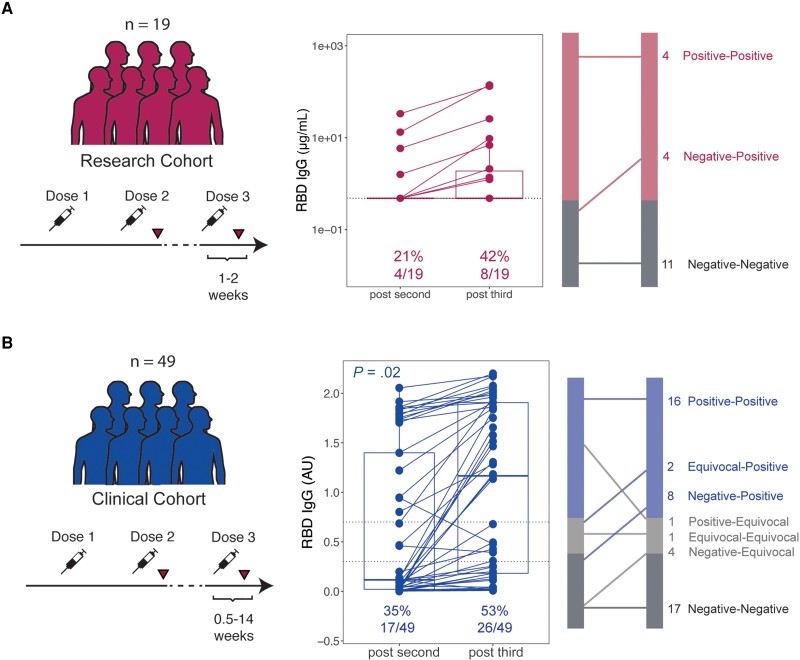
Serologic response to third severe acute respiratory syndrome coronavirus 2 vaccination in patients with lymphoma. Paired research cohort (A) and clinical cohort (B) anti–receptor-binding domain (RBD) immunoglobulin G (IgG) responses after second and third vaccines doses, with graphical representation of changes at right. P value derived from Fisher exact test.

References

    1. Plotkin SA. Correlates of protection induced by vaccination. Clin Vaccine Immunol 2010; 17:1055–65. - PMC - PubMed
    1. Plotkin SA. Correlates of vaccine-induced immunity. Clin Infect Dis 2008; 47:401–9. - PubMed
    1. Pal Singh S, Dammeijer F, Hendriks RW. Role of Bruton’s tyrosine kinase in B cells and malignancies. Mol Cancer 2018; 17:57. - PMC - PubMed
    1. Alu A, Lei H, Han X, Wei Y, Wei X. BTK inhibitors in the treatment of hematological malignancies and inflammatory diseases: mechanisms and clinical studies. J Hematol Oncol 2022; 15:138. - PMC - PubMed
    1. June CH, O’Connor RS, Kawalekar OU, Ghassemi S, Milone MC. CAR T cell immunotherapy for human cancer. Science 2018; 359:1361–5. - PubMed

MeSH terms