. 2024 Jul 25;230(1):e121-e130.
doi: 10.1093/infdis/jiad414.

The Fading of the Mpox Outbreak Among Men Who Have Sex With Men: A Mathematical Modelling Study

Affiliations

The Fading of the Mpox Outbreak Among Men Who Have Sex With Men: A Mathematical Modelling Study

Maria Xiridou et al. J Infect Dis. .

Abstract

Background: In the Netherlands, the number of mpox cases started declining before mpox vaccination was initiated. Most cases were men who have sex with men (MSM). We investigated whether the decline in mpox could be attributed to infection-induced immunity or behavioral adaptations.

Methods: We developed a transmission model and accounted for possible behavioral adaptations: fewer casual partners and shorter time until MSM with mpox refrain from sexual contacts.

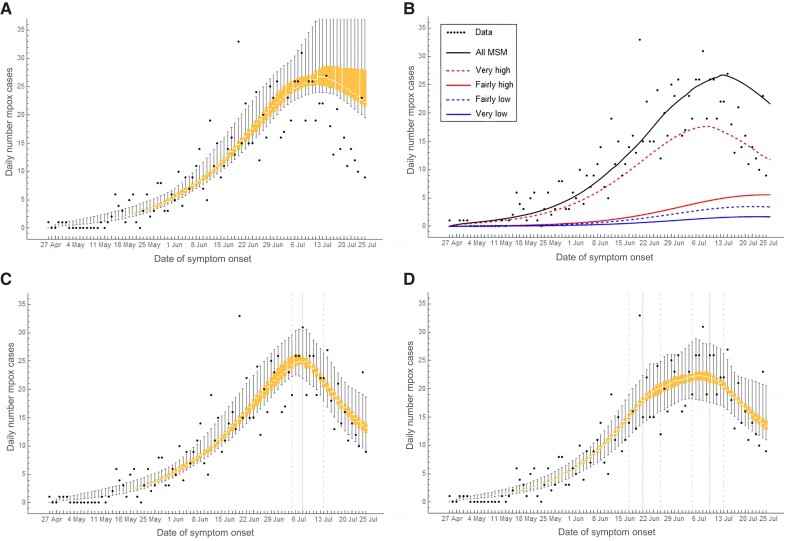
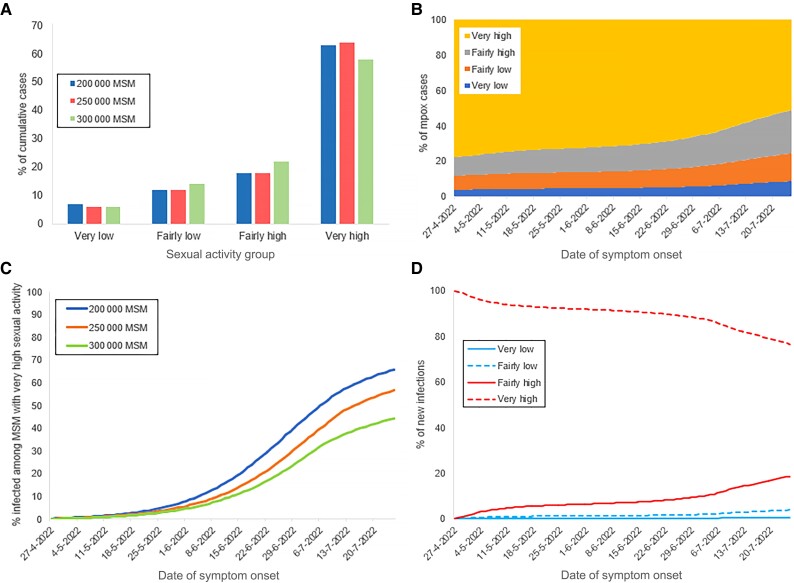
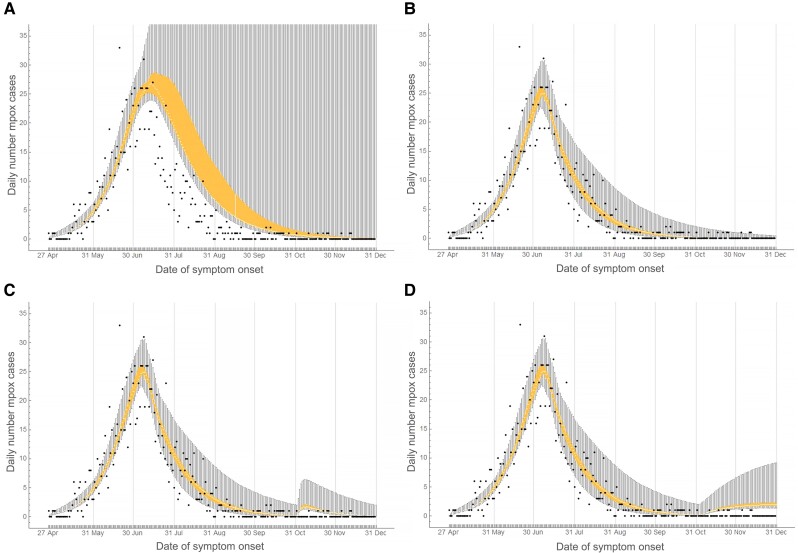
Results: Without behavioral adaptations, the peak in modelled cases matched observations, but the decline was less steep than observed. With behavioral adaptations in the model, we found a decline of 16%-18% in numbers of casual partners in June and 13%-22% in July 2022. Model results showed a halving of the time before refraining from sex. When mpox vaccination started, 57% of MSM with very high sexual activity in the model had been infected. Model scenarios revealed that the outbreak could have waned by November 2022 even without vaccination.

Conclusions: The limited duration of the mpox outbreak in the Netherlands can be ascribed primarily to infection-induced immunity among MSM with high sexual activity levels. The decline was accelerated by behavioral adaptations. Immunity among those most sexually active is essential to impede mpox resurgence.

Keywords: MSM; immunity; mathematical model; men who have sex with men; monkeypox; mpox; sexual behavior; vaccination.


Conflict of interest statement

Potential conflicts of interest. All authors: No reported conflicts of interest. All authors have submitted the ICMJE Form for Disclosure of Potential Conflicts of Interest. Conflicts that the editors consider relevant to the content of the manuscript have been disclosed.

Figures
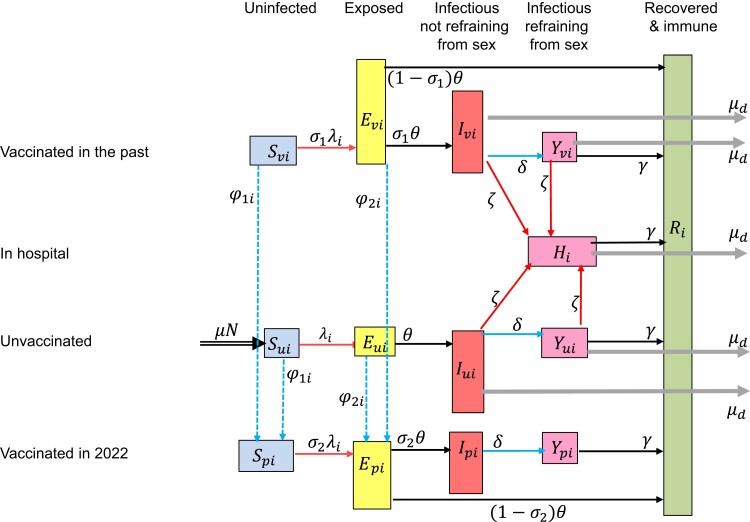
Figure 1.
Figure 1.
Flow diagram of the model for monkeypox virus (MPXV) infections. Individuals in the model are divided into classes according to stage of mpox infection, vaccination status, and whether they are refraining from sexual contacts. Unvaccinated individuals can be susceptible to MPXV (Sui), exposed to MPXV (Eui), infectious not refraining from sexual contacts (Iui), or infectious but refraining from sexual contacts (Yui). Individuals vaccinated in the past can be susceptible (Svi), exposed (Evi), infectious not refraining or refraining from sexual contacts (Ivi, Yvi). Individuals vaccinated in 2022 can be susceptible (Spi), exposed (Epi), infectious not refraining or refraining from sexual contacts (Ipi,Ypi). Infectious cases may need hospitalization (Hi). After recovery, they are immune (Ri). These classes are further divided into 4 subclasses according to level of sexual activity. In the model, we accounted for exit out of the population at a per capita rate μ that is not shown in the diagram.
Figure 2.
Figure 2.
The daily number of mpox cases among men who have sex with men (MSM) in the Netherlands from 27 April to 25 July 2022. Bullets show data from the national database of notifiable diseases of the Netherlands. All other results were calculated from the model. Mpox cases are shown according to date of symptom onset. The box-plots show interquartile range and min-max range of the daily numbers of mpox cases in the overall MSM population: (A) without behavioral adaptations; (C) with behavioral adaptations only in July 2022; and (D) with behavioral adaptations in June and July 2022. B, Median daily number of mpox cases in the overall MSM population (thick line) and separately in the four groups with different sexual activity level. C and D, Vertical grey lines show medians (solid lines) and 95% credible intervals (dashed lines) of the day at which the behavioral adaptations occurred, as obtained from the model fitting. Model results were calculated in a population of 250 000 MSM.
Figure 3.
Figure 3.
The role of subgroups of men who have sex with men (MSM) with different levels of sexual activity, as calculated from the model, for the scenarios with behavioral adaptations in July 2022. A, Distribution of cumulative mpox cases until 25 July 2022. B, Distribution of daily mpox cases. C, Percent of MSM with very high sexual activity being susceptible to monkeypox virus. D, Distribution of new monkeypox virus infections among MSM according to the sexual activity group of the infecting individual. A and C, Results with population of 200 000, 250 000, or 300 000 MSM. B and D, results with population of 250 000 MSM.
Figure 4.
Figure 4.
Daily number of mpox cases among men who have sex with men (MSM) in the Netherlands from 27 April to 31 December 2022. Bullets show data obtained from the national database of notifiable infectious diseases of the Netherlands. Box-plots show medians, interquartile ranges, and min-max ranges calculated from the model in a population of 250 000 MSM. Vertical solid grey lines show the last day of each calendar month. A, Without behavioral adaptations. B, With behavioral adaptations in July 2022. C, With behavioral adaptations in July 2022 and import of 20 unvaccinated infectious mpox cases into the group with very high level of sexual activity on 1 November 2022. D, With behavioral adaptations in July 2022 and import of 1 infectious case per day (in the group with very high level of sexual activity) from 1 November to 31 December 2022.

References

    1. Fine PE, Jezek Z, Grab B, Dixon H. The transmission potential of monkeypox virus in human populations. Int J Epidemiol 1988; 17:643–50. - PubMed
    1. World Health Organization . 2022 Mpox (monkeypox) outbreak: global trends, 13 December 2022. https://worldhealthorg.shinyapps.io/mpx_global/_w_77b7113a/#section-fns. Accessed 28 December 2022.
    1. European Centre for Disease Prevention and Control . Monkeypox multi-country outbreak—second update 18 October 2022. https://www.ecdc.europa.eu/sites/default/files/documents/Monkeypox-multi.... Accessed 28 December 2022.
    1. Brand SPC, Cavallaro M, Hilton Jet al. The role of vaccination and public awareness in forecasts of Mpox incidence in the United Kingdom. Nat Commun 2023; 14:4100. doi: 10.1038/s41467-023-38816-8 - DOI - PMC - PubMed
    1. Murayama H, Pearson CAB, Abbott S, et al. Accumulation of immunity in heavy-tailed sexual contact networks shapes mpox outbreak sizes. J Infect Dis 2024; 229:59–63. - PMC - PubMed