


Effectiveness of Influenza Vaccination During Pregnancy Against Laboratory-Confirmed Seasonal Influenza Among Infants Under 6 Months of Age in Ontario, Canada
- PMID: 39052720
- PMCID: PMC11272077
- DOI: 10.1093/infdis/jiad539
Effectiveness of Influenza Vaccination During Pregnancy Against Laboratory-Confirmed Seasonal Influenza Among Infants Under 6 Months of Age in Ontario, Canada
Abstract
Background: Randomized trials conducted in low- and middle-income settings demonstrated efficacy of influenza vaccination during pregnancy against influenza infection among infants <6 months of age. However, vaccine effectiveness (VE) estimates from settings with different population characteristics and influenza seasonality remain limited.
Methods: We conducted a test-negative study in Ontario, Canada. All influenza virus tests among infants <6 months from 2010 to 2019 were identified and linked with health databases to ascertain information on maternal-infant dyads. VE was estimated from the odds ratio for influenza vaccination during pregnancy among cases versus controls, computed using logistic regression with adjustment for potential confounders.
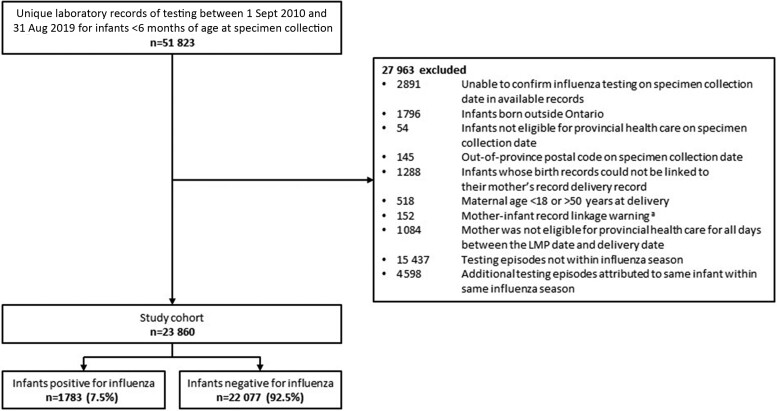
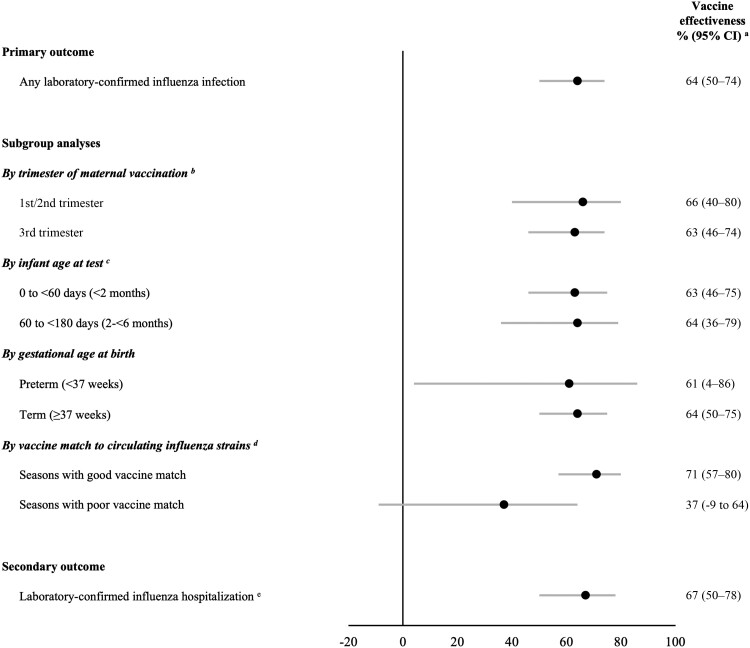
Results: Among 23 806 infants tested for influenza, 1783 (7.5%) were positive and 1708 (7.2%) were born to mothers vaccinated against influenza during pregnancy. VE against laboratory-confirmed infant influenza infection was 64% (95% confidence interval [CI], 50%-74%). VE was similar by trimester of vaccination (first/second, 66% [95% CI, 40%-80%]; third, 63% [95% CI, 46%-74%]), infant age at testing (0 to <2 months, 63% [95% CI, 46%-75%]; 2 to <6 months, 64% [95% CI, 36%-79%]), and gestational age at birth (≥37 weeks, 64% [95% CI, 50%-75%]; < 37 weeks, 61% [95% CI, 4%-86%]). VE against influenza hospitalization was 67% (95% CI, 50%-78%).
Conclusions: Influenza vaccination during pregnancy offers effective protection to infants <6 months, for whom vaccines are not currently available.
Keywords: effectiveness; influenza; pregnancy; vaccination.
© The Author(s) 2023. Published by Oxford University Press on behalf of Infectious Diseases Society of America.
Conflict of interest statement
Potential conflicts of interest . During the conduct of this work, D. B. F. worked for the University of Ottawa and had academic appointments at the Children's Hospital of Eastern Ontario Research Institute and ICES; she is currently employed by Pfizer. K. W. is a cofounder and Chief Scientific Officer of CANImmunize, Inc; he served on the Independent Data Monitoring Committee for Medicago; and is a member of the Moderna Global Advisory Core Consultancy Group. All other authors report no potential conflicts. All authors have submitted the ICMJE Form for Disclosure of Potential Conflicts of Interest. Conflicts that the editors consider relevant to the content of the manuscript have been disclosed.
Figures
References
-
- Abu-Raya B, Madhi SA, Omer SB, et al. . Global perspectives on immunization against SARS-CoV-2 during pregnancy and priorities for future research: an international consensus paper from the World Association of Infectious Diseases and Immunological Disorders. Front Immunol 2021; 12:808064. - PMC - PubMed
-
- Nair H, Brooks WA, Katz M, et al. . Global burden of respiratory infections due to seasonal influenza in young children: a systematic review and meta-analysis. Lancet 2011; 378:1917–30. - PubMed
MeSH terms
Substances
Grants and funding
LinkOut - more resources
Full Text Sources
Medical
