Review
. 2024 Jul 25;16(1):175.
doi: 10.1186/s13098-024-01412-x.

The multiple actions of dipeptidyl peptidase 4 (DPP-4) and its pharmacological inhibition on bone metabolism: a review

Affiliations
Review

The multiple actions of dipeptidyl peptidase 4 (DPP-4) and its pharmacological inhibition on bone metabolism: a review

L M Pechmann et al. Diabetol Metab Syndr. .

Abstract

Background: Dipeptidyl peptidase 4 (DPP-4) plays a crucial role in breaking down various substrates. It also has effects on the insulin signaling pathway, contributing to insulin resistance, and involvement in inflammatory processes like obesity and type 2 diabetes mellitus. Emerging effects of DPP-4 on bone metabolism include an inverse relationship between DPP-4 activity levels and bone mineral density, along with an increased risk of fractures.

Main body: The influence of DPP-4 on bone metabolism occurs through two axes. The entero-endocrine-osseous axis involves gastrointestinal substrates for DPP-4, including glucose-dependent insulinotropic polypeptide (GIP) and glucagon-like peptides 1 (GLP-1) and 2 (GLP-2). Studies suggest that supraphysiological doses of exogenous GLP-2 has a significant inhibitory effect on bone resorption, however the specific mechanism by which GLP-2 influences bone metabolism remains unknown. Of these, GIP stands out for its role in bone formation. Other gastrointestinal DPP-4 substrates are pancreatic peptide YY and neuropeptide Y-both bind to the same receptors and appear to increase bone resorption and decrease bone formation. Adipokines (e.g., leptin and adiponectin) are regulated by DPP-4 and may influence bone remodeling and energy metabolism in a paracrine manner. The pancreatic-endocrine-osseous axis involves a potential link between DPP-4, bone, and energy metabolism through the receptor activator of nuclear factor kappa B ligand (RANKL), which induces DPP-4 expression in osteoclasts, leading to decreased GLP-1 levels and increased blood glucose levels. Inhibitors of DPP-4 participate in the pancreatic-endocrine-osseous axis by increasing endogenous GLP-1. In addition to their glycemic effects, DPP-4 inhibitors have the potential to decrease bone resorption, increase bone formation, and reduce the incidence of osteoporosis and fractures. Still, many questions on the interactions between DPP-4 and bone remain unanswered, particularly regarding the effects of DPP-4 inhibition on the skeleton of older individuals.

Conclusion: The elucidation of the intricate interactions and impact of DPP-4 on bone is paramount for a proper understanding of the body's mechanisms in regulating bone homeostasis and responses to internal stimuli. This understanding bears significant implications in the investigation of conditions like osteoporosis, in which disruptions to these signaling pathways occur. Further research is essential to uncover the full extent of DPP-4's effects on bone metabolism and energy regulation, paving the way for novel therapeutic interventions targeting these pathways, particularly in older individuals.

Keywords: Bone; Bone diseases; Bone resorption; Dipeptidyl peptidase 4; Dipeptidyl-peptidase IV inhibitors; Fractures; Incretins; Metabolic; Osteoclasts; Osteogenesis; Osteoporosis.


Conflict of interest statement

The authors declare no competing interests.

Figures
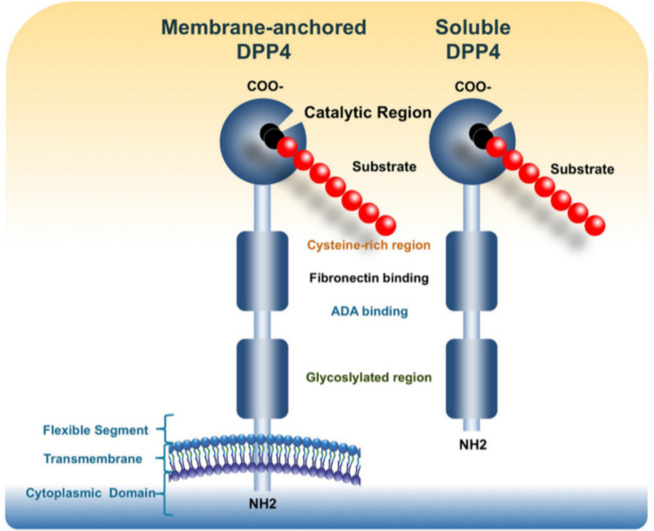
Fig. 1
Fig. 1
Schematic representation of the dipeptidyl peptidase 4 (DPP-4) monomer bound to the membrane and the soluble DPP-4. Schematic representation of the dipeptidyl peptidase 4 (DPP-4) monomer bound to the membrane and to soluble DPP-4. Catalytically active DPP-4 is released from the plasma membrane, producing a soluble circulating form (i.e., soluble DPP-4, which contains 727 amino acids). The soluble DPP-4 lacks the intracellular and transmembrane domains and accounts for a substantial proportion of DPP-4 activity in human serum. Both membrane-bound and circulating soluble DPP-4 share many domains, including the glycosylated region (residues 101–535, specific residues 85, 92, 150), ADA binding domain (340–343), fibronectin binding domain (468–479), cysteine-rich domain (351–506, disulfide bonds are formed from 385–394, 444–472, and 649–762), and the catalytic domain (507–766, including residues composing the catalytic active site 630, 708, and 740). Adapted from Mulvihill et al. Endocrine Reviews, December 2014, 35(6):992–1019 (20). Reproduced with permission from Oxford University Press and Copyright Clearance Center (License number 570255101696)
Fig. 2
Fig. 2
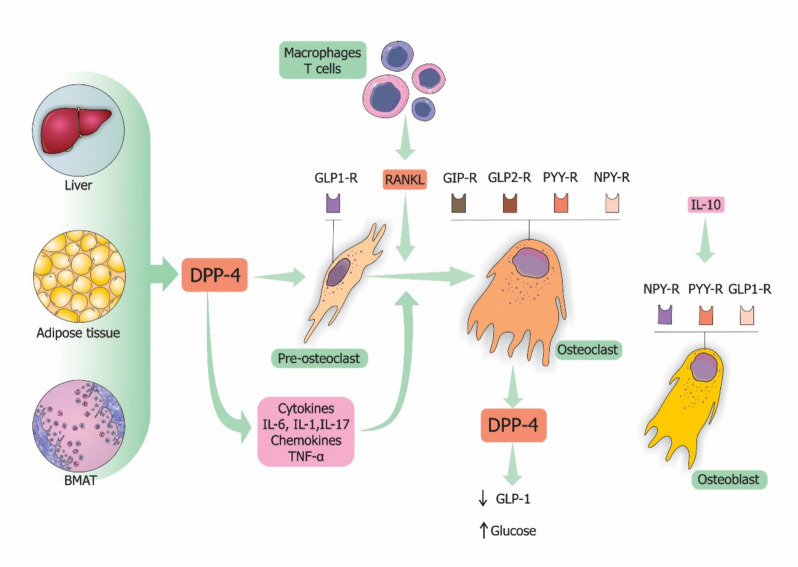
Potential mechanisms of action of dipeptidyl peptidase 4 on bone metabolism*. BMAT, bone marrow adipose tissue; DPP-4, dipeptidyl peptidase 4; GLP1-R, receptor for glucagon-like peptide 1 (GLP-1); GIPR, receptor for glucose-dependent insulinotropic polypeptide (GIP); IL, interleukin; PYR, receptor for peptide YY; NPYR, receptor for neuropeptide Y; RANKL, receptor activator of nuclear factor-kappa B ligand, TNF-α, tumor necrosis factor-alpha. Complex roles of DPP-4 in classical enzymatic and nonenzymatic functions of bone metabolism. Bone marrow mesenchymal cells, liver, and adipose tissue produce DPP-4, while RANKL induces the expression of DPP-4 by osteoclasts, leading to decreased GLP-1 levels and increased blood glucose levels. Further, DPP-4 cleaves various sites on chemokines, interleukins, and other cytokines that participate actively in bone remodeling. Potentially, DPP-4 exerts indirect regulation of bone remodeling by interacting with multiple peptide substrates on bone cells, including GLP-1, glucagon-like peptide-2 (GLP-2), GIP, NPY, and PYY
Fig. 3
Fig. 3
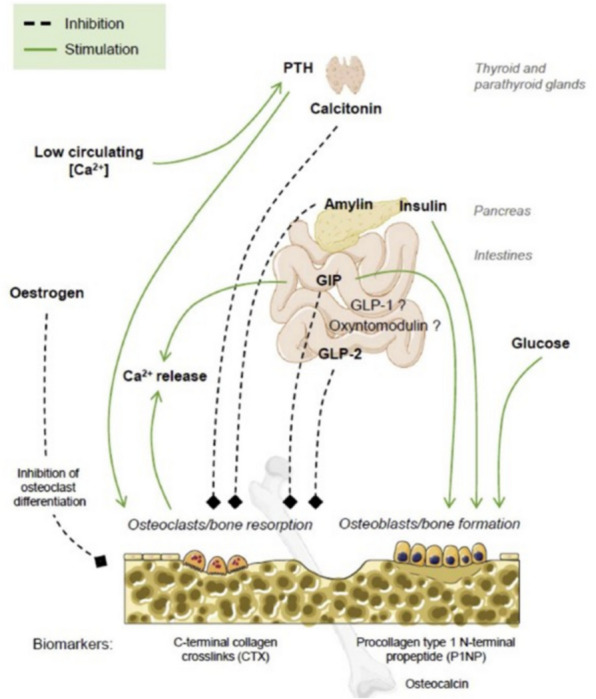
Entero endocrine-osseous axis The entero-endocrine-osseous axis. Lower serum calcium levels stimulate the parathyroid release of PTH, which increases bone reabsorption with release of calcium into the circulation. Thyroid C cells present receptors for GLP-1, as demonstrated in preclinical studies, and stimulation of calcitonin production inhibits osteoclastic activity. The contributions of endogenous GIP to postprandial bone homeostasis are as follows: endogenous GIP contributes to the postprandial suppression of bone resorption in humans and stimulates bone formation through stimulation of osteoblasts [47]. Both GIP and GLP‐2 receptors are expressed in parathyroid tissue, and the effect of GLP‐2 on bone turnover seems to depend on changes in PTH levels and may be mediated through GLP‐2 receptor in the parathyroid gland. Effects of GIP on bone turnover may be mediated directly via GIP receptor expressed in osteoblasts and osteoclasts, which may occur independently from PTH [47]. SOURCE: Adapted from Stensen et al. The enterosseous axis and its relationship with thyroid C cells and PTH. Copyright provided by Elsevier and Copyright Clearance Center. License Number 5702571099338. Abbreviations: GIP, glucose-dependent insulinotropic polypeptide; GLP-1, glucagon-like peptide 1; GLP-2, glucagon-like peptide 2; CTX, carboxy-terminal type 1 collagen crosslinks; P1NP, procollagen type 1 amino-terminal propeptide

References

    1. Matteucci E, Giampietro O. Dipeptidyl peptidase-4 (CD26): knowing the function before inhibiting the enzyme. Curr Med Chem. 2009;16:2943–51. 10.2174/092986709788803114 - DOI - PubMed
    1. Yang Q, Fu B, Luo D, Wang H, Cao H, Chen X, et al. The multiple biological functions of dipeptidyl peptidase-4 in bone metabolism. Front Endocrinol (Lausanne). 2022;2:13. - PMC - PubMed
    1. Weivoda MM, Chew CK, Monroe DG, Farr JN, Atkinson EJ, Geske JR, et al. Identification of osteoclast-osteoblast coupling factors in humans reveals links between bone and energy metabolism. Nat Commun. 2020. 10.1038/s41467-019-14003-6. 10.1038/s41467-019-14003-6 - DOI - PMC - PubMed
    1. Varin EM, Mulvihill EE, Beaudry JL, Pujadas G, Fuchs S, Tanti JF, et al. Circulating levels of soluble dipeptidyl peptidase-4 are dissociated from inflammation and induced by enzymatic DPP4 inhibition. Cell Metab. 2019;29(2):320-334.e5. 10.1016/j.cmet.2018.10.001 - DOI - PubMed
    1. Kim SW, Cho EH. High levels of serum DPP-4 activity are associated with low bone mineral density in obese postmenopausal women. Endocrinol Metab. 2016;31(1):93–9. 10.3803/EnM.2016.31.1.93 - DOI - PMC - PubMed

LinkOut - more resources