Case Reports
. 2024 Jul 11:14:1343238.
doi: 10.3389/fonc.2024.1343238. eCollection 2024.

Case report: Pathological complete response to neoadjuvant brigatinib in stage III non-small cell lung cancer with ALK rearrangement

Affiliations
Case Reports

Case report: Pathological complete response to neoadjuvant brigatinib in stage III non-small cell lung cancer with ALK rearrangement

Hayoung Seong et al. Front Oncol. .

Abstract

Purpose: The use of neoadjuvant anaplastic lymphoma kinase (ALK)-tyrosine kinase inhibitors (TKIs) has not been extensively explored. The current case report highlights the notable pathological complete response (pCR) achieved following neoadjuvant brigatinib therapy in a patient with stage IIIA ALK-positive non-small cell lung cancer (NSCLC).

Case presentation: A 32-year-old male presented with incidental lung lesions, ultimately diagnosed as clinical stage T3N1M0, IIIA NSCLC with an ALK gene rearrangement. Following a multidisciplinary discussion, the patient opted for neoadjuvant brigatinib therapy, which significantly reduced the tumor size. Subsequently, surgery with curative intent was performed, revealing pCR with no residual tumor cells. The patient remained disease-free during a 13-month follow-up period.

Conclusion: This case report provides compelling evidence of pCR following brigatinib therapy in ALK-positive NSCLC, suggesting that surgery after neoadjuvant therapy with brigatinib may offer a safe and effective approach for patients with ALK-positive NSCLC.

Keywords: anaplastic lymphoma kinase-tyrosine kinase inhibitor; brigatinib; case report; lung cancer; neoadjuvant treatment.


Conflict of interest statement

The authors declare that the research was conducted in the absence of any commercial or financial relationships that could be construed as a potential conflict of interest.

Figures

Figure 1
Figure 1
Computed tomography images before and after treatment with brigatinib. (A–C) Before treatment, a primary mass measuring 4.9 cm can be observed, along with a satellite nodule measuring 1.2 cm in the lower lobe of the right lung, with right interlobar lymph node metastasis. (D–F) A significant response in the primary lung lesions, satellite nodule, and lymph node can be observed after brigatinib therapy.
Figure 2
Figure 2
Pathological examination of the tissue specimen from endobronchial ultrasound-guided transbronchial needle aspiration and video-assisted thoracoscopic right lower lobectomy with mediastinal lymph node dissection. (A) The biopsy sample shows clusters of atypical epithelial cells with plump cytoplasm (H&E, 200×). (B) Representative immunohistochemistry image showing tumor cells nuclear-positive for TTF1 (200×). (C) Representative image showing strong granular cytoplasmic expression of anaplastic lymphoma kinase (D5F3, Ventana CDx) (H&E, 200×). (D) Representative image showing a break in the ALK locus, indicated by the Vysis ALK Break abnormal signal pattern of isolated red and distinct break-apart signals (Vysis ALK Break Apart FISH probe).
Figure 3
Figure 3
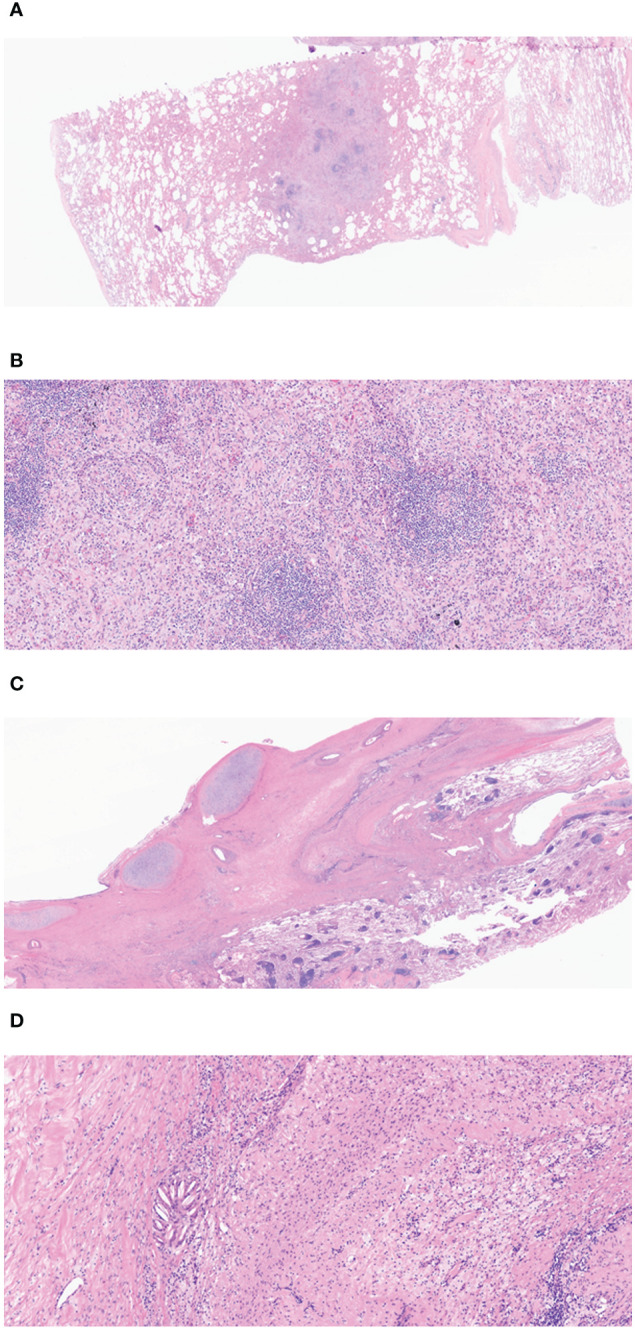
(A) The low magnification view shows a nodular area, considered the tumor bed (H&E, 10×). (B) Lymphoid aggregation and fibroblast can be observed in the nodular area of (A) (H&E, 100×). (C) Fibrotic changes can be seen in the peribronchial area, which is compatible with the tumor bed (H&E, 400×). (D) In the high-power view of (C), macrophage and lymphocyte infiltration and a cholesterol cleft can be observed in the fibrotic area. (H&E). Overall, there are no viable tumor cells on tumor bed and the final diagnosis is compatible with pathologic complete response.
Figure 4
Figure 4
The timeline of the entire therapy process.

References

    1. Ettinger DS, Wood DE, Aisner DL, Akerley W, Bauman JR, Bharat A, et al. . NCCN guidelines® Insights: non–small cell lung cancer, version 2.2023: featured updates to the NCCN guidelines. J Natl Compr Canc Netw. (2023) 21:340–50. doi: 10.6004/jnccn.2023.0020 - DOI - PubMed
    1. Li S, de Camargo Correia GS, Wang J, Manochakian R, Zhao Y, Lou Y. Emerging targeted therapies in advanced non-small-cell lung cancer. Cancers. (2023) 15:2899. doi: 10.3390/cancers15112899 - DOI - PMC - PubMed
    1. Solomon BJ, Mok T, Kim DW, Wu YL, Nakagawa K, Mekhail T, et al. . First-line crizotinib versus chemotherapy in ALK-positive lung cancer. N Engl J Med. (2014) 371:2167–77. doi: 10.1056/NEJMoa1408440 - DOI - PubMed
    1. Mok T, Camidge DR, Gadgeel SM, Rosell R, Dziadziuszko R, Kim DW, et al. . Updated overall survival and final progression-free survival data for patients with treatment-naive advanced ALK-positive non-small-cell lung cancer in the ALEX study. Ann Oncol. (2020) 31:1056–64. doi: 10.1016/j.annonc.2020.04.478 - DOI - PubMed
    1. Lv C, Fang W, Wu N, Jiao W, Xu S, Ma H, et al. . Osimertinib as neoadjuvant therapy in patients with EGFR-mutant resectable stage II-IIIB lung adenocarcinoma (NEOS): A multicenter, single-arm, open-label phase 2b trial. Lung Cancer. (2023) 178:151–6. doi: 10.1016/j.lungcan.2023.02.011 - DOI - PubMed

Publication types

LinkOut - more resources