Review
. 2024 Jul 9;13(14):1172.
doi: 10.3390/cells13141172.

Evolving Paradigms in Sepsis Management: A Narrative Review

Affiliations
Review

Evolving Paradigms in Sepsis Management: A Narrative Review

Min-Ji Kim et al. Cells. .

Abstract

Sepsis, a condition characterized by life-threatening organ dysfunction due to a dysregulated host response to infection, significantly impacts global health, with mortality rates varying widely across regions. Traditional therapeutic strategies that target hyperinflammation and immunosuppression have largely failed to improve outcomes, underscoring the need for innovative approaches. This review examines the development of therapeutic agents for sepsis, with a focus on clinical trials addressing hyperinflammation and immunosuppression. It highlights the frequent failures of these trials, explores the underlying reasons, and outlines current research efforts aimed at bridging the gap between theoretical advancements and clinical applications. Although personalized medicine and phenotypic categorization present promising directions, this review emphasizes the importance of understanding the complex pathogenesis of sepsis and developing targeted, effective therapies to enhance patient outcomes. By addressing the multifaceted nature of sepsis, future research can pave the way for more precise and individualized treatment strategies, ultimately improving the management and prognosis of sepsis patients.

Keywords: hyperinflammation; immune paralysis; sepsis.


Conflict of interest statement

The authors declare no conflicts of interest.

Figures
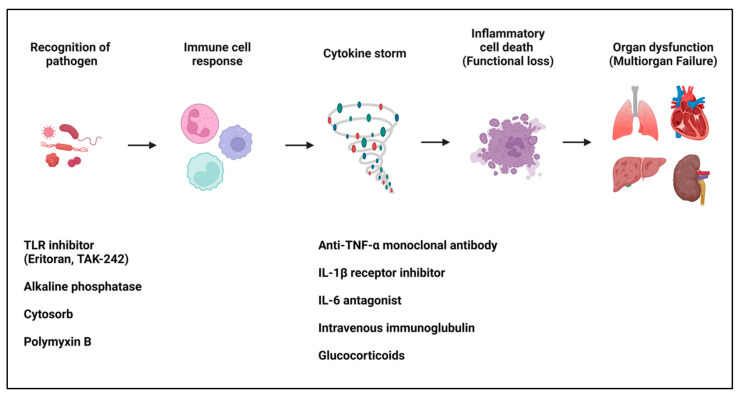
Figure 1
Figure 1
Simplified diagram explaining the pathogenesis of sepsis from a classical perspective and treatment strategies. This diagram depicts the classical pathogenesis of sepsis, underscoring the activation of the innate immune system by PAMPs via TLRs. It delineates how this activation can escalate into cytokine storms, causing systemic inflammation and multiorgan failure. Various therapeutic strategies based on this classical understanding are illustrated below, including TLR inhibitors, alkaline phosphatase, CytoSorb, polymyxin B, anti-TNF-α monoclonal antibodies, IL-1β receptor inhibitors, IL-6 antagonists, and glucocorticoids. Each treatment is positioned underneath the process it targets.
Figure 2
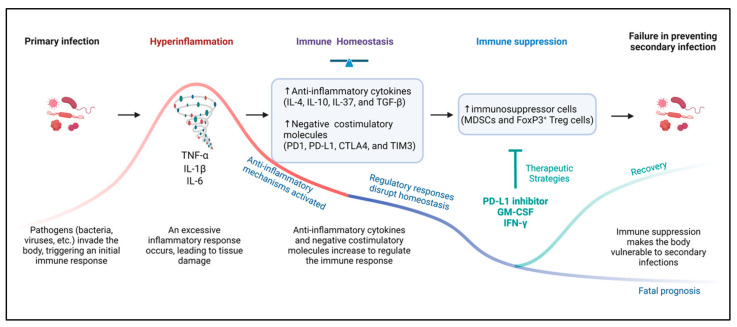
Figure 2
Mechanisms and consequences of immunosuppression in sepsis and potential therapeutic strategies. During hyperinflammatory states, several anti-inflammatory mechanisms are activated to mitigate inflammation and promote tissue recovery, aiming to restore immune homeostasis. These include the upregulation of negative costimulatory molecules such as PD-L1 and PD-1 on immune cells, the increased production of anti-inflammatory cytokines like IL-4, IL-10, IL-37, and TGF-β, and the expansion of the myeloid-derived suppressor cell (MDSC) population together with an increase in FoxP3+ T cells. These regulatory responses can disrupt immune homeostasis, leading to immunosuppression characterized by suppressed T cell responses and increased apoptosis. This immunosuppression can result in failure in preventing secondary infection. Therapeutic strategies targeting these pathways include GM-CSF to enhance neutrophil activity, anti-PD-L1 antibodies to alleviate T cell exhaustion, and IFN-γ to boost macrophage capabilities.
Figure 3
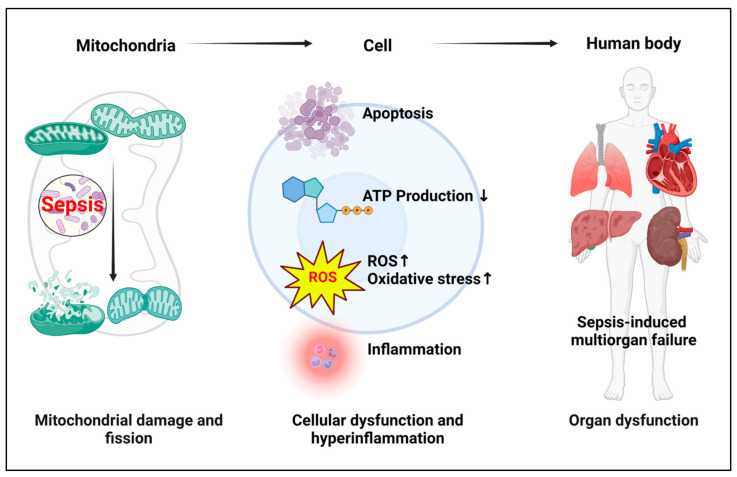
Figure 3
Impact of mitochondrial damage on sepsis-related organ failure. In sepsis, mitochondrial damage leads to increased fragmentation, which boosts apoptotic signaling and impairs the primary function of mitochondria, namely energy production. This failure results in heightened ROS production, exacerbating hyperinflammation. Ultimately, these disruptions contribute to cellular dysfunction and death, culminating in organ dysfunction.

References

    1. Singer M., Deutschman C.S., Seymour C.W., Shankar-Hari M., Annane D., Bauer M., Bellomo R., Bernard G.R., Chiche J.D., Coopersmith C.M., et al. The Third International Consensus Definitions for Sepsis and Septic Shock (Sepsis-3) JAMA. 2016;315:801–810. doi: 10.1001/jama.2016.0287. - DOI - PMC - PubMed
    1. Rudd K.E., Johnson S.C., Agesa K.M., Shackelford K.A., Tsoi D., Kievlan D.R., Colombara D.V., Ikuta K.S., Kissoon N., Finfer S., et al. Global, regional, and national sepsis incidence and mortality, 1990–2017: Analysis for the Global Burden of Disease Study. Lancet. 2020;395:200–211. doi: 10.1016/S0140-6736(19)32989-7. - DOI - PMC - PubMed
    1. Fleischmann C., Scherag A., Adhikari N.K., Hartog C.S., Tsaganos T., Schlattmann P., Angus D.C., Reinhart K., International Forum of Acute Care Trialists Assessment of Global Incidence and Mortality of Hospital-treated Sepsis. Current Estimates and Limitations. Am. J. Respir. Crit. Care Med. 2016;193:259–272. doi: 10.1164/rccm.201504-0781OC. - DOI - PubMed
    1. Phua J., Koh Y., Du B., Tang Y.Q., Divatia J.V., Tan C.C., Gomersall C.D., Faruq M.O., Shrestha B.R., Gia Binh N., et al. Management of severe sepsis in patients admitted to Asian intensive care units: Prospective cohort study. BMJ. 2011;342:d3245. doi: 10.1136/bmj.d3245. - DOI - PMC - PubMed
    1. Bode C., Weis S., Sauer A., Wendel-Garcia P., David S. Targeting the host response in sepsis: Current approaches and future evidence. Crit. Care. 2023;27:478. doi: 10.1186/s13054-023-04762-6. - DOI - PMC - PubMed

Publication types

LinkOut - more resources