


Unraveling the Immune Microenvironment in Diffuse Large B-Cell Lymphoma: Prognostic and Potential Therapeutic Implications
- PMID: 39057061
- PMCID: PMC11276293
- DOI: 10.3390/cimb46070420
Unraveling the Immune Microenvironment in Diffuse Large B-Cell Lymphoma: Prognostic and Potential Therapeutic Implications
Abstract
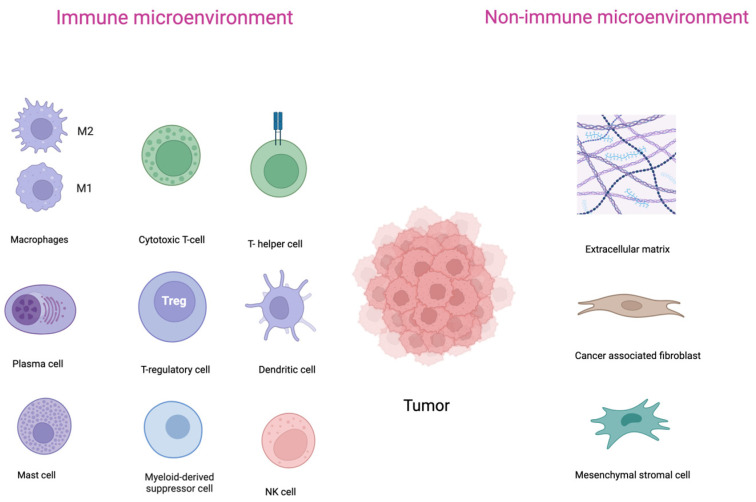
Diffuse large B cell lymphoma (DLBCL) is a multifaceted condition characterized by significant diversity in its molecular and pathological subtypes and clinical manifestation. Despite the progress made in the treatment of DLBCL through the development of novel drugs, an estimated one-third of patients encounter relapse or acquire refractory disease. The tumor microenvironment (TME) of DLBCL, a complex network consisting of cellular and noncellular components that engage in interactions with the tumor, is a parameter that is gaining increasing attention. The TME comprises both the immune and nonimmune microenvironments. The immune microenvironment comprises natural killer (NK) cells, dendritic cells (DCs), tumor-associated macrophages (TAMs), neutrophils, myeloid-derived suppressor cells (MDSCs), and T and B lymphocytes. The nonimmune microenvironment consists of the extracellular matrix (ECM), cancer-associated fibroblasts (CAFs), mesenchymal stromal cells, and other molecules that are secreted. Despite ongoing research, the exact impact of these components and their interaction on the progression of the disease remains elusive. A comprehensive review of significant discoveries concerning the cellular and noncellular constituents, molecular characteristics, and treatment response and prognosis of the TME in DLBCL, as well as the potential targeting of the TME with novel therapeutic approaches, is provided in this article.
Keywords: DLBCL; TME; lymphoma; microenvironment.
Conflict of interest statement
The authors declare no conflicts of interest.
Figures
References
-
- Bea S., Zettl A., Wright G., Salaverria I., Jehn P., Moreno V., Burek C., Ott G., Puig X., Yang L., et al. Diffuse large B-cell lymphoma subgroups have distinct genetic profiles that influence tumor biology and improve gene-expression-based survival prediction. Blood. 2005;106:3183–3190. doi: 10.1182/blood-2005-04-1399. - DOI - PMC - PubMed
-
- Meyer P.N., Fu K., Greiner T.C., Smith L.M., Delabie J., Gascoyne R.D., Ott G., Rosenwald A., Braziel R.M., Campo E., et al. Immunohistochemical methods for predicting cell of origin and survival in patients with diffuse large B-cell lymphoma treated with rituximab. J. Clin. Oncol. 2011;29:200–207. doi: 10.1200/JCO.2010.30.0368. - DOI - PMC - PubMed
Publication types
LinkOut - more resources
Full Text Sources
