. 2024 Jul 14;15(7):534.
doi: 10.3390/insects15070534.

Emerald Ash Borer Infestation-Induced Elevated Negative Correlations and Core Genera Shift in the Endophyte Community of Fraxinus bungeana

Affiliations

Emerald Ash Borer Infestation-Induced Elevated Negative Correlations and Core Genera Shift in the Endophyte Community of Fraxinus bungeana

Hua-Ling Wang et al. Insects. .

Abstract

Endophytes, prevalent in plants, mediate plant-insect interactions. Nevertheless, our understanding of the key members of endophyte communities involved in inhibiting or assisting EAB infestation remains limited. Employing ITS and 16S rRNA high-throughput sequencing, along with network analysis techniques, we conducted a comprehensive investigation into the reaction of endophytic fungi and bacteria within F. bungeana phloem by comparing EAB-infested and uninfected samples. Our findings reveal that EAB infestation significantly impacts the endophytic communities, altering both their diversity and overall structure. Interestingly, both endophytic fungi and bacteria exhibited distinct patterns in response to the infestation. For instance, in the EAB-infested phloem, the fungi abundance remained unchanged, but diversity decreased significantly. Conversely, bacterial abundance increased, without significant diversity changes. The fungi community structure altered significantly, which was not observed in bacteria. The bacterial composition in the infested phloem underwent significant changes, characterized by a substantial decrease in beneficial species abundance, whereas the fungal composition remained largely unaffected. In network analysis, the endophytes in infested phloem exhibited a modular topology, demonstrating greater complexity due to an augmented number of network nodes, elevated negative correlations, and a core genera shift compared to those observed in healthy phloem. Our findings increase understanding of plant-insect-microorganism relationships, crucial for pest control, considering endophytic roles in plant defense.

Keywords: Agrilus planipennis; Fraxinus bungeana; diversity; endophyte.


Conflict of interest statement

The authors declare no conflicts of interest.

Figures

Figure 1
Figure 1
Principal coordinate analysis of endophytic fungi (A) and bacteria (B) in phloem of F. bungeana.
Figure 2
Figure 2
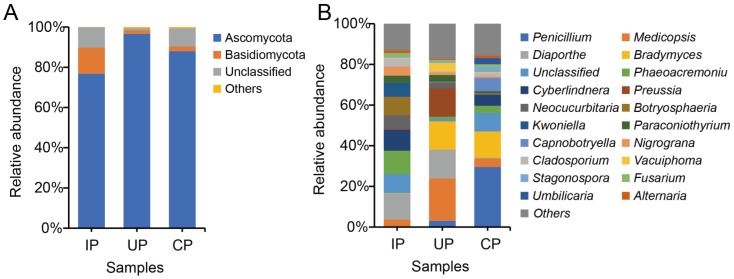
Community structure of endophytic fungi from the phloem in F. bungeana at the phylum (A) and genus (B) levels. In figure (A), the category “Others” represents the aggregated relative abundance of each fungal taxa with a relative abundance of less than 1%. In Figure (B), “Others” refers to the collective abundance of the fungal taxa grouped within the lowest quintile of their ranked abundance.
Figure 3
Figure 3
Community structure of endophytic bacteria from the phloem in F. bungeana at the phylum (A) and genus (B) levels. In both figures, the category “Others” represents the aggregated relative abundance of each bacterial taxa constituting less than 1% of the total community.
Figure 4
Figure 4
Differential genus of endophytic bacteria in the phloem of F. bungeana. (A) Medicosis; (B) Bradyrhizobium; (C) Rhodopseudomonas; (D) Psedomonas. a, b indicated significant difference among samples at the p < 0.05 level.
Figure 5
Figure 5
Functional prediction of endophytic fungi (A) and endophytic bacteria (B) in the phloem of F. bungeana. In both figures, the category “Others” refers to the collective abundance of fungal taxa grouped within the lowest quintile of their ranked abundance.
Figure 6
Figure 6
Correlation network analysis of endophytes in F. bungeana at the genus level. (AC) represent control phloem (CP), infested phloem (IP), and uninfected phloem (UP), respectively. Circles depict endophytic fungi, while triangles represent endophytic bacteria. (D) Different colors denote distinct phyla. The sizes of the shapes indicate the degree of connectivity, and the lines connecting the points signify the relevance between them. Specifically, the red lines represent a positive correlation, whereas the blue lines indicate a negative correlation.

References

    1. Arora J., Ramawat K.G. An introduction to endophytes: Biology and biotechnology. In: Maheshwari D., editor. Sustainable Development and Biodiversity. Volume 15. Springer; Berlin/Heidelberg, Germany: 2017. pp. 1–23.
    1. Wani Z.A., Ashraf N., Mohiuddin T., Hassan S.R.U. Plant-endophyte symbiosis, an ecological perspective. Appl. Microbiol. Biotechnol. 2015;99:2955–2965. doi: 10.1007/s00253-015-6487-3. - DOI - PubMed
    1. Vandenkoornhuyse P., Quaiser A., Duhamel M., Le V.A., Dufresne A. The importance of the microbiome of the plant holobiont. New Phytol. 2015;206:1196–1206. doi: 10.1111/nph.13312. - DOI - PubMed
    1. Hacquard S., Schadt C.W. Towards a holistic understanding of the beneficial interactions across the Populus microbiome. New Phytol. 2014;205:1424–1430. doi: 10.1111/nph.13133. - DOI - PubMed
    1. Trivedi P., Leach J.E., Tringe S.G., Sa T., Singh B.K. Plant-microbiome interactions: From community assembly to plant health. Nat. Rev. Microbiol. 2020;18:607–621. doi: 10.1038/s41579-020-0412-1. - DOI - PubMed

LinkOut - more resources