


Complex Hospital-Based Electronic Prescribing-Based Intervention to Support Antimicrobial Stewardship: Qualitative Study
- PMID: 39059001
- PMCID: PMC11316148
- DOI: 10.2196/54458
Complex Hospital-Based Electronic Prescribing-Based Intervention to Support Antimicrobial Stewardship: Qualitative Study
Abstract
Background: Antimicrobial resistance (AMR) represents a growing concern for public health.
Objective: We sought to explore the challenges associated with development and implementation of a complex intervention designed to improve AMS in hospitals.
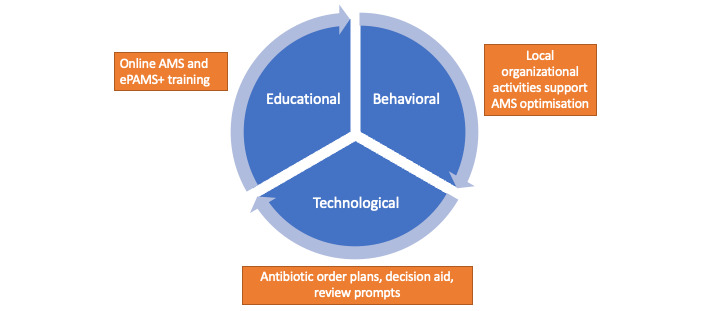
Methods: We conducted a qualitative evaluation of a complex AMS intervention with educational, behavioral, and technological components in 5 wards of an English hospital. At 2 weeks and 7 weeks after initiating the intervention, we interviewed 25 users of the intervention, including senior and junior prescribers, a senior nurse, a pharmacist, and a microbiologist. Topics discussed included perceived impacts of different elements of the intervention and facilitators and barriers to effective use. Interviews were supplemented by 2 observations of ward rounds to gain insights into AMS practices. Data were audio-recorded, transcribed, and inductively and deductively analyzed thematically using NVivo12.
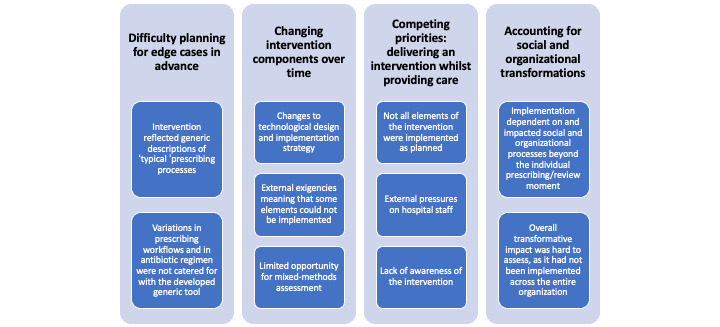
Results: Tracing the adoption and impact of the various components of the intervention was difficult, as it had been introduced into a setting with competing pressures. These particularly affected behavioral and educational components (eg, training, awareness-building activities), which were often delivered ad hoc. We found that the participatory intervention design had addressed typical use cases but had not catered for edge cases that only became visible when the intervention was delivered in real-world settings (eg, variations in prescribing workflows across different specialties and conditions).
Conclusions: Effective user-focused design of complex interventions to promote AMS can support acceptance and use. However, not all requirements and potential barriers to use can be fully anticipated or tested in advance of full implementation in real-world settings.
Keywords: AMR; AMS; antimicrobial; antimicrobial resistance; antimicrobial stewardship; antimicrobials; behavioral; complex intervention; complex interventions; development; e-prescribing; ePAMS+; educational; electronic prescribing; evaluation; healthcare; hospital; hospital-based; hospitals; implementation; in-depth; interview; interviews; microbiologist; microbiologists; nurse; nurses; observation; observations; pharmacist; pharmacists; prescriber; prescribers; prescribing; prescription; public health; qualitative study; technological; thematic analysis.
©Kathrin Cresswell, Susan Hinder, Aziz Sheikh, Neil Watson, David Price, Andrew Heed, Sarah Katie Pontefract, Jamie Coleman, Jillian Beggs, Antony Chuter, Ann Slee, Robin Williams. Originally published in JMIR Formative Research (https://formative.jmir.org), 26.07.2024.
Conflict of interest statement
Conflicts of Interest: None declared.
Figures
References
-
- Michael CA, Dominey-Howes D, Labbate M. The antimicrobial resistance crisis: causes, consequences, and management. Front Public Health. 2014 Sep 16;2:145. doi: 10.3389/fpubh.2014.00145. https://europepmc.org/abstract/MED/25279369 - DOI - PMC - PubMed
-
- Dadgostar P. Antimicrobial resistance: implications and costs. Infect Drug Resist. 2019;12:3903–3910. doi: 10.2147/IDR.S234610. https://europepmc.org/abstract/MED/31908502 234610 - DOI - PMC - PubMed
-
- Parker HM, Mattick K. The determinants of antimicrobial prescribing among hospital doctors in England: a framework to inform tailored stewardship interventions. Br J Clin Pharmacol. 2016 Aug 18;82(2):431–40. doi: 10.1111/bcp.12953. https://europepmc.org/abstract/MED/27038778 - DOI - PMC - PubMed
LinkOut - more resources
Full Text Sources
