Review
. 2024 Jul 18;16(14):2580.
doi: 10.3390/cancers16142580.

The Bright Side of Curcumin: A Narrative Review of Its Therapeutic Potential in Cancer Management

Affiliations
Review

The Bright Side of Curcumin: A Narrative Review of Its Therapeutic Potential in Cancer Management

Andrea Amaroli et al. Cancers (Basel). .

Abstract

Curcumin, a polyphenolic compound derived from Curcuma longa, exhibits significant therapeutic potential in cancer management. This review explores curcumin's mechanisms of action, the challenges related to its bioavailability, and its enhancement through modern technology and approaches. Curcumin demonstrates strong antioxidant and anti-inflammatory properties, contributing to its ability to neutralize free radicals and inhibit inflammatory mediators. Its anticancer effects are mediated by inducing apoptosis, inhibiting cell proliferation, and interfering with tumor growth pathways in various colon, pancreatic, and breast cancers. However, its clinical application is limited by its poor bioavailability due to its rapid metabolism and low absorption. Novel delivery systems, such as curcumin-loaded hydrogels and nanoparticles, have shown promise in improving curcumin bioavailability and therapeutic efficacy. Additionally, photodynamic therapy has emerged as a complementary approach, where light exposure enhances curcumin's anticancer effects by modulating molecular pathways crucial for tumor cell growth and survival. Studies highlight that combining low concentrations of curcumin with visible light irradiation significantly boosts its antitumor efficacy compared to curcumin alone. The interaction of curcumin with cytochromes or drug transporters may play a crucial role in altering the pharmacokinetics of conventional medications, which necessitates careful consideration in clinical settings. Future research should focus on optimizing delivery mechanisms and understanding curcumin's pharmacokinetics to fully harness its therapeutic potential in cancer treatment.

Keywords: anticancer agent; antitumor drugs; cancer; cell metabolism; chemotherapy; curcuminoid; drug delivery; drug targeting; nanoparticle; oxidative phosphorylation; oxidative stress; photochemotherapies; photodynamic therapy; tumor; turmeric.


Conflict of interest statement

The authors declare no conflicts of interest. The funders had no role in the design of the study; in the collection, analyses, or interpretation of the data; in the writing of the manuscript; or in the decision to publish the results.

Figures
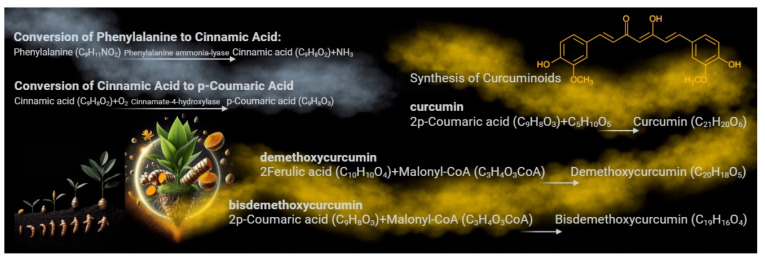
Figure 1
Figure 1
The biosynthesis pathway of curcumin in turmeric. The biosynthesis of curcumin in the rhizomes of Curcuma longa involves several enzymatic steps. It begins with phenylalanine ammonia-lyase converting phenylalanine into cinnamic acid. Cinnamic acid is then converted into p-coumaric acid, a key intermediate. Through a series of enzymatic reactions, p-coumaric acid forms curcuminoid precursors such as curcumin, demethoxycurcumin, and bis-demethoxycurcumin. Notably, demethoxycurcumin is formed from the intermediate ferulic acid derived from p-coumaric acid through methylation and other modifications. These rhizome processes contribute to the plant’s defense mechanisms and protection against oxidative stress and pathogens.
Figure 2
Figure 2
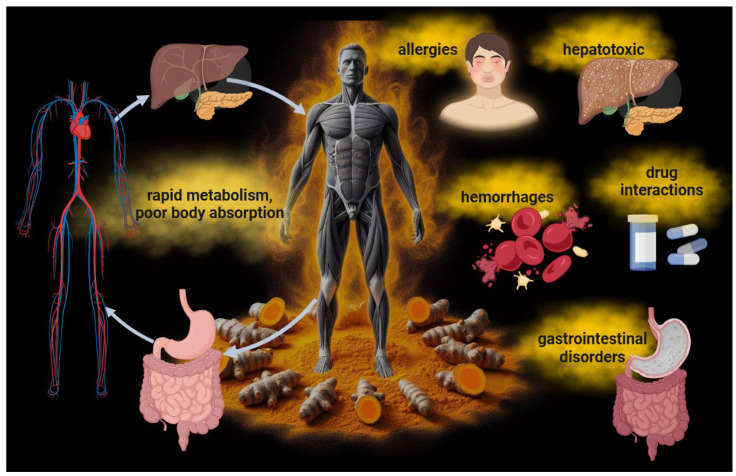
The limitations in the therapeutic application of curcumin in patients. Curcumin’s low bioavailability due to its poor water solubility, rapid hepatic metabolism, and low intestinal absorption results in ineffective absorption by the body. The necessity of using high concentrations of the molecule can lead to side effects such as allergies, gastrointestinal disturbances, hepatotoxicity, and sometimes anticoagulant and antiplatelet effects. Curcumin may also interact with certain medications, including anti-inflammatory, cardiovascular, antibiotic, and antitumor drugs.
Figure 3
Figure 3
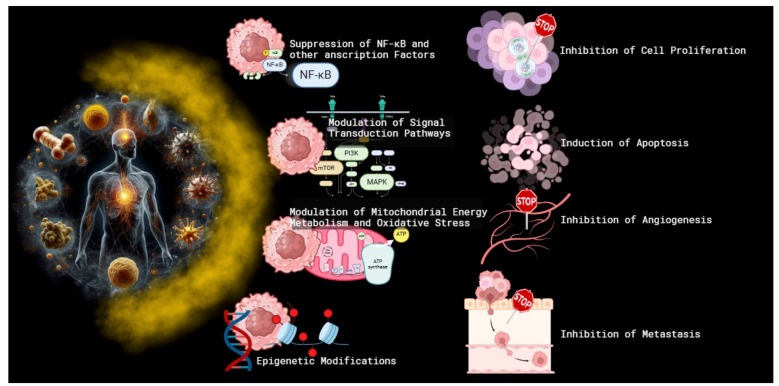
The mechanisms of curcumin’s anticancer effects. Curcumin, a polyphenolic compound derived from turmeric, exerts its anticancer effects through multiple mechanisms. These include the inhibition of cell proliferation and the induction of apoptosis via cell cycle arrest and the modulation of apoptotic proteins. Curcumin suppresses the activity of key transcription factors like NF-κB, STAT3, and AP-1 and interferes with critical signal transduction pathways such as PI3K/Akt/mTOR and MAPK/ERK. Additionally, curcumin inhibits angiogenesis and metastasis by downregulating VEGF, VEGFR2, and matrix metalloproteinases (MMPs). Epigenetic modifications through the inhibition of DNA methyltransferases (DNMTs) and histone deacetylases (HDACs) further contribute to its anticancer properties. Finally, curcumin alters mitochondrial energy metabolism and reduces oxidative stress by inhibiting FoF1-ATP synthase, thereby impacting ATP production and reactive oxygen species (ROS) generation, which are crucial for cancer cell growth and proliferation.
Figure 4
Figure 4
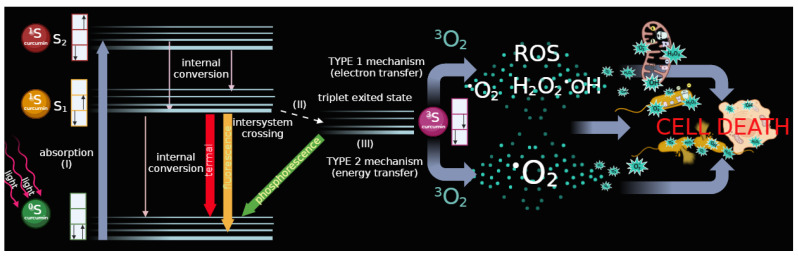
Photodynamic therapy mechanism of action. Upon irradiation, the photosensitizer (e.g., curcumin) transitions from the 0S ground state to the 1S excited singlet state and then, via intersystem crossing, to the 3S triplet. The longer-lived triplet interacts with surrounding molecules, generating cytotoxic species such as reactive oxygen species (ROS). These include singlet oxygen (-O2), a hydroxyl radical (-OH), and hydrogen peroxide (H2O2). PDT is divided into two types based on the tissue’s oxygen concentration: both involve the transition from the basic singlet state (0S) to the excited singlet state (1S). In the Type I mechanism, reactions with the excited sensitizer produce free radicals and reactive oxygen species, which cause oxidative damage. In the Type II mechanism, the excited triplet transfers energy to molecular oxygen, producing singlet oxygen. This interacts with biological substrates, leading to oxidative damage and cell death.
Figure 5
Figure 5
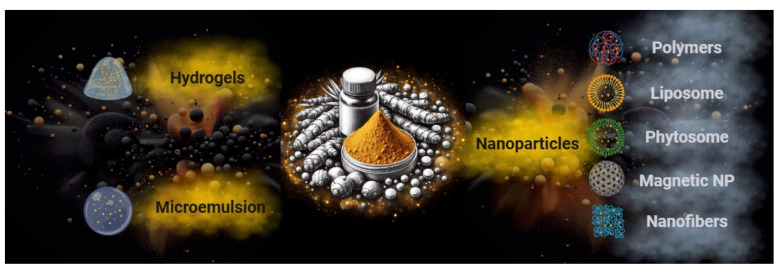
Improving curcumin’s therapeutic effectiveness: applications of nanotechnology for anticancer drug delivery. This illustration highlights various drug delivery systems developed to enhance curcumin’s bioavailability and therapeutic efficacy. These systems include hydrogels, microemulsions, nanoparticles (phytosomes, polymeric nanoparticles, liposomes, and magnetic nanoparticles), and implantable nanofibers. Each system offers unique advantages in terms of stability, targeted delivery, controlled release, and increased bioavailability, addressing the challenges posed by curcumin’s poor water solubility and rapid metabolism.
Figure 6
Figure 6
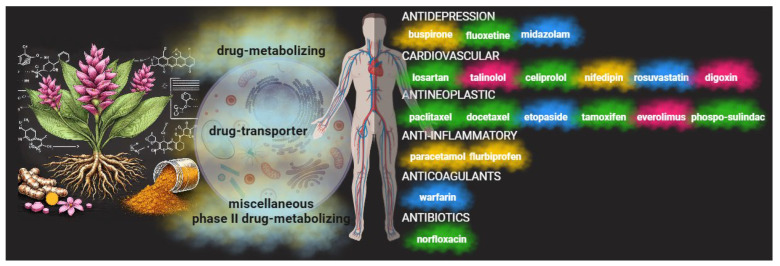
Curcumin and drug interactions. Curcumin has demonstrated an ability to interact with cellular pathways such as cytochrome P450 and other drug transporters. These play a key role in modulating the pharmacokinetics of conventional drugs. Consequently, through synergistic or antagonistic behavior, curcumin can influence a drug’s efficacy. In some cases, there is no discernible effect (yellow clouds); in others, the effects are mixed and concentration-dependent (blue clouds). Lastly, curcumin can support the drug effects (green clouds) or be potentially dangerous (red clouds). Thus, the therapeutic activities of various categories of drugs used in antitumor therapy, in managing tumor-related side effects, or in specific therapies can be altered.

References

    1. Sharifi-Rad J., Rayess Y.E., Rizk A.A., Sadaka C., Zgheib R., Zam W., Sestito S., Rapposelli S., Neffe-Skocińska K., Zielińska D., et al. Turmeric and Its Major Compound Curcumin on Health: Bioactive Effects and Safety Profiles for Food, Pharmaceutical, Biotechnological and Medicinal Applications. Front. Pharmacol. 2020;11:1021. doi: 10.3389/fphar.2020.01021. - DOI - PMC - PubMed
    1. Urošević M., Nikolić L., Gajić I., Nikolić V., Dinić A., Miljković V. Curcumin: Biological Activities and Modern Pharmaceutical Forms. Antibiotics. 2022;11:135. doi: 10.3390/antibiotics11020135. - DOI - PMC - PubMed
    1. Rodrigues J.L., Prather K.L.J., Kluskens L.D., Rodrigues L.R. Heterologous Production of Curcuminoids. Microbiol. Mol. Biol. Rev. 2015;79:39. doi: 10.1128/MMBR.00031-14. - DOI - PMC - PubMed
    1. Ramirez-Ahumada M.d.C., Timmermann B.N., Gang D.R. Biosynthesis of Curcuminoids and Gingerols in Turmeric (Curcuma longa) and Ginger (Zingiber officinale): Identification of Curcuminoid Synthase and Hydroxycinnamoyl-CoA Thioesterases. Phytochemistry. 2006;67:2017–2029. doi: 10.1016/j.phytochem.2006.06.028. - DOI - PubMed
    1. Kriplani P., Guarve K. Physicochemical and Biological Aspects of Curcumin: A Review. Nat. Prod. J. 2020;11:318–343. doi: 10.2174/2210315510999200330170241. - DOI

LinkOut - more resources