


Peripheral Intravenous Therapy in Internal Medicine Department-Antibiotics and Other Drugs' Consumption and Characteristics of Vascular Access Devices in 2-Year Observation Study
- PMID: 39061346
- PMCID: PMC11274068
- DOI: 10.3390/antibiotics13070664
Peripheral Intravenous Therapy in Internal Medicine Department-Antibiotics and Other Drugs' Consumption and Characteristics of Vascular Access Devices in 2-Year Observation Study
Abstract
Background: The aim of the study was to characterize the procedure of peripheral intravenous therapy (IT), including the characteristics of vascular access and related complications and qualitative and quantitative analyses of drug consumption.
Materials and methods: A two-year, retrospective, single-center observational study was conducted. The criterion for including a patient in the study was the use of peripheral intravenous catheters (PIVCs) upon admission or during the stay at the internal medicine department (IMD).
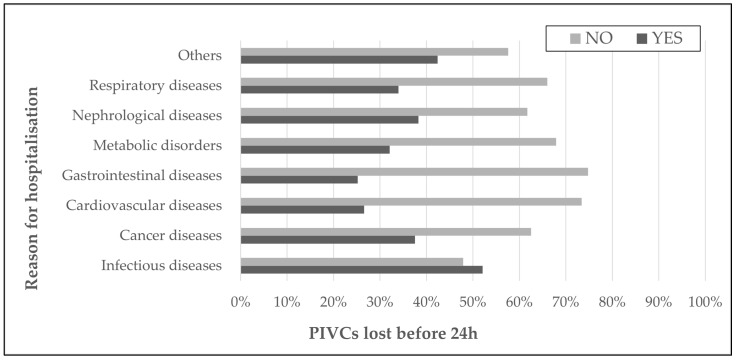
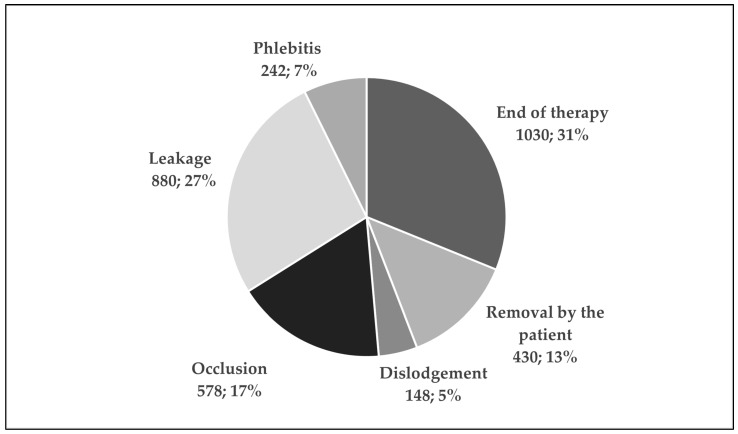
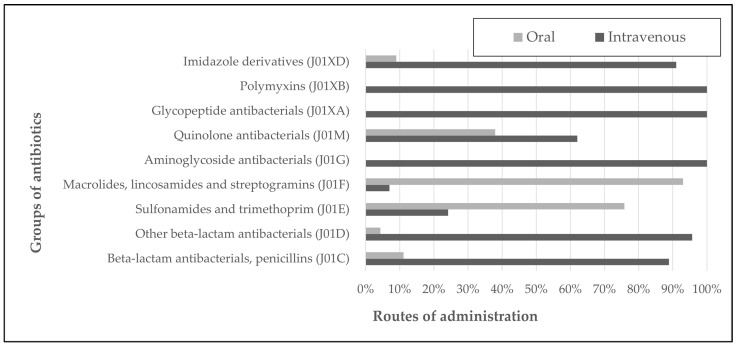
Results: The main reasons for hospitalization were exacerbations of chronic diseases for 78% of the patients and acute infections for 22%. IT was used in 83.6% of all the patients. IT was used primarily for antibiotics (5009.9 defined daily doses (DDD)). Further, 22.6% of the PIVCs stopped functioning within 24 h, more frequently in infectious patients. The main reasons for PIVC removal were leakage (n = 880, 26.6%) and occlusion (n = 578, 17.5%). The PIVC locations were mostly suboptimal (n = 2010, 59.5%), and such locations were related to leakage and occlusion (p = 0.017).
Conclusions: In the IMD, most patients require the use of a PIVC, and antibiotics dominate the group of drugs administered intravenously. Up to 1/5 of peripheral intravenous catheters are lost within the first 24 h after their insertion, with most of them placed suboptimally. A properly functioning PIVC appears to be crucial for antimicrobial treatment.
Keywords: antibiotic treatment; geriatric patients; internal medicine; intravenous therapy; peripheral intravenous catheter; vascular access device.
Conflict of interest statement
The authors declare no conflicts of interest.
Figures
References
-
- Regina M.L., Vecchié A., Bonaventura A., Prisco D. Patient Safety in Internal Medicine. In: Donaldson L., Ricciardi W., Sheridan S., Tartaglia R., editors. Textbook of Patient Safety and Clinical Risk Management. Springer; Cham, Switzerland: 2020. pp. 213–252. - PubMed
-
- Pittiruti M., Van Boxtel T., Scoppettuolo G., Carr P., Konstantinou E., Ortiz Miluy G., Simcock L., Dupont C., Inwood S., Pepe G., et al. European recommendations on the proper indication and use of peripheral venous access devices: A WoCoVA project. J. Vasc. Access. 2023;24:165–182. doi: 10.1177/11297298211023274. - DOI - PubMed
LinkOut - more resources
Full Text Sources
Research Materials
