


Predictive Value and Diagnostic Potential of IL-10, IL-17A, IL1-β, IL-6, CXCL, and MCP for Severe COVID-19 and COVID-19 Mortality
- PMID: 39062105
- PMCID: PMC11274648
- DOI: 10.3390/biomedicines12071532
Predictive Value and Diagnostic Potential of IL-10, IL-17A, IL1-β, IL-6, CXCL, and MCP for Severe COVID-19 and COVID-19 Mortality
Abstract
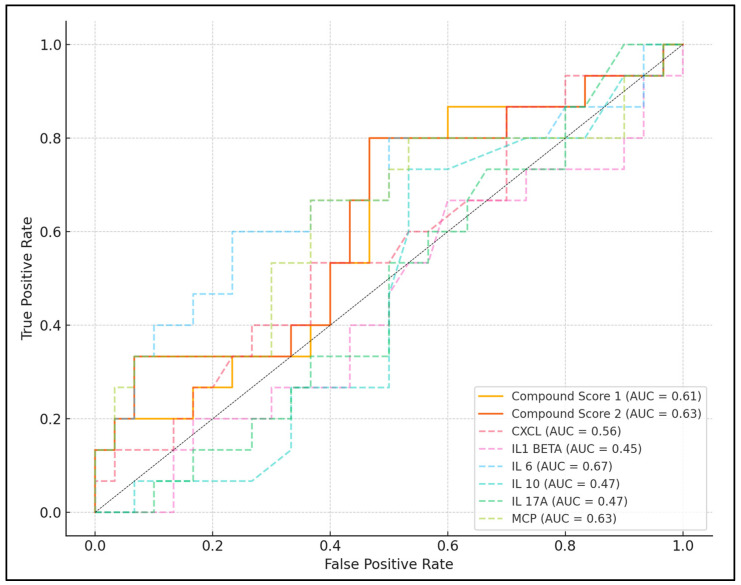
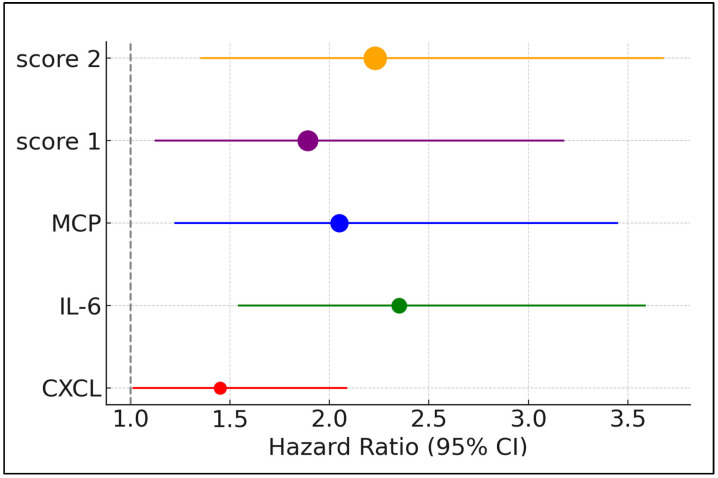
The severe acute respiratory syndrome coronavirus 2 (SARS-CoV-2) necessitates advanced prognostic tools to anticipate disease progression and optimize patient outcomes. This study evaluates the predictive value and diagnostic potential of interleukins interleukin (IL) IL-10, IL-17A, IL1-β, IL-6, chemokine ligand (CXCL), and Monocyte Chemotactic Protein (MCP) for severe coronavirus disease 2019 (COVID-19) and COVID-19 mortality, aiming to correlate cytokine levels with disease severity. Conducted from January 2023 to January 2024, this prospective cohort study involved patients hospitalized with moderate and severe COVID-19 from Romania. This study analyzed statistically significant predictors of severe COVID-19 outcomes. IL-6 and MCP emerged as significant, with hazard ratios (HRs) of 2.35 (95% confidence interval (CI): 1.54-3.59, p = 0.014) and 2.05 (95% CI: 1.22-3.45, p = 0.007), respectively. Compound scores integrating multiple inflammatory markers also demonstrated predictive value; Compound Score 2 had an HR of 2.23 (95% CI: 1.35-3.68, p = 0.002), surpassing most single markers in association with severe disease. Notably, interleukins IL-10 and IL-1β did not show significant associations with disease severity. This study underscores the importance of IL-6 and MCP as robust predictors of severe COVID-19, substantiating their role in clinical assessments to foresee patient deterioration. The utility of compound scores in enhancing predictive accuracy suggests a composite approach may be more effective in clinical settings.
Keywords: COVID-19; SARS-CoV-2; inflammation; respiratory infections.
Conflict of interest statement
The authors declare no conflicts of interest.
Figures
References
-
- Sawicka B., Aslan I., Della Corte V., Periasamy A., Krishnamurthy S.K., Mohammed A., Tolba Said M.M., Saravanan P., Del Gaudio G., Adom D., et al. Coronavirus Drug Discovery: SARS-CoV-2 (COVID-19) Prevention, Diagnosis, and Treatment. Volume 1 in Drug Discovery Update. Elsevier; Amsterdam, The Netherlands: 2022. The coronavirus global pandemic and its impacts on society; pp. 267–311. - DOI
-
- Padilla-Bórquez D.L., Matuz-Flores M.G., Hernández-Bello J., Sánchez-Zuno G.A., García-Arellano S., Oregon-Romero E., Herrera-Godina M.G., González-Estevez G., Adan-Bante N.P., Rosas-Rodríguez J.A., et al. Seroprevalence of IgM/IgG and Neutralizing Antibodies against SARS-CoV-2 in Unvaccinated Young Adults from Mexico Who Reported Not Having Had a Previous COVID-19 Infection. Can. J. Infect. Dis. Med. Microbiol. 2024;2024:8871439. doi: 10.1155/2024/8871439. - DOI - PMC - PubMed
-
- Marks M., O’Hara G., Houlihan C., Bell L., Heightman M., Hart N. Encyclopedia of Respiratory Medicine. 2nd ed. Academic Press; Cambridge, MA, USA: 2022. Severe Acute Respiratory Syndrome Coronavirus 2; pp. 231–242. - DOI
LinkOut - more resources
Full Text Sources
Miscellaneous
