Review
. 2024 Jul 12;25(14):7666.
doi: 10.3390/ijms25147666.

Understanding Autoimmunity: Mechanisms, Predisposing Factors, and Cytokine Therapies

Affiliations
Review

Understanding Autoimmunity: Mechanisms, Predisposing Factors, and Cytokine Therapies

Farzana Yasmeen et al. Int J Mol Sci. .

Abstract

Autoimmunity refers to an organism's immune response against its own healthy cells, tissues, or components, potentially leading to irreversible damage to vital organs. Central and peripheral tolerance mechanisms play crucial roles in preventing autoimmunity by eliminating self-reactive T and B cells. The disruption of immunological tolerance, characterized by the failure of these mechanisms, results in the aberrant activation of autoreactive lymphocytes that target self-tissues, culminating in the pathogenesis of autoimmune disorders. Genetic predispositions, environmental exposures, and immunoregulatory disturbances synergistically contribute to the susceptibility and initiation of autoimmune pathologies. Within the realm of immune therapies for autoimmune diseases, cytokine therapies have emerged as a specialized strategy, targeting cytokine-mediated regulatory pathways to rectify immunological imbalances. Proinflammatory cytokines are key players in inducing and propagating autoimmune inflammation, highlighting the potential of cytokine therapies in managing autoimmune conditions. This review discusses the etiology of autoimmune diseases, current therapeutic approaches, and prospects for future drug design.

Keywords: IL-1; TNF; autoimmunity; immune tolerance; targeted immune therapies.


Conflict of interest statement

The authors declare no conflicts of interest.

Figures
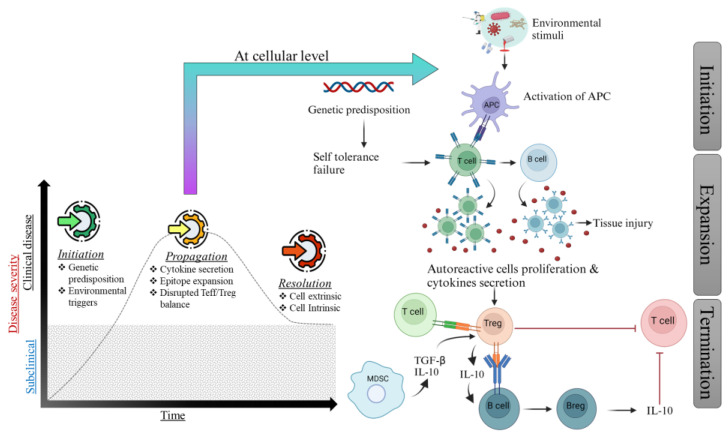
Figure 1
Figure 1
Autoimmune diseases progress through three major phases. In the initiation phase, a combination of environmental triggers and genetic predispositions leads to the breakdown of immune tolerance. This breakdown triggers the activation of autoreactive immune cells. During the amplification phase, these autoreactive cells escalate the immune response by releasing cytokine and attracting additional immune cells to the inflammation site. This phase can become self-perpetuating, often resulting in chronic inflammation. The resolution phase is characterized by the subsiding of autoimmune reactions. This occurs through the activation of cell-intrinsic inhibitory pathways and cell-extrinsic mechanisms, which collectively work to limit the effector response and restore the balance between T effector cells (Teffs) and T regulatory cells (Tregs). However, patients in this phase frequently experience disease relapses and remissions. These relapses, marked by a continuous struggle between pathogenic effector responses and regulatory mechanisms, can cause tissue damage, leading to the clinical manifestations of autoimmune diseases. It is important to note that the severity and duration of these phases can vary significantly, depending on the specific autoimmune disease and individual patient factors.
Figure 2
Figure 2
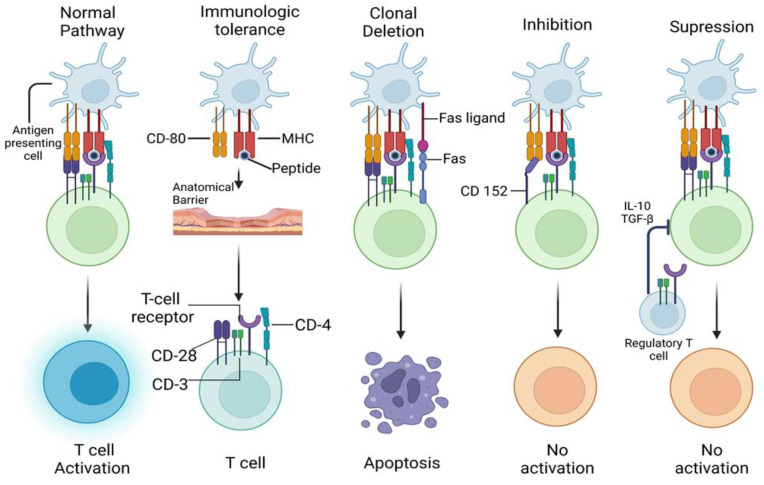
Peripheral mechanisms of T-cell tolerance induction. This figure illustrates various methods by which T-cell tolerance is induced peripherally. It includes immunologic ignorance, where T- cells physically separated from their specific antigen (e.g., by the blood–brain barrier) cannot become activated. T-cells expressing the Fas (CD95) molecule undergo apoptosis upon interaction with cells expressing Fas ligand, a process known as deletion. Inhibition of T-cell activation is exemplified by the binding of CD152 to CD80 on antigen-presenting cells. Additionally, regulatory T-cells suppress other T-cells, likely through the production of inhibitory cytokines such as interleukin-10 and transforming growth factor β (TGF-β).
Figure 3
Figure 3
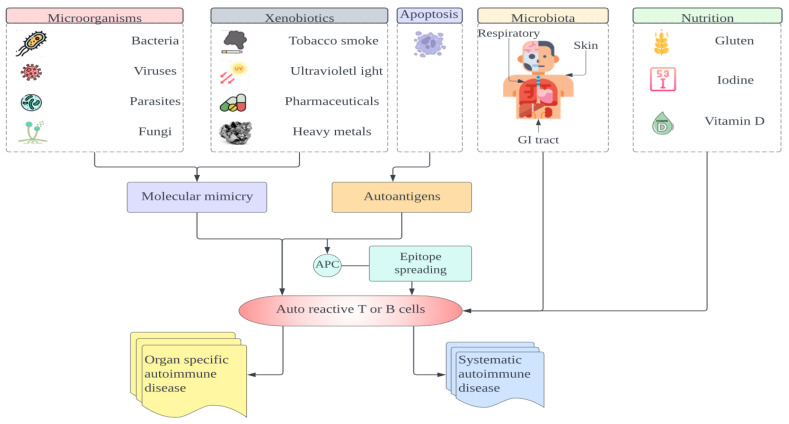
Environmental factors and their role in autoimmunity.

References

    1. Warrington R., Watson W., Kim H.L., Antonetti F.R. An introduction to immunology and immunopathology. Allergy Asthma Clin. Immunol. 2011;7:S1. doi: 10.1186/1710-1492-7-S1-S1. - DOI - PMC - PubMed
    1. Burnet F. A Reassessment of the Forbidden Clone Hypothesis of Autoimmune Disease. Immunol. Cell Biol. 1972;50:1–9. doi: 10.1038/icb.1972.1. - DOI - PubMed
    1. Tauber A.I., Podolsky S.H. Frank Macfarlane Burnet and the immune self. J. Hist. Biol. 1994;27:531–573. doi: 10.1007/BF01058996. - DOI - PubMed
    1. Pisetsky D.S. Pathogenesis of autoimmune disease. Nat. Rev. Nephrol. 2023;19:509–524. doi: 10.1038/s41581-023-00720-1. - DOI - PMC - PubMed
    1. Barrett J.C., Hansoul S., Nicolae D.L., Cho J.H., Duerr R.H., Rioux J.D., Brant S.R., Silverberg M.S., Taylor K.D., Barmada M.M., et al. Genome-wide association defines more than 30 distinct susceptibility loci for Crohn’s disease. Nat. Genet. 2008;40:955–962. doi: 10.1038/ng.175. - DOI - PMC - PubMed

LinkOut - more resources