Review
. 2024 Jul 13;17(14):3472.
doi: 10.3390/ma17143472.

Hydrogels for Neural Regeneration: Exploring New Horizons

Affiliations
Review

Hydrogels for Neural Regeneration: Exploring New Horizons

Hossein Omidian et al. Materials (Basel). .

Abstract

Nerve injury can significantly impair motor, sensory, and autonomic functions. Understanding nerve degeneration, particularly Wallerian degeneration, and the mechanisms of nerve regeneration is crucial for developing effective treatments. This manuscript reviews the use of advanced hydrogels that have been researched to enhance nerve regeneration. Hydrogels, due to their biocompatibility, tunable properties, and ability to create a supportive microenvironment, are being explored for their effectiveness in nerve repair. Various types of hydrogels, such as chitosan-, alginate-, collagen-, hyaluronic acid-, and peptide-based hydrogels, are discussed for their roles in promoting axonal growth, functional recovery, and myelination. Advanced formulations incorporating growth factors, bioactive molecules, and stem cells show significant promise in overcoming the limitations of traditional therapies. Despite these advancements, challenges in achieving robust and reliable nerve regeneration remain, necessitating ongoing research to optimize hydrogel-based interventions for neural regeneration.

Keywords: biocompatibility; clinical translation; hydrogels; neural regeneration; neural scaffolding.


Conflict of interest statement

Authors partly used the OpenAI Large-Scale Language Model to maximize accuracy, clarity, and organization.

Figures
Scheme 1
Scheme 1
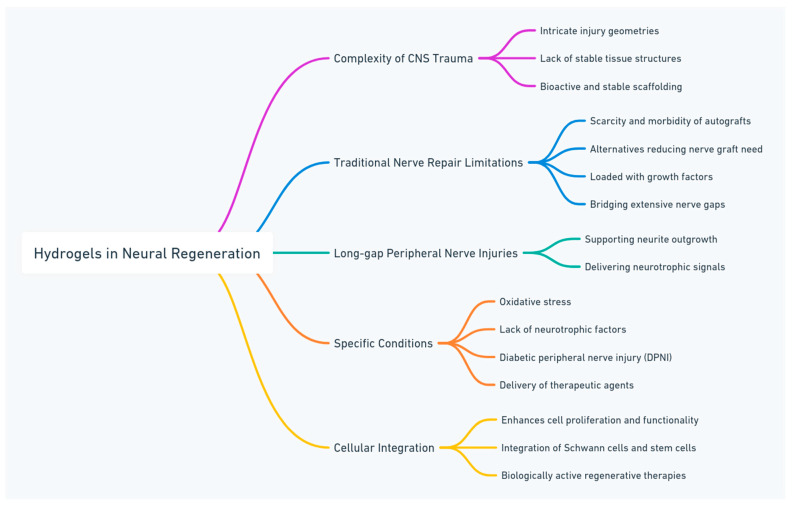
Potential uses and challenges of hydrogel interventions in neural regeneration.
Figure 1
Figure 1
Gross views of regenerated sciatic nerves 10 weeks postoperatively. Regenerated sciatic nerves in rats with defects that were bridged by chitosan conduits filled with simvastatin/Pluronic F-127 hydrogel were much thicker than regenerated nerves in groups treated with hollow conduits or Pluronic F-127 hydrogel without simvastatin [9].
Figure 2
Figure 2
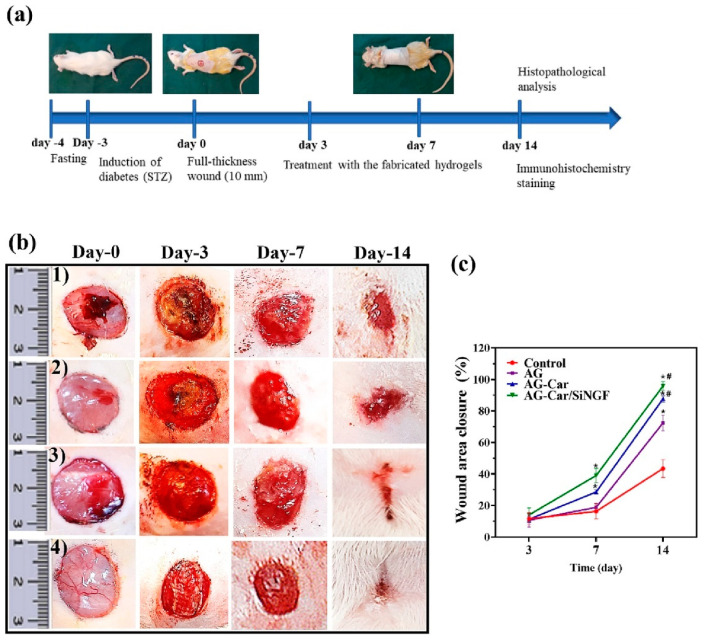
The evaluation of the wound-healing effects of hydrogels in STZ-induced diabetic rats. (a) A schematic illustration of the experiments. (b) The morphology of wounds treated with the hydrogels at different time points (0, 3, 7, and 14 days) during DFU healing. Untreated (control) group (1), AG hydrogel group (2), AG-Car hydrogel group (3), and AG-Car/SiNGF hydrogel group (4). (c) A graphical representation of the wound closure area measured using Image J software (V 1.8.0) (* p < 0.05, compared with control group; # p < 0.05, compared with control and AG hydrogel groups) [24].
Figure 3
Figure 3
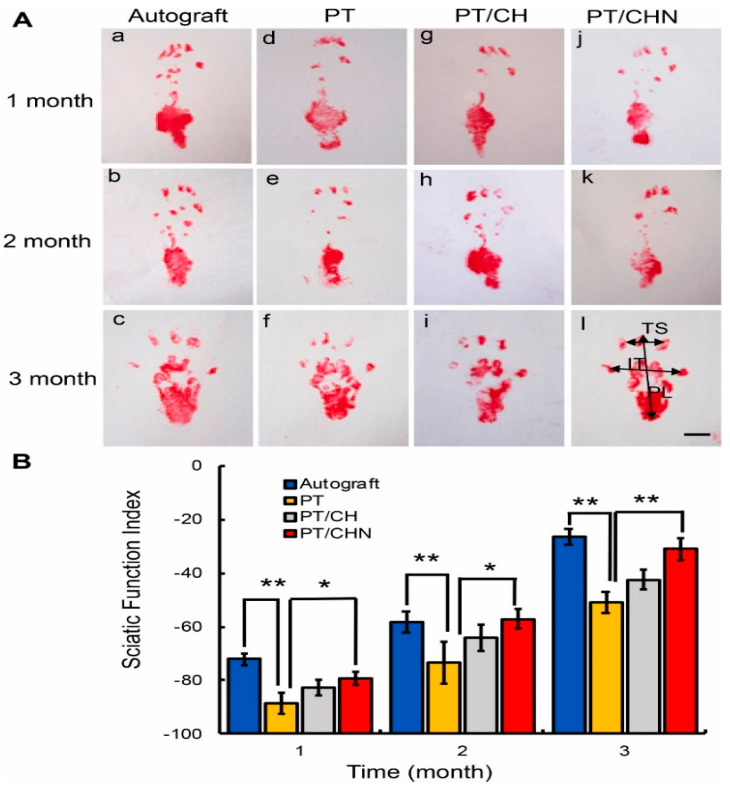
Walking track analyses in vivo. (A): Footprint collected on the walking track at different time points (1, 2, and 3 months after implantation): first column: autograft group; second column: PT group; third column: PT/CH group; fourth column: PT/CHN group. Scale bar, 5 mm. (B): SFIs calculated at different time points (1, 2, 3 months after implantation) * p < 0.05, ** p < 0.01 [26].
Figure 4
Figure 4
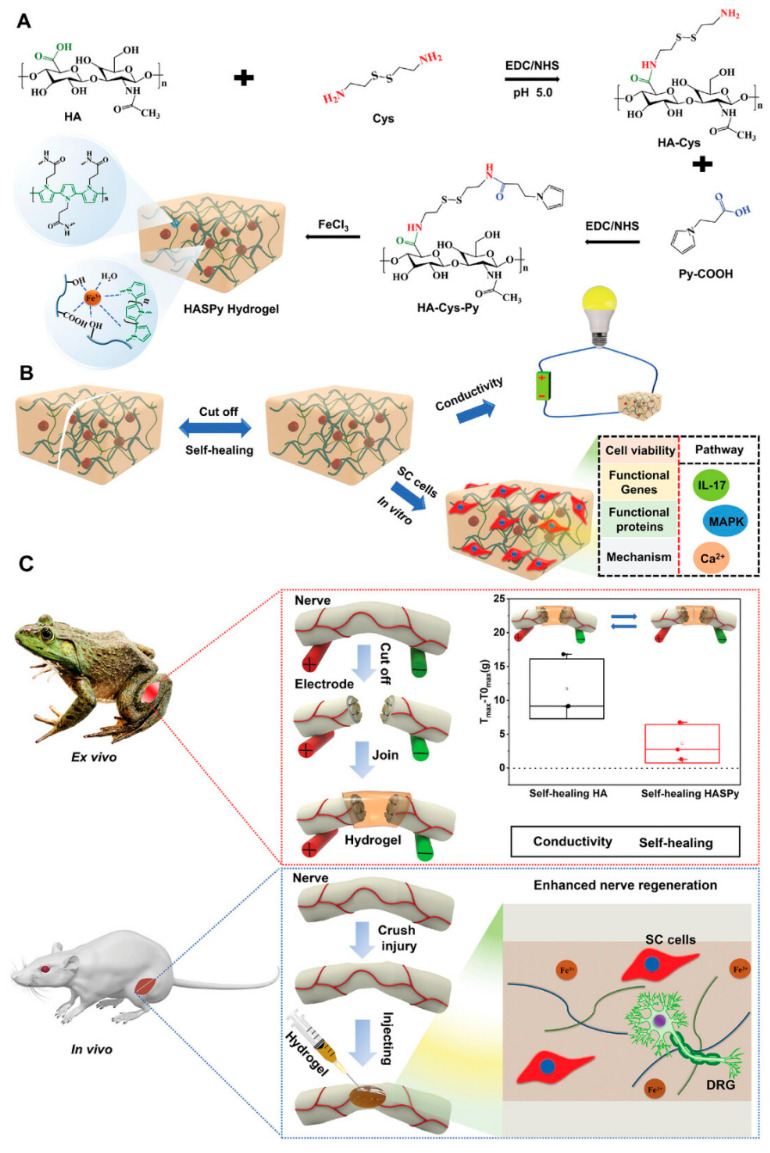
(A) A schematic diagram of the preparation of an injectable self-healing conductive hydrogel. (B) A schematic of the self-healing and electrical conductivity of the hydrogel and its regulation of the expression of Schwann functional genes and proteins. (C) A schematic representation of the bullfrog sciatic nerve placed in the hydrogel ex vivo and the rat peripheral nerve regenerated in vivo by injection [35].

References

    1. Navarro X., Vivo M., Valero-Cabre A. Neural plasticity after peripheral nerve injury and regeneration. Prog. Neurobiol. 2007;82:163–201. doi: 10.1016/j.pneurobio.2007.06.005. - DOI - PubMed
    1. Stoll G., Muller H.W. Nerve injury, axonal degeneration and neural regeneration: Basic insights. Brain Pathol. 1999;9:313–325. doi: 10.1111/j.1750-3639.1999.tb00229.x. - DOI - PMC - PubMed
    1. Gazdar A.F., Dammin G.J. Neural degeneration and regeneration in human renal transplants. N. Engl. J. Med. 1970;283:222–224. doi: 10.1056/NEJM197007302830502. - DOI - PubMed
    1. Gulati A.K. Peripheral nerve regeneration through short- and long-term degenerated nerve transplants. Brain Res. 1996;742:265–270. doi: 10.1016/S0006-8993(96)01012-8. - DOI - PubMed
    1. Yasuda H., Terada M., Maeda K., Kogawa S., Sanada M., Haneda M., Kashiwagi A., Kikkawa R. Diabetic neuropathy and nerve regeneration. Prog. Neurobiol. 2003;69:229–285. doi: 10.1016/S0301-0082(03)00034-0. - DOI - PubMed

LinkOut - more resources