


Immunoneuroendocrine, Stress, Metabolic, and Behavioural Responses in High-Fat Diet-Induced Obesity
- PMID: 39064652
- PMCID: PMC11279988
- DOI: 10.3390/nu16142209
Immunoneuroendocrine, Stress, Metabolic, and Behavioural Responses in High-Fat Diet-Induced Obesity
Abstract
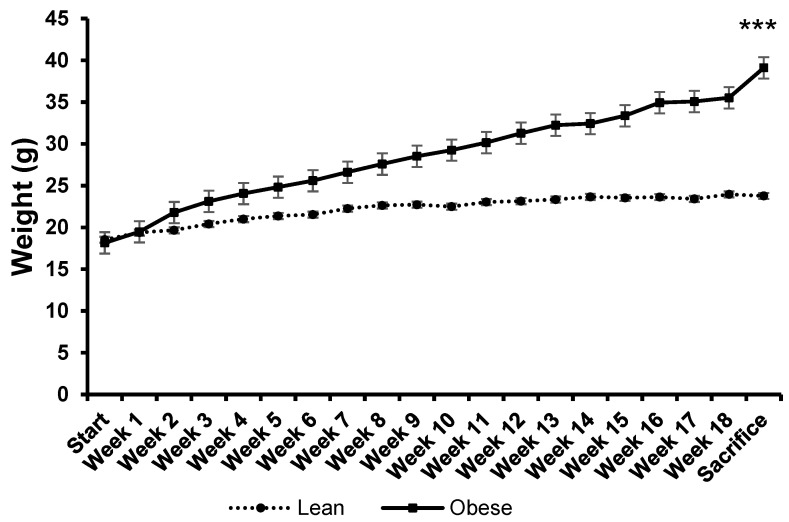
Obesity has reached global epidemic proportions, and even though its effects are well-documented, studying the interactions among all influencing factors is crucial for a better understanding of its physiopathology. In a high-fat-diet-induced obesity animal model using C57BL/6J mice, behavioural responses were assessed through a battery of tests, while stress biomarkers and systemic inflammatory cytokines were measured using an Enzyme-Linked ImmunoSorbent Assay and a Bio-Plex Multiplex System. The peritoneal macrophage microbicide capacity was analysed via flow cytometry, and crown-like structures (CLSs) in white adipose tissue (WAT) were evaluated through staining techniques. Results indicated that obese mice exhibited increased body weight, hyperglycaemia, and hyperlipidaemia after 18 weeks on a high-fat diet, as well as worse physical conditions, poorer coordination and balance, and anxiety-like behaviour. Differences in corticosterone and noradrenaline concentrations were also found in obese animals, revealing a stress response and noradrenergic dysregulation, along with a weakened innate immune response characterized by a lower microbicide capacity, and the presence of an underlying inflammation evidenced by more CLSs in WAT. Altogether, these findings indicate that obesity deteriorates the entire stress, inflammatory, metabolic, sensorimotor and anxiety-like behavioural axis. This demonstrates that jointly evaluating all these aspects allows for a deeper and better exploration of this disease and its associated comorbidities, emphasizing the need for individualized and context-specific strategies for its management.
Keywords: anxiety; inflammation; macrophages; management; obesity; prevention; stress.
Conflict of interest statement
The authors declare no conflicts of interest. The funders had no role in the design of the study; in the collection, analyses, or interpretation of data; in the writing of the manuscript; or in the decision to publish the results.
Figures


References
-
- Veniaminova E., Cespuglio R., Markova N., Mortimer N., Cheung C.W., Steinbusch H.W., Lesch K.-P., Strekalova T. Behavioral Features of Mice Fed with a Cholesterol-Enriched Diet: Deficient Novelty Exploration and Unaltered Aggressive Behavior. Transl. Neurosci. Clin. 2016;2:87–95. doi: 10.18679/CN11-6030_R.2016.014. - DOI
MeSH terms
Substances
Grants and funding
LinkOut - more resources
Full Text Sources
Medical
