Review
. 2024 Jul 20;16(14):2352.
doi: 10.3390/nu16142352.

Contemporary Perspectives on the Role of Vitamin D in Enhancing Gut Health and Its Implications for Preventing and Managing Intestinal Diseases

Affiliations
Review

Contemporary Perspectives on the Role of Vitamin D in Enhancing Gut Health and Its Implications for Preventing and Managing Intestinal Diseases

Jiaxin Wang et al. Nutrients. .

Abstract

Vitamin D, a crucial fat-soluble vitamin, is primarily synthesized in the skin upon exposure to ultraviolet radiation and is widely recognized as a bone-associated hormone. However, recent scientific advancements have unveiled its intricate association with gut health. The intestinal barrier serves as a vital component, safeguarding the intestinal milieu and maintaining overall homeostasis. Deficiencies in vitamin D have been implicated in altering the gut microbiome composition, compromising the integrity of the intestinal mucosal barrier, and predisposing individuals to various intestinal pathologies. Vitamin D exerts its regulatory function by binding to vitamin D receptors (VDR) present in immune cells, thereby modulating the production of pro-inflammatory cytokines and influencing the intestinal barrier function. Notably, numerous studies have reported lower serum vitamin D levels among patients suffering from intestinal diseases, including inflammatory bowel disease, irritable bowel syndrome, and celiac disease, highlighting the growing significance of vitamin D in gut health maintenance. This comprehensive review delves into the latest advancements in understanding the mechanistic role of vitamin D in modulating the gut microbiome and intestinal barrier function, emphasizing its pivotal role in immune regulation. Furthermore, we consolidate and present relevant findings pertaining to the therapeutic potential of vitamin D in the management of intestinal diseases.

Keywords: IBD; IBS; gut microbiome; intestinal barrier; vitamin D.


Conflict of interest statement

The authors declare no conflicts of interest.

Figures
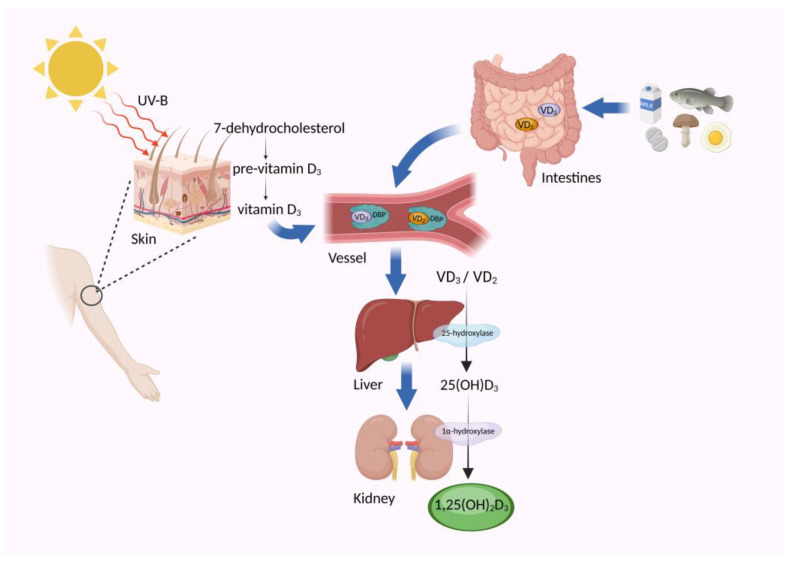
Figure 1
Figure 1
The synthesis, sources, and metabolism of vitamin D. Under the influence of UV-B radiation, the 7-dehydrocholesterol in the skin undergoes conversion into pre-vitamin D, subsequently transforming into vitamin D3 through body temperature-mediated processes. Alternatively, dietary supplements can also serve as sources of vitamin D. Notably, vitamin D2 is sourced from plants, whereas vitamin D3 originates from animals. Upon entering the bloodstream, vitamin D2/D3 binds to the vitamin D binding protein (DBP), facilitating its transportation to the liver and kidneys. Within these organs, it undergoes successive transformations, ultimately culminating in the formation of biologically active 1,25-dihydroxyvitamin D3 (1,25(OH)D3). This active form is then circulated throughout the body via the bloodstream, delivering its vital functions to various organs and tissues. Created with Biorender.com (accessed on 18 July 2024).
Figure 2
Figure 2
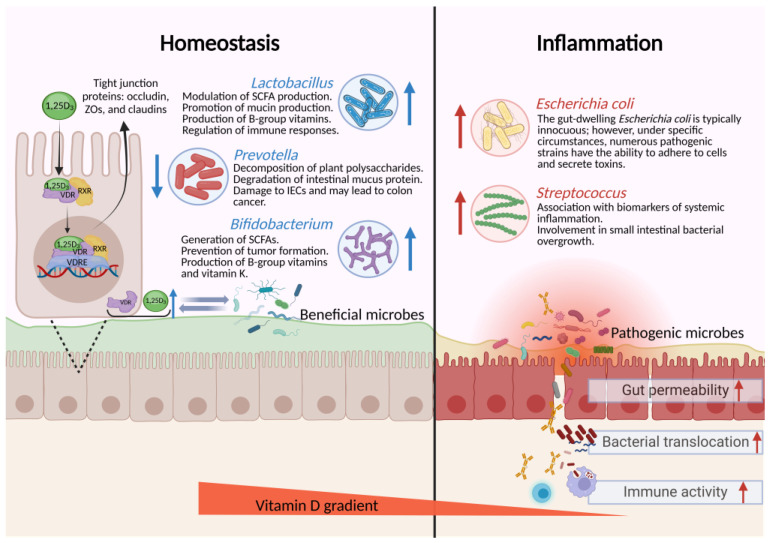
Unlocking the nexus: vitamin D, gut microbes, and epithelial cell dynamics. The vitamin D receptors (VDR) are highly abundant in intestinal epithelial cells [58]. Following the entry of vitamin D into intestinal epithelial cells, VDR can form a heterodimer with RXR. This complex translocates to the nucleus and binds to the vitamin D response element (VDRE) in the promoter region of the target genes, thereby regulating VDR expression. Interactions between vitamin D/VDR and intestinal microbes are observed. On one hand, they enhance tight junction protein expression, maintain intestinal epithelial tissue integrity, reduce bacterial translocation, promote colonization by beneficial bacteria, and alleviate mucosal damage and abnormal immune activation [59,60,61]. On the other hand, the gut microbiota can produce lithocholic acid (LCA), which facilitates vitamin D absorption. Created with Biorender.com (accessed on 18 July 2024).
Figure 3
Figure 3
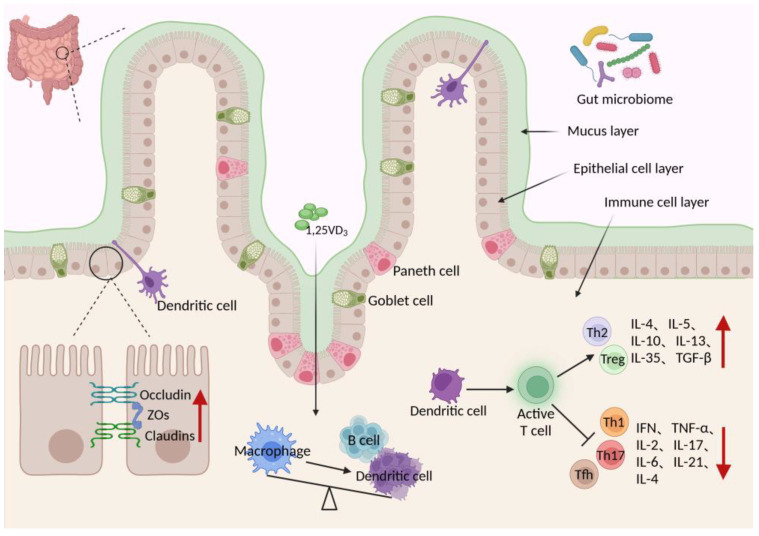
Modulation of intestinal barrier and mucosal immunity by vitamin D. Upon entering the intestine, vitamin D plays a crucial role in modulating immune responses by facilitating the differentiation of mononuclear macrophages into B cells and dendritic cells. This process significantly enhances the recognition and presentation of antigens. Furthermore, vitamin D promotes the transformation of dendritic cells into T cells, steering their differentiation towards Th2 and Treg phenotypes. This shift is accompanied by an increase in the secretion of anti-inflammatory cytokines such as IL-10 and TGF-β, while inhibiting the differentiation into pro-inflammatory Th1, Th17, and Tfh cells. Notably, vitamin D also downregulates the secretion of pro-inflammatory cytokines, including IFN, TNF-α, IL-17, and IL-6, further attenuating inflammatory responses. Additionally, it upregulates the expression of tight junction proteins such as occludin, zonula occludens (ZOs), and claudins, thereby reinforcing intestinal barrier integrity. Created with Biorender.com (accessed on 18 July 2024).
Figure 4
Figure 4
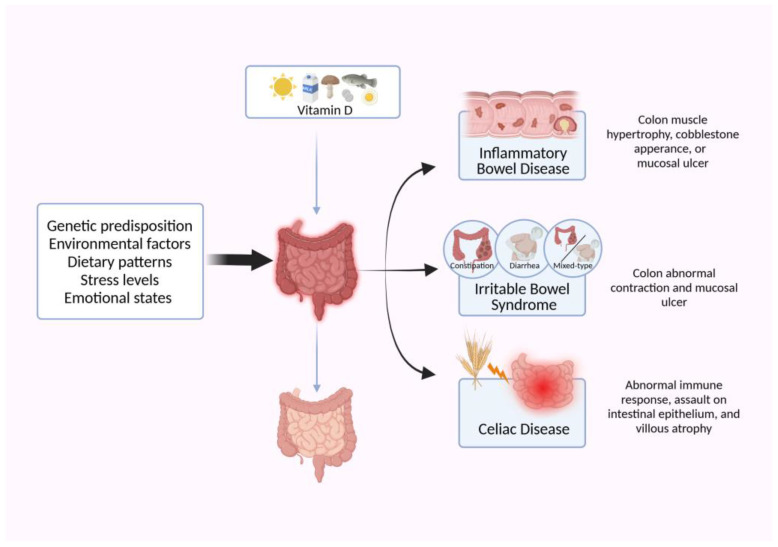
Factors affecting gut health and the role of vitamin D in gut diseases. Various factors including genetic predisposition, environmental influences, dietary patterns, stress levels, and emotional states contribute to the development of gut-related diseases. In this context, vitamin D supplementation has emerged as a promising intervention for alleviating conditions such as inflammatory bowel disease (IBD), irritable bowel syndrome (IBS), and celiac disease (CeD). IBD primarily manifests through colonic muscle hypertrophy, epithelial tissue fissures, pebble-like alterations (ulcerative colitis, UC), and mucosal injury (Crohn’s disease, CD). IBS patients often experience abnormal spasms in the large intestine and mucosal damage, leading to symptoms of constipation (IBS-C), diarrhea (IBS-D), or a combination of both (IBS-M). CeD, primarily affecting susceptible individuals consuming gluten, involves abnormal activation of intestinal mucosal immunity, consequently compromising the integrity of the intestinal barrier. Created with Biorender.com (accessed on 18 July 2024).

References

    1. Wacker M., Holick M.F. Sunlight and Vitamin D: A global perspective for health. Dermato-Endocrinology. 2013;5:51–108. doi: 10.4161/derm.24494. - DOI - PMC - PubMed
    1. Fleet J.C. Vitamin D and Gut Health. Adv. Exp. Med. Biol. 2022;1390:155–167. doi: 10.1007/978-3-031-11836-4_9. - DOI - PMC - PubMed
    1. Thursby E., Juge N. Introduction to the human gut microbiota. Biochem. J. 2017;474:1823–1836. doi: 10.1042/BCJ20160510. - DOI - PMC - PubMed
    1. Qiu P., Ishimoto T., Fu L., Zhang J., Zhang Z., Liu Y. The Gut Microbiota in Inflammatory Bowel Disease. Front. Cell. Infect. Microbiol. 2022;12:733992. doi: 10.3389/fcimb.2022.733992. - DOI - PMC - PubMed
    1. Chen Y., Feng S., Li Y., Zhang C., Chao G., Zhang S. Gut microbiota and intestinal immunity—A crosstalk in irritable bowel syndrome. Immunology. 2024;172:1–20. doi: 10.1111/imm.13749. - DOI - PubMed

MeSH terms

LinkOut - more resources