


A Framework for Selecting and Assessing Wearable Sensors Deployed in Safety Critical Scenarios
- PMID: 39065986
- PMCID: PMC11280513
- DOI: 10.3390/s24144589
A Framework for Selecting and Assessing Wearable Sensors Deployed in Safety Critical Scenarios
Abstract
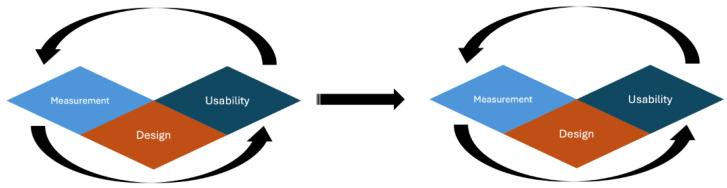
Wearable sensors for psychophysiological monitoring are becoming increasingly mainstream in safety critical contexts. They offer a novel solution to capturing sub-optimal states and can help identify when workers in safety critical environments are suffering from states such as fatigue and stress. However, sensors can differ widely in their application, design, usability, and measurement and there is a lack of guidance on what should be prioritized or considered when selecting a sensor. The paper aims to highlight which concepts are important when creating or selecting a device regarding the optimization of both measurement and usability. Additionally, the paper discusses how design choices can enhance both the usability and measurement capabilities of wearable sensors. The hopes are that this paper will provide researchers and practitioners in human factors and related fields with a framework to help guide them in building and selecting wearable sensors that are well suited for deployment in safety critical contexts.
Keywords: design; psychophysiology; safety critical; usability; wearable sensors.
Conflict of interest statement
The authors declare no conflicts of interest.
Figures


References
-
- Palmer B., Gershbein D. Wearables for Good: Use Case Handbook. UNICEF; New York City, NY, USA: 2017.
-
- Wu Y., Miwa T., Uchida M. Using physiological signals to measure operator’s mental workload in shipping—An engine room simulator study. J. Mar. Eng. Technol. 2017;16:61–69. doi: 10.1080/20464177.2016.1275496. - DOI
-
- Fujita K., Kinoshita F., Touyama H. Detection of cognitive decline due to mental fatigue using electroencephalogram; Proceedings of the 2018 IEEE International Conference on Systems, Man, and Cybernetics (SMC); Miyazaki, Japan. 7–10 October 2018; pp. 562–567.
-
- Jebelli H., Choi B., Lee S. Application of wearable biosensors to construction sites. I: Assessing workers’ stress. J. Constr. Eng. Manag. 2019;145:04019079. doi: 10.1061/(ASCE)CO.1943-7862.0001729. - DOI
-
- Tsai C.Y., Cheong H.I., Houghton R., Majumdar A., Liu W.T., Lee K.Y., Wu C.J., Liu Y.S. Dangerous Driving Prediction Model based on Long Short-term Memory Network with Dynamic Weighted Moving Average of Heart-Rate Variability; Proceedings of the 2020 IEEE 7th International Conference on Engineering Technologies and Applied Sciences (ICETAS); Kuala Lumpur, Malaysia. 18–20 December 2020; pp. 1–7.
Publication types
MeSH terms
LinkOut - more resources
Full Text Sources
