


Acquired Hemophilia A after SARS-CoV-2 Immunization: A Narrative Review of a Rare Side Effect
- PMID: 39066347
- PMCID: PMC11281676
- DOI: 10.3390/vaccines12070709
Acquired Hemophilia A after SARS-CoV-2 Immunization: A Narrative Review of a Rare Side Effect
Abstract
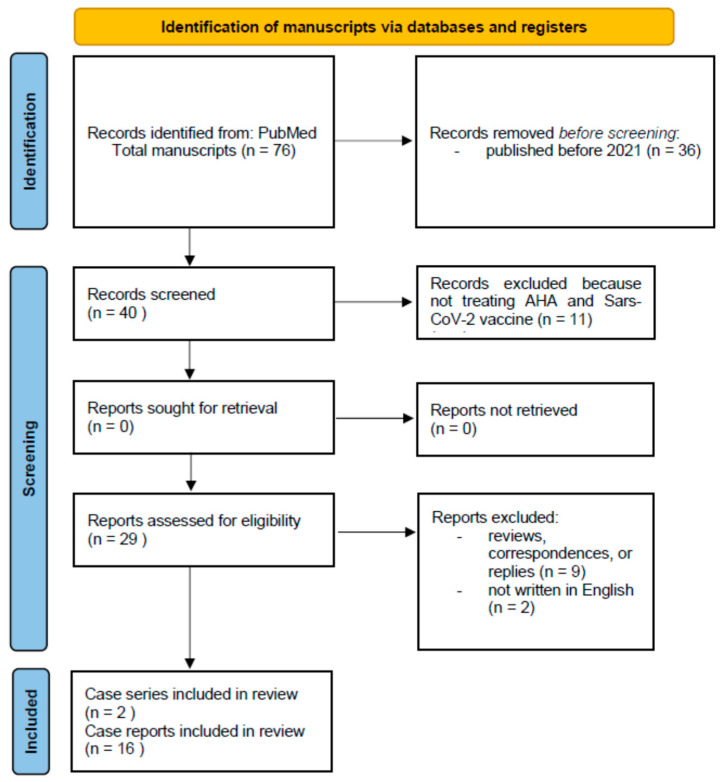
Acquired hemophilia A (AHA) is a rare bleeding disorder (1.4 per million inhabitants per year) caused by neutralizing antibodies against factor VIII. Although uncommon, these autoantibodies can cause a high rate of morbidity and mortality. Several conditions are linked with AHA; based on an EACH2 study, 3.8% of AHA could be connected to infection. In the last four years, most humans have contracted the SARS-CoV-2 infection or have been vaccinated against it. Whether or not COVID-19 immunization might induce AHA remains controversial. This review aims to evaluate the evidence about this possible association. Overall, 18 manuscripts (2 case series and 16 case reports) were included. The anti-SARS-CoV-2 vaccination, as also happens with other vaccines, may stimulate an autoimmune response. However, older individuals with various comorbidities are both at risk of developing AHA and of COVID-19-related morbidity and mortality. Therefore, the COVID-19 vaccine must always be administered because the benefits still outweigh the risks. Yet, we should consider the rare possibility that the activation of an immunological response through vaccination may result in AHA. Detailed registries and prospective studies would be necessary to analyze this post-vaccine acquired bleeding disorder, looking for possible markers and underlying risk factors for developing the disease in association with vaccination.
Keywords: BNT162b2; COVID-19; CoronaVac; SARS-CoV-2; Vaxzevria; acquired hemophilia A; inactivated vaccine; mRNA vaccines; mRNA-1273; vaccine; viral vector vaccine.
Conflict of interest statement
The authors declare no conflicts of interest.
References
-
- Guerrero Camacho R., Álvarez Román M.T., Butta Coll N., Zagrean D., Rivas Pollmar I., Martín Salces M., Gasior Kabat M., Jiménez-Yuste V. Acquired Haemophilia A: A 15-Year Single-Centre Experience of Demography, Clinical Features and Outcome. J. Clin. Med. 2022;11:2721. doi: 10.3390/jcm11102721. - DOI - PMC - PubMed
Publication types
Grants and funding
LinkOut - more resources
Full Text Sources
Miscellaneous
