


High-order brain interactions in ketamine during rest and task: a double-blinded cross-over design using portable EEG on male participants
- PMID: 39068157
- PMCID: PMC11283531
- DOI: 10.1038/s41398-024-03029-0
High-order brain interactions in ketamine during rest and task: a double-blinded cross-over design using portable EEG on male participants
Abstract
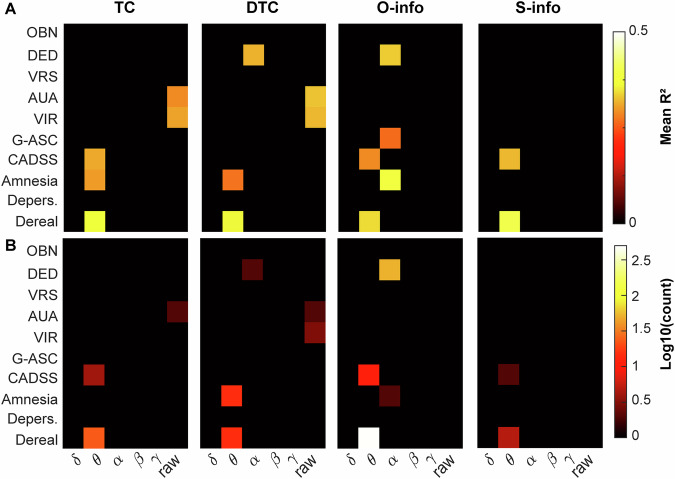
Ketamine is a dissociative anesthetic that induces a shift in global consciousness states and related brain dynamics. Portable low-density EEG systems could be used to monitor these effects. However, previous evidence is almost null and lacks adequate methods to address global dynamics with a small number of electrodes. This study delves into brain high-order interactions (HOI) to explore the effects of ketamine using portable EEG. In a double-blinded cross-over design, 30 male adults (mean age = 25.57, SD = 3.74) were administered racemic ketamine and compared against saline infusion as a control. Both task-driven (auditory oddball paradigm) and resting-state EEG were recorded. HOI were computed using advanced multivariate information theory tools, allowing us to quantify nonlinear statistical dependencies between all possible electrode combinations. Ketamine induced an increase in redundancy in brain dynamics (copies of the same information that can be retrieved from 3 or more electrodes), most significantly in the alpha frequency band. Redundancy was more evident during resting state, associated with a shift in conscious states towards more dissociative tendencies. Furthermore, in the task-driven context (auditory oddball), the impact of ketamine on redundancy was more significant for predictable (standard stimuli) compared to deviant ones. Finally, associations were observed between ketamine's HOI and experiences of derealization. Ketamine appears to increase redundancy and HOI across psychometric measures, suggesting these effects are correlated with alterations in consciousness towards dissociation. In comparisons with event-related potential (ERP) or standard functional connectivity metrics, HOI represent an innovative method to combine all signal spatial interactions obtained from low-density dry EEG in drug interventions, as it is the only approach that exploits all possible combinations between electrodes. This research emphasizes the potential of complexity measures coupled with portable EEG devices in monitoring shifts in consciousness, especially when paired with low-density configurations, paving the way for better understanding and monitoring of pharmacological-induced changes.
© 2024. The Author(s).
Conflict of interest statement
FB, MI, HN, BM and LR-D are employees and shareholders of Cumulus Neuroscience Ltd. MW is a member of the following advisory boards and has given presentations to the following companies: Bayer AG, Germany; Boehringer Ingelheim, Germany; and Biologische Heilmittel Heel GmbH, Germany. MW has further conducted studies with institutional research support from HEEL and Janssen Pharmaceutical Research for a clinical trial (IIT) on ketamine in patients with MDD, unrelated to this investigation. MW did not receive any financial compensation from the companies mentioned above. DLB and PO were employees and shareholders of Takeda Pharmaceuticals at the time of the original study. The other authors declare that they have no competing interests.
Figures


Update of
-
High-order brain interactions in ketamine during rest and task: A double-blinded cross-over design using portable EEG.Res Sq [Preprint]. 2024 Mar 21:rs.3.rs-3954073. doi: 10.21203/rs.3.rs-3954073/v1. Res Sq. 2024. Update in: Transl Psychiatry. 2024 Jul 27;14(1):310. doi: 10.1038/s41398-024-03029-0. PMID: 38562802 Free PMC article. Updated. Preprint.
References
-
- Krystal JH, Karper LP, Seibyl JP, Freeman GK, Delaney R, Douglas Bremner J, et al. Subanesthetic effects of the noncompetitive NMDA antagonist, ketamine, in humans: psychotomimetic, perceptual, cognitive, and neuroendocrine responses. Arch Gen Psychiatry. 1994;51:199–214. 10.1001/archpsyc.1994.03950030035004 - DOI - PubMed
Publication types
MeSH terms
Substances
Grants and funding
LinkOut - more resources
Full Text Sources
