Randomized Controlled Trial
. 2024 Dec;124(12):3671-3682.
doi: 10.1007/s00421-024-05567-3. Epub 2024 Jul 28.

The effect of sodium bicarbonate mini-tablets ingested in a carbohydrate hydrogel system on 40 km cycling time trial performance and metabolism in trained male cyclists

Affiliations
Randomized Controlled Trial

The effect of sodium bicarbonate mini-tablets ingested in a carbohydrate hydrogel system on 40 km cycling time trial performance and metabolism in trained male cyclists

Eli Spencer Shannon et al. Eur J Appl Physiol. 2024 Dec.

Abstract

Introduction: Sodium bicarbonate (NaHCO3) ingestion has been found to be ergogenic in high-intensity exercise that ranges from 1 to 10 min; however, limited studies have investigated high-intensity exercise beyond this duration.

Purpose: The present study aimed to determine the effect of NaHCO3 ingested using a carbohydrate hydrogel delivery system on 40 km time trial (TT) performance in trained male cyclists.

Methods: Fourteen trained male cyclists ingested 0.3 g kg-1 BM NaHCO3 (Maurten AB, Sweden) to determine individualised peak alkalosis, which established time of ingestion prior to exercise. Participants completed a 40 km familiarisation TT, and two 40 km experimental TTs after ingestion of either NaHCO3 or placebo in a randomised, double-blind, crossover design.

Results: NaHCO3 supplementation improved performance (mean improvement = 54.14 s ± 18.16 s; p = 0.002, g = 0.22) and increased blood buffering capacity prior to (HCO3- mean increase = 5.6 ± 0.2 mmol L-1, p < 0.001) and throughout exercise (f = 84.82, p < 0.001, pη2 = 0.87) compared to placebo. There were no differences in total gastrointestinal symptoms (GIS) between conditions either pre- (NaHCO3, 22 AU; Placebo, 44 AU; p = 0.088, r = 0.46) or post-exercise (NaHCO3, 76 AU; Placebo, 63 AU; p = 0.606, r = 0.14).

Conclusion: The present study suggests that ingesting NaHCO3 mini-tablets in a carbohydrate hydrogel can enhance 40 km TT performance in trained male cyclists, with minimal GIS. This ingestion strategy could therefore be considered by cyclists looking for a performance enhancing ergogenic aid.

Keywords: Alkalosis; Ergogenic aid; Extracellular buffering; High intensity exercise.


Conflict of interest statement

Declarations Conflicts of interest ESS, AR, BD, XY, and LRM have no conflicts of interest. At the time of study design, data collection and analysis, SAS was a colleague of ESS, AR, BD, and LRM, but is now employed by Maurten AB, Sweden. Maurten AB Sweden had no input to the design, data collection, analysis, or interpretation of these data. Maurten AB provided the sodium bicarbonate product free of charge.

Figures

Fig. 1
Fig. 1
Mean and individual values for total time (A), and mean power (B) following sodium bicarbonate (NaHCO3) and placebo ingestion. “*” denotes a significant difference between conditions (p < 0.01)
Fig. 2
Fig. 2
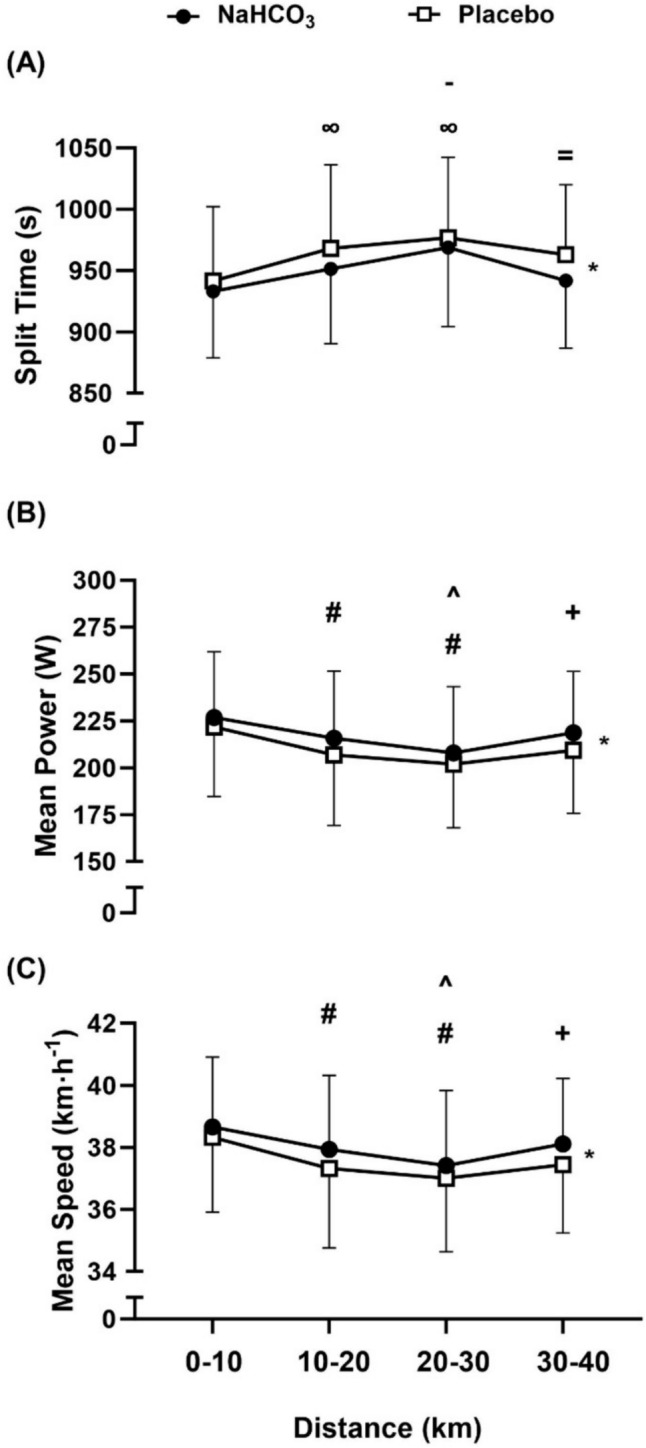
Mean ± SD split time (A), mean power (B) and mean speed (C). “” denotes significant increase from first timepoint (0–10 km) (p < 0.01), “-” denotes significant increase from second timepoint (10–20 km) (p < 0.05), “ = ” denotes significant decrease from third timepoint (20–30 km) (p < 0.05), “#” denotes significant decrease from first timepoint (0–10 km) (p < 0.001), “^” denotes significant decrease from second timepoint (10–20 km) (p < 0.01), and + denotes significant increase from third timepoint (20–30 km) (p < 0.05). “*” denotes a significant condition difference throughout all timepoints (p < 0.01)
Fig. 3
Fig. 3
Mean ± SD blood HCO3 (A) and blood pH (B) responses before and throughout 40 km TT after NaHCO3 and placebo ingestion. “ + ” denotes significant increase from first time point (baseline) (p < 0.01), “” denotes significant decrease from first (pre-exercise) and second (post warm-up) time point (p < 0.01), “-” denotes significant decrease from second time point (pre-exercise) (p = 0.01), “ = ” denotes significant increase from fourth time point (10 km) (p < 0.05), “#” denotes significant decrease from sixth time point (30 km) (p < 0.005), “*” denotes a significant condition difference between NaHCO3 and placebo conditions (p < 0.01)
Fig. 4
Fig. 4
Mean ± SD VCO2 (A), VO2 (B), RER (C), heart rate (D), blood lactate (E), and RPE (F) responses throughout 40 km TT after NaHCO3 and placebo ingestion. “^” denotes significant decrease from first timepoint (9-10 km) (p < 0.05). “#” denotes significant increase from first timepoint (10 km) (p < 0.001). “+” denotes significant increase from second timepoint (20 km) (p < 0.01). “-” denotes significant increase from third timepoint (30 km) (p < 0.01). “*” denotes significant condition difference at all timepoints (p < 0.01)

References

    1. Boegman S, Stellingwerff T, Shaw G, Clarke N, Graham K, Cross R, Siegler JC (2020) The impact of individualizing sodium bicarbonate supplementation strategies on world-class rowing performance. Front Nutr 9(7):138. 10.3389/fnut.2020.00138 - PMC - PubMed
    1. Borg G (1982) Ratings of perceived exertion and heart rates during short-term cycle exercise and their use in a new cycling strength test. Int J Sports Med 3(03):153–158. 10.1055/s-2008-1026080 - PubMed
    1. Calvo J, Xu H, Mon-López D, Pareja-Galeano H, Jiménez S (2021) Effect of sodium bicarbonate contribution on energy metabolism during exercise: a systematic review and meta-analysis. J Int Soc Sports Nutr 18(1):11. 10.1186/s12970-021-00410-y - PMC - PubMed
    1. Cameron SL, McLay-Cooke RT, Brown RC, Gray AR, Fairbairn KA (2010) Increased blood pH but not performance with sodium bicarbonate supplementation in elite rugby union players. Int J Sport Nutr Exerc Metab 20(4):307–321. 10.1123/ijsnem.20.4.307 - PubMed
    1. Carr A, Slater G, Gore C, Dawson B, Burke L (2011) Effect of sodium bicarbonate on [HCO3−], pH, and gastrointestinal symptoms. Int J Sport Nutr Exerc Metab 21(3):189–194. 10.1123/ijsnem.21.3.189 - PubMed

Publication types

MeSH terms

LinkOut - more resources