. 2024 Jul 26;13(8):e1521.
doi: 10.1002/cti2.1521. eCollection 2024.

Primary SARS-CoV-2 infection in children and adults results in similar Fc-mediated antibody effector function patterns

Affiliations

Primary SARS-CoV-2 infection in children and adults results in similar Fc-mediated antibody effector function patterns

Anne T Gelderloos et al. Clin Transl Immunology. .

Abstract

Objectives: Increasing evidence suggests that Fc-mediated antibody effector functions have an important role in protection against respiratory viruses, including SARS-CoV-2. However, limited data are available on the potential differences in the development, heterogeneity and durability of these responses in children compared to adults.

Methods: Here, we assessed the development of spike S1-specific serum antibody-dependent cellular phagocytosis (ADCP), complement deposition (ADCD) and natural killer cell activation (ADNKA), alongside specific antibody binding concentrations (IgG, IgA and IgM) and IgG avidity in healthy adults (n = 38, 18-56 years) and children (n = 21, 5-16 years) following primary SARS-CoV-2 infection, with a 10-month longitudinal follow-up. Differences between groups were assessed using a nonparametric Kruskal-Wallis test with Dunn's multiple comparisons test.

Results: We found similar (functional) antibody responses in children compared to adults, with a tendency for increased durability in children, which was statistically significant for ADCD (P < 0.05). While ADNKA was strongly reduced in both adults (P < 0.001) and children (P < 0.05) at the latest time point, ADCP remained relatively stable over time, possibly relating to an increase in avidity of the spike-specific antibodies (P < 0.001). Finally, the ADNKA capacity relative to antibody concentration appeared to decrease over time in both children and adults.

Conclusion: In conclusion, our data provide novel insights into the development of SARS-CoV-2-specific antibody Fc-mediated effector functions in children and adults. An increased understanding of these characteristics in specific age populations is valuable for the future design of novel and improved vaccination strategies for respiratory viruses such as SARS-CoV-2.

Keywords: Fc‐functionality; adults; children; monocytes; natural killer cells; viral infection.


Conflict of interest statement

The authors declare no conflict of interest.

Figures

Figure 1
Figure 1
Study overview and SARS‐CoV‐2 spike S1‐specific IgG concentrations in adults and children up to 10 months after symptom onset of a primary SARS‐CoV‐2 infection. (a) Schematic overview of the study participants and sample collection schedule. Sampling time points are indicated by coloured circles on the timeline. (b, c) SARS‐CoV‐2 spike S1‐specific serum IgG binding concentrations were determined using a bead‐based immunoassay in adults (blue, A) and children (orange, C) up to 10 months after symptom onset. The kinetics graph (b) includes T1/2/3/4 samples for adults (n = 37) and T2/4 samples for children (n = 16). The black line indicates the smoothed conditional mean, the grey shading the 95% confidence interval of all samples. The boxplot (c) depicts median and quartiles for adults (n = 38) and children (n = 21). Differences between groups were assessed using a Kruskal–Wallis test with Dunn's multiple comparisons test and Holm's correction for multiple comparisons. *P < 0.05. BAU, binding antibody units.
Figure 2
Figure 2
SARS‐CoV‐2 spike S1‐specific IgA and IgM binding concentrations and IgG avidity in adults and children up to 10 months after symptom onset of a primary SARS‐CoV‐2 infection. SARS‐CoV‐2 spike S1‐specific serum IgA (a, b) and IgM (c, d) binding concentrations and IgG avidity (e, f) were determined using a bead‐based immunoassay in adults (blue, A) and children (orange, C) up to 10 months after symptom onset. The kinetics graphs (a, c, e) include T1/2/3/4 samples for adults (n = 30–37) and T2/4 samples for children (n = 16). The black lines indicate the smoothed conditional means, the grey shading the 95% confidence interval of all samples. The boxplots (b, d, f) depict median and quartiles for adults (n = 37 or 38) and children (n = 21). Differences between groups were assessed using a Kruskal–Wallis test with Dunn's multiple comparisons test and Holm's correction for multiple comparisons. *P < 0.05; ***P < 0.001. AU, arbitrary units.
Figure 3
Figure 3
SARS‐CoV‐2 spike S1‐specific Fc‐mediated effector functions in adults and children up to 10 months after symptom onset of a primary SARS‐CoV‐2 infection. SARS‐CoV‐2 spike S1‐specific ADCP (a, b), ADCD (c, d) and ADNKA (e, f) activity in adults (blue, A) and children (orange, C) up to 10 months after symptom onset. The kinetics graphs (a, c, e) include T1/2/3/4 samples for adults (n = 36–37) and T2/4 samples for children (n = 16). The black lines indicate the smoothed conditional means, the grey shading the 95% confidence interval of all samples. The boxplots (b, d, f) depict median and quartiles for adults (n = 37 or 38) and children (n = 21). The horizontal grey dotted lines represent the negative PBS control. Differences between groups were assessed using a Kruskal–Wallis test with Dunn's multiple comparisons test and Holm's correction for multiple comparisons. *P < 0.05, ***P < 0.001. ADCD, antibody‐dependent complement deposition; ADCP, antibody‐dependent cellular phagocytosis; ADNKA, antibody‐dependent NK cell activation; iMFI, integrated median fluorescence intensity; NK, natural killer.
Figure 4
Figure 4
Integrated analysis of SARS‐CoV‐2 spike S1‐specific antibody features. (a) A correlation matrix for all measured variables was produced based on Spearman's rank‐order correlation analysis of data from children (T2 and T4) and adults (T1–T4). Only correlations with a P‐value below 0.02 are shown as dots, of which the size and colour indicate the strength and direction of the correlation (also see the legend on the right side of the matrix). (b) Principal component analysis (PCA) was performed using data for adults and children at T2 and T4. The diagram shows the correlation between the five principal components extracted from PCA and the original variables (IgG, IgA and IgM concentration, IgG avidity, ADCP, ADCD and ADNKA). Correlations are indicated as dots of which the size and colour indicate the strength and direction of the correlation (also see legend on the right side of the matrix). PCA plots associated with the analysis in (b) visualising adults and children (c) and time of sampling (d). The coloured ellipses represent the 95% confidence ellipses of the scatter around overall assay mean of each group. ADCD, antibody‐dependent complement deposition; ADCP, antibody‐dependent cellular phagocytosis; ADNKA, antibody‐dependent NK cell activation; AI, avidity index; NK, natural killer.
Figure 5
Figure 5
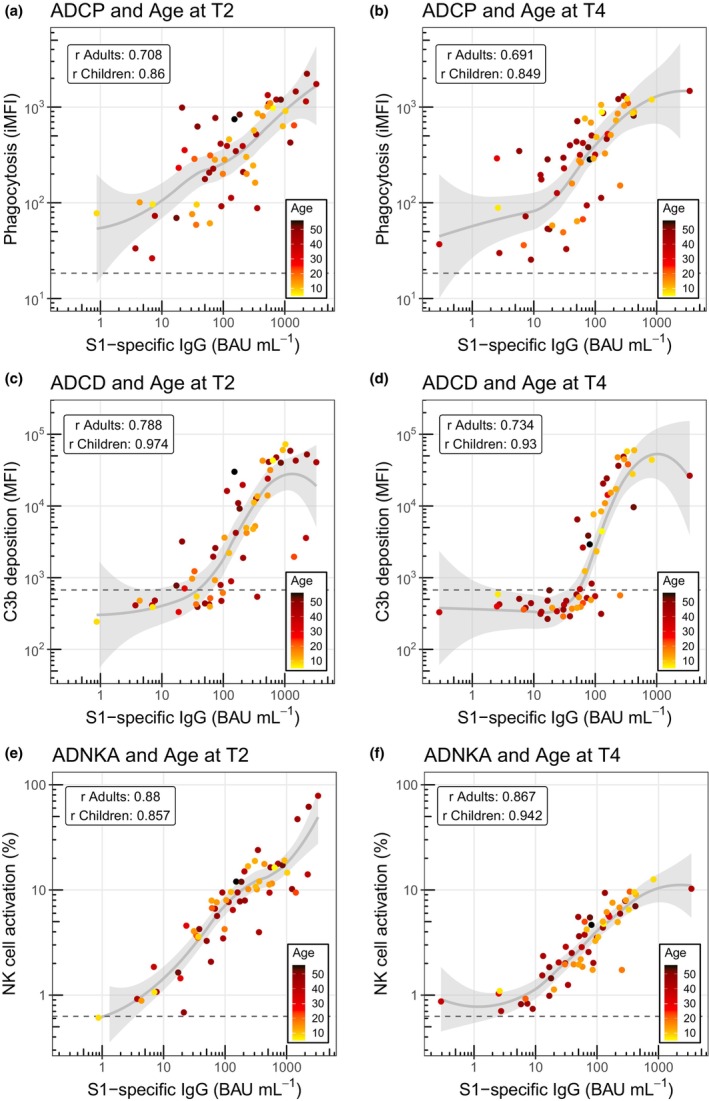
Correlation analysis of SARS‐CoV‐2 spike S1‐specific IgG binding concentration and Fc‐mediated effector functions separated by timepoints T2 and T4 in adults and children coloured by age. Correlations of SARS‐CoV‐2 spike S1‐specific serum IgG binding concentrations and ADCP (a, b), ADCD (c, d) and ADNKA (e, f) in adults (n = 37 or 38) and children (n = 21) at time points T2 and T4. Data points are coloured by linear age. Solid grey lines and shading represent smoothed conditional means and 95% confidence intervals. The horizontal grey dotted lines represent the negative PBS control. Correlations were assessed using the Spearman's rank‐order correlation test for adults and children separately and are indicated in each graph. ADCD, antibody‐dependent complement deposition; ADCP, antibody‐dependent cellular phagocytosis; ADNKA, antibody‐dependent NK cell activation; BAU, binding antibody units; iMFI, integrated median fluorescence intensity; NK, natural killer; r, Spearman's rank correlation coefficient.
Figure 6
Figure 6
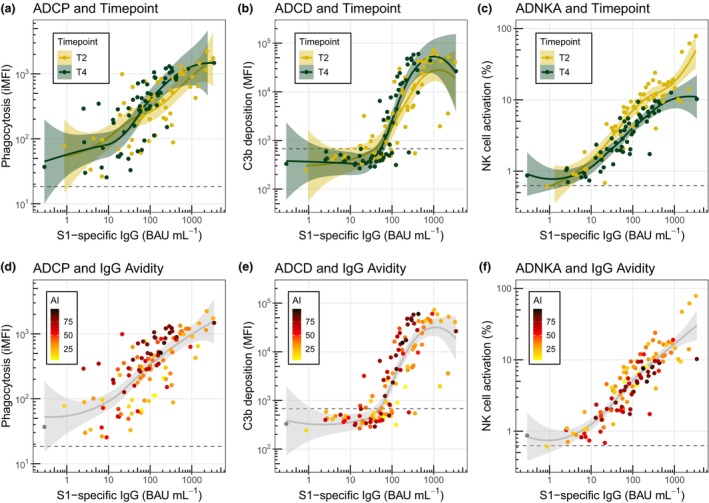
Correlation analysis of SARS‐CoV‐2 spike S1‐specific IgG binding concentration and Fc‐mediated effector functions coloured by time of sampling and avidity. Correlations of SARS‐CoV‐2 spike S1‐specific serum IgG binding concentrations and ADCP, ADCD and ADNKA in adults (n = 37 or 38) and children (n = 21) at timepoints T2 and T4. Data points are coloured by time of sampling (a–c) or avidity index (d–f). Solid lines and shading represent smoothed conditional means and 95% confidence intervals. The horizontal grey dotted lines represent the negative PBS control. ADCD, antibody‐dependent complement deposition; ADCP, antibody‐dependent cellular phagocytosis; ADNKA, antibody‐dependent NK cell activation; AI, avidity index; BAU, binding antibody units; iMFI, integrated median fluorescence intensity; NK, natural killer.

References

    1. Almendro‐Vázquez P, Laguna‐Goya R, Ruiz‐Ruigomez M et al. Longitudinal dynamics of SARS‐CoV‐2‐specific cellular and humoral immunity after natural infection or BNT162b2 vaccination. PLoS Pathog 2021; 1: e1010211. - PMC - PubMed
    1. Dehgani‐Mobaraki P, Zaidi AK, Yadav N, Floridi A, Floridi E. Longitudinal observation of antibody responses for 14 months after SARS‐CoV‐2 infection. Clin Immunol 2021; 230: 108814. - PMC - PubMed
    1. den Hartog G, Vos ERA, van den Hoogen LL et al. Persistence of antibodies to severe acute respiratory syndrome coronavirus 2 in relation to symptoms in a nationwide prospective study. Clin Infect Dis 2021; 73: 2155–2162. - PMC - PubMed
    1. Renk H, Dulovic A, Seidel A et al. Robust and durable serological response following pediatric SARS‐CoV‐2 infection. Nat Commun 2022; 13: 128. - PMC - PubMed
    1. Wright PF, Prevost‐Reilly AC, Natarajan H et al. Longitudinal systemic and mucosal immune responses to SARS‐CoV‐2 infection. J Infect Dis 2022; 226: 1204–1214. - PMC - PubMed

LinkOut - more resources