


Therapeutic impact of basic critical care echocardiography performed by residents after limited training
- PMID: 39073505
- PMCID: PMC11286607
- DOI: 10.1186/s13613-024-01354-7
Therapeutic impact of basic critical care echocardiography performed by residents after limited training
Abstract
Background: The objective was to assess the agreement between therapeutic proposals derived from basic critical care echocardiography performed by novice operators in ultrasonography after a limited training (residents) and by experts considered as reference. Secondary objectives were to assess the agreement between operators' answers to simple clinical questions and the concordance between basic two-dimensional measurements.
Methods: This observational, prospective, single-center study was conducted over a 3-year period in a medical-surgical intensive care unit. Adult patients with acute circulatory and/or respiratory failure requiring a transthoracic echocardiography (TTE) examination were studied. In each patient, a TTE was performed by a resident novice in ultrasonography after a short training program and by an expert, independently but within 1 h and in random order. Each operator addressed standardized simple clinical questions and subsequently proposed a therapeutic strategy based on a predefined algorithm.
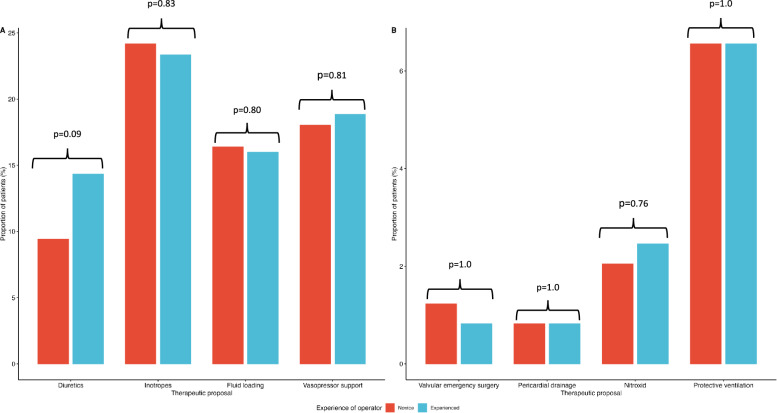
Results: Residents performed an average of 33 TTE studies in 244 patients (156 men; age: 63 years [52-74]; SAPS2: 45 [34-59]; 182 (75%) mechanically ventilated). Agreement between the therapeutic proposals of residents and experienced operators was good-to-excellent. The concordance was excellent for suggesting fluid loading, inotrope or vasopressor support (all Kappa values > 0.80). Inter-observer agreement was only moderate when considering the indication of negative fluid balance (Kappa: 0.65; 95% CI 0.50-0.80), since residents proposed diuretics in 23 patients (9.5%) while their counterparts had the same suggestion in 35 patients (14.4%). Overall agreement of responses to simple clinical questions was also good-to-excellent. Intraclass correlation coefficient exceeded 0.75 for measurement of ventricular and inferior vena cava size.
Conclusions: A limited training program aiming at acquiring the basic level in critical care echocardiography enables ICU residents novice in ultrasonography to propose therapeutic interventions with a good-to-excellent agreement with experienced operators.
Keywords: Intensive care unit; Point of care technology; Therapeutic uses; Training; Transthoracic echocardiography; Ultrasound.
© 2024. The Author(s).
Conflict of interest statement
The authors declare no competing interests.
Figures
References
-
- Robba C, Wong A, Poole D, Al Tayar A, Arntfield RT, Chew MS, et al. Basic ultrasound head-to-toe skills for intensivists in the general and neuro intensive care unit population: consensus and expert recommendations of the European Society of Intensive Care Medicine. Intensive Care Med. 2021;47:1347–67. 10.1007/s00134-021-06486-z - DOI - PMC - PubMed
LinkOut - more resources
Full Text Sources
