Restoration of respiration in high cervical spinal cord injury via phrenic nerve reinnervation: illustrative case
- PMID: 39074401
- PMCID: PMC11301593
- DOI: 10.3171/CASE24236
Restoration of respiration in high cervical spinal cord injury via phrenic nerve reinnervation: illustrative case
Abstract
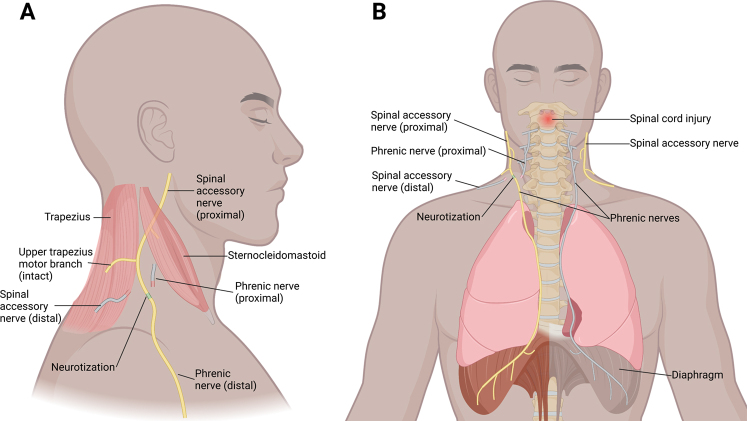
Background: Traumatic high cervical spinal cord injury (SCI) can result in a devastating loss of functional respiration, leaving patients permanently dependent on mechanical ventilation. Nerve transfer is a promising reinnervation strategy that has the potential to restore connectivity in paralyzed distal muscles. The spinal accessory nerve (SAN) remains functional in most cases after high cervical SCI and can serve as a donor to reinnervate the phrenic nerve (PN), thereby improving diaphragmatic function.
Observations: Information regarding thorough physical, electrodiagnostic, and pulmonary assessments to establish candidacy for nerve transfer, as well as the surgical procedure, was summarized with an illustrative case. The patient demonstrated improvement in pulmonary function testing but did not achieve independent respiration. A systematic literature review identified 3 studies with 9 additional patients who had undergone SAN-to-PN transfer. The nerve transfer meaningfully restored diaphragmatic function, improving pulmonary function tests and reducing ventilator dependency.
Lessons: Respiratory dependency significantly impacts the quality of life of patients with a high cervical SCI. The use of the lower SAN motor branch for PN transfer is safe and does not result in a meaningful downgrade in trapezius function. Outcomes following this procedure are promising but heterogeneous, indicating a need for significant innovation and improvement for future therapies. https://thejns.org/doi/10.3171/CASE24236.
Keywords: diaphragm reinnervation; nerve transfer; phrenic nerve; respiration; spinal accessory nerve; spinal cord injury.
Figures

References
-
- Como JJ, Sutton ER, McCunn M, et al. Characterizing the need for mechanical ventilation following cervical spinal cord injury with neurologic deficit. J Trauma. 2005;59(4):912-916. - PubMed
-
- DeVivo MJ, Chen Y. Trends in new injuries, prevalent cases, and aging with spinal cord injury. Arch Phys Med Rehabil. 2011;92(3):332-338. - PubMed
-
- Javeed S, Greenberg JK, Zhang JK, et al. Association of upper-limb neurological recovery with functional outcomes in high cervical spinal cord injury. J Neurosurg Spine. 2023;39(3):355-362. - PubMed
LinkOut - more resources
Full Text Sources