One-Year Safety and Effectiveness of Bivalirudin versus Heparin in Patients Undergoing Elective Percutaneous Coronary Intervention
- PMID: 39076722
- PMCID: PMC11262434
- DOI: 10.31083/j.rcm2408218
One-Year Safety and Effectiveness of Bivalirudin versus Heparin in Patients Undergoing Elective Percutaneous Coronary Intervention
Abstract
Background: Bivalirudin reduces ischemic and hemorrhagic events in patients undergoing primary percutaneous coronary intervention (PCI), but the safety and efficacy for such individuals are unclear. Our aim was to evaluate the long-term safety and efficacy of bivalirudin in patients undergoing elective PCI.
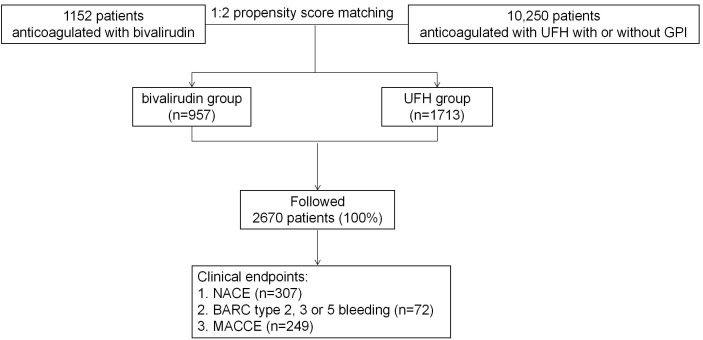
Methods: We examined 957 patients with bivalirudin anticoagulation and 1713 patients with unfractionated heparin (UFH) anticoagulation with and without glycoprotein IIb/IIIa inhibitors (GPI). The primary endpoint was net adverse clinical events (NACE), a composite of death, myocardial infarction, revascularization, stent thrombosis, stroke, and bleeding. The secondary endpoints were bleeding and major adverse cardiovascular and cerebrovascular events (MACCE).
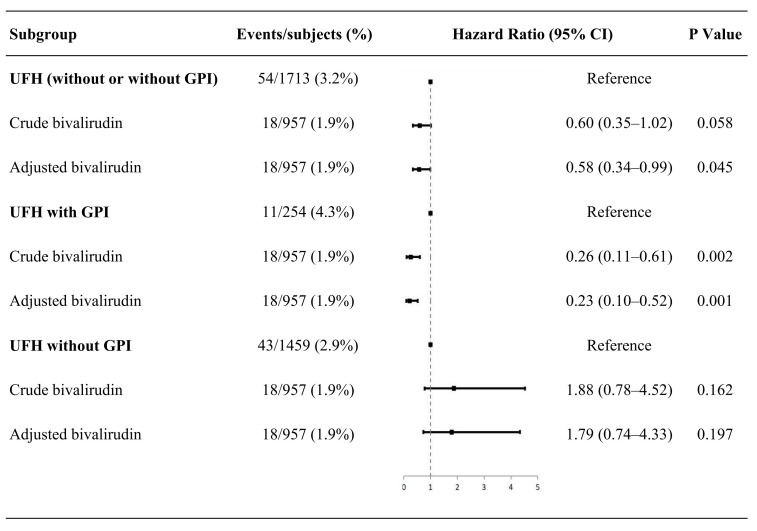
Results: In one year of follow-up, 307 (11.5%) NACEs, 72 (2.7%) bleedings, and 249 (9.3%) MACCEs occurred. Statistically, patients with bivalirudin anticoagulation had less NACE [hazard ratio (HR): 0.75, 95% confidence interval (CI): 0.58-0.96, p = 0.021] and bleeding (HR: 0.58, 95% CI: 0.34-0.99, p = 0.045) but not less MACCE, than did those with UFH anticoagulation. Furthermore, the risk of bleeding in the bivalirudin group was lower than in the UFH with GPI group (p = 0.001) but not lower than in the group of UFH without GPI (p = 0.197).
Conclusions: In patients who undergo elective PCI, the use of bivalirudin significantly decreased the risk of NACE and bleeding without increasing the risk of MACCE; the reduction of bleeding risk with bivalirudin was mainly attributed to the presence of GPIs in the UFH group.
Keywords: bivalirudin; elective percutaneous coronary intervention; glycoprotein IIb/IIIa inhibitors; unfractionated heparin.
Copyright: © 2023 The Author(s). Published by IMR Press.
Conflict of interest statement
The authors declare no conflict of interest.
Figures
References
-
- Levine GN, Bates ER, Blankenship JC, Bailey SR, Bittl JA, Cercek B, et al. 2015 ACC/AHA/SCAI Focused Update on Primary Percutaneous Coronary Intervention for Patients With ST-Elevation Myocardial Infarction: An Update of the 2011 ACCF/AHA/SCAI Guideline for Percutaneous Coronary Intervention and the 2013 ACCF/AHA Guideline for the Management of ST-Elevation Myocardial Infarction: A Report of the American College of Cardiology/American Heart Association Task Force on Clinical Practice Guidelines and the Society for Cardiovascular Angiography and Interventions. Circulation . 2016;133:1135–1147. - PubMed
-
- Windecker S, Kolh P, Alfonso F, Collet JP, Cremer J, Falk V, et al. 2014 ESC/EACTS Guidelines on myocardial revascularization: The Task Force on Myocardial Revascularization of the European Society of Cardiology (ESC) and the European Association for Cardio-Thoracic Surgery (EACTS)Developed with the special contribution of the European Association of Percutaneous Cardiovascular Interventions (EAPCI) European Heart Journal . 2014;35:2541–2619. - PubMed
-
- Eikelboom JW, Mehta SR, Anand SS, Xie C, Fox KAA, Yusuf S. Adverse impact of bleeding on prognosis in patients with acute coronary syndromes. Circulation . 2006;114:774–782. - PubMed
-
- Zeymer U, Rao SV, Montalescot G. Anticoagulation in coronary intervention. European Heart Journal . 2016;37:3376–3385. - PubMed
-
- Stone GW, Witzenbichler B, Guagliumi G, Peruga JZ, Brodie BR, Dudek D, et al. Bivalirudin during primary PCI in acute myocardial infarction. The New England Journal of Medicine . 2008;358:2218–2230. - PubMed
LinkOut - more resources
Full Text Sources
Miscellaneous