Elevated Glucose on Admission Was an Independent Risk Factor for 30-Day Major Adverse Cardiovascular Events in Patients with STEMI but Not NSTEMI
- PMID: 39077362
- PMCID: PMC11263140
- DOI: 10.31083/j.rcm2502046
Elevated Glucose on Admission Was an Independent Risk Factor for 30-Day Major Adverse Cardiovascular Events in Patients with STEMI but Not NSTEMI
Abstract
Background: The purpose of this study was to evaluate the impact of glucose levels on admission, on the risk of 30-day major adverse cardiovascular events (MACEs) in patients with acute myocardial infarction (AMI), and to assess the difference in outcome between ST-segment elevation myocardial infarction (STEMI) and non-ST-segment elevation myocardial infarction (NSTEMI) patients.
Methods: This study was a post hoc analysis of the Acute Coronary Syndrome Quality Improvement in Kerala Study, and 13,398 participants were included in the final analysis. Logistic regression models were used to assess the association between glucose levels on admission and the risk of 30-day MACEs, adjusting for potential confounders.
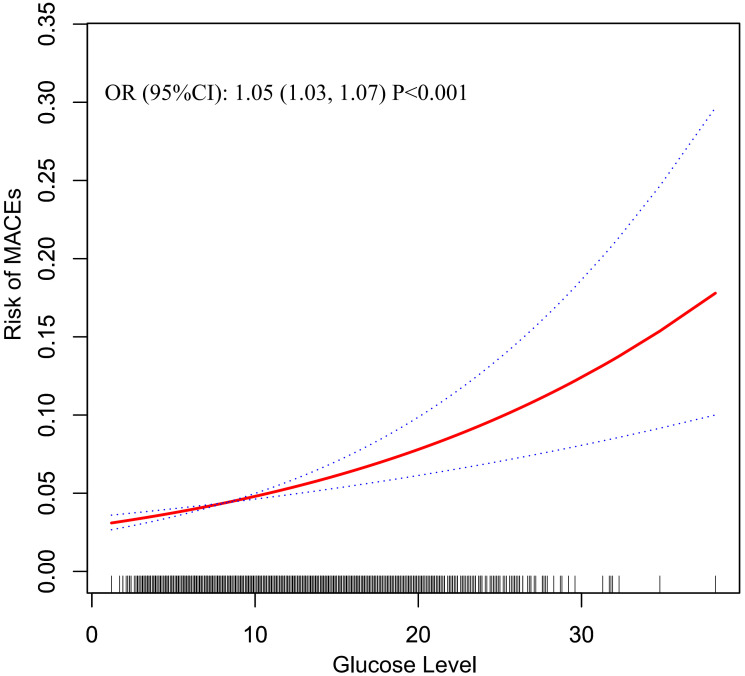
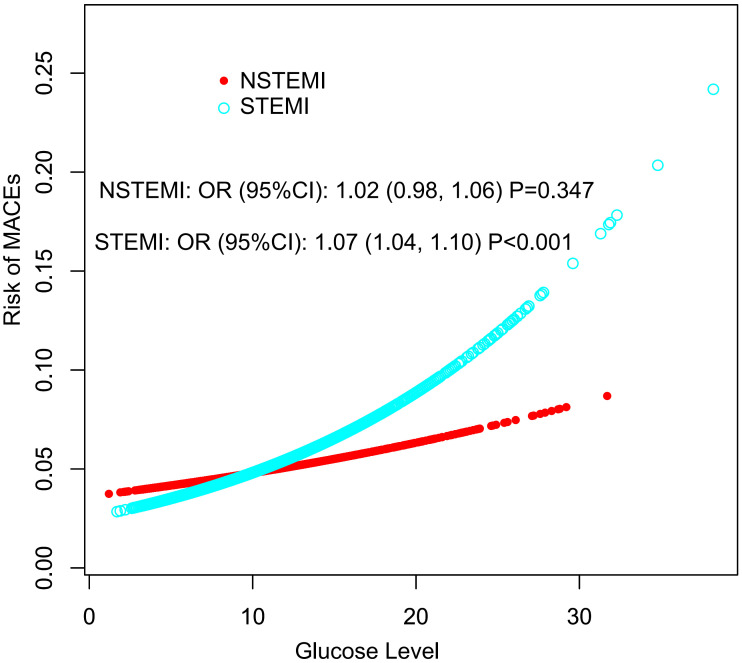
Results: Participants were divided according to the glucose quintiles. There was a positive linear association between glucose levels at admission and the risk of 30-day MACEs in AMI patients [adjusted OR (95% CI): 1.05 (1.03, 1.07), p 0.001]. Compared to participants with an admission glucose between 5.4 and 6.3 mmol/L, participants with the highest quintile of glucose level ( 10.7 mmol/L) were associated with increased risk of 30-day MACEs in the fully adjusted logistic regression model [adjusted OR (95% CI): 1.82 (1.33, 2.50), p 0.001]. This trend was more significant in patients with STEMI (p for interaction = 0.036).
Conclusions: In patients with AMI, elevated glucose on admission was associated with an increased risk of 30-day MACEs, but only in patients with STEMI.
Keywords: ST-elevation myocardial infarction; glucose; major adverse cardiovascular events; non-ST-elevation myocardial infarction.
Copyright: © 2024 The Author(s). Published by IMR Press.
Conflict of interest statement
The authors declare no conflict of interest.
Figures
References
-
- Prabhakaran D, Jeemon P, Roy A. Cardiovascular Diseases in India: Current Epidemiology and Future Directions. Circulation . 2016;133:1605–1620. - PubMed
-
- Lopez AD, Mathers CD, Ezzati M, Jamison DT, Murray CJL. Global and regional burden of disease and risk factors, 2001: systematic analysis of population health data. Lancet . 2006;367:1747–1757. - PubMed
-
- Rathore V, Singh N, Mahat RK, Kocak M, Fidan K, Ayazoglu T, et al. Risk factors for acute myocardial infarction: a review. Eurasian Journal of Medical Investigation . 2018;2:1–7.
-
- Anand SS, Islam S, Rosengren A, Franzosi MG, Steyn K, Yusufali AH, et al. Risk factors for myocardial infarction in women and men: insights from the INTERHEART study. European Heart Journal . 2008;29:932–940. - PubMed
LinkOut - more resources
Full Text Sources