


Evaluation of the effect of agroclimatic variables on the probability and timing of olive fruit fly attack
- PMID: 39077508
- PMCID: PMC11284310
- DOI: 10.3389/fpls.2024.1401669
Evaluation of the effect of agroclimatic variables on the probability and timing of olive fruit fly attack
Abstract
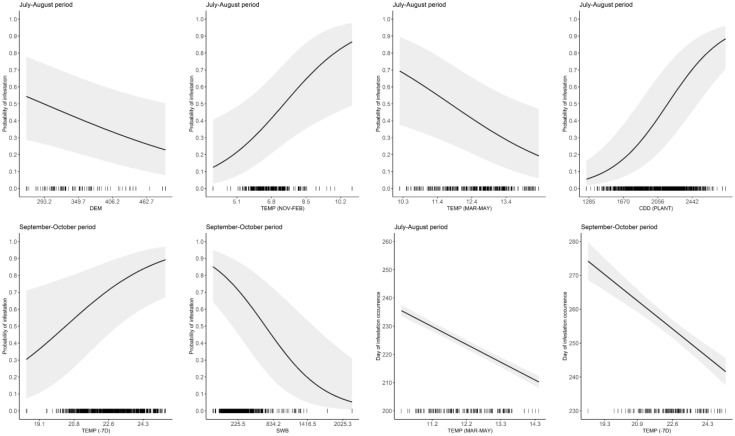
Agroclimatic variables may affect insect and plant phenology, with unpredictable effects on pest populations and crop losses. Bactrocera oleae Rossi (Diptera: Tephritidae) is a specific pest of Olea europaea plants that can cause annual economic losses of more than one billion US dollars in the Mediterranean region. In this study, we aimed at understanding the effect of olive tree phenology and other agroclimatic variables on B. oleae infestation dynamics in the Umbria region (Central Italy). Analyses were carried out on B. oleae infestation data collected in 79 olive groves during a 7-year period (from 2015 to 2021). In July-August, B. oleae infestation (1% attack) was negatively affected by altitude and spring mean daily temperatures and positively by higher winter mean daily temperatures and olive tree cumulative degree days. In September-October, infestation was negatively affected by a positive soil water balance and high spring temperatures. High altitude and cumulative plant degree days were related to delayed attacks. In contrast, high winter and spring temperatures accelerated them. Our results could be helpful for the development of predictive models and for increasing the reliability of decision support systems currently used in olive orchards.
Keywords: Bactrocera oleae; Diptera; Oleaceae; Tephritidae; insect monitoring; oviposition; pest management.
Copyright © 2024 Rondoni, Mattioli, Giannuzzi, Chierici, Betti, Natale, Petacchi, Famiani, Natale and Conti.
Conflict of interest statement
Authors EM and AN were employed by the company TeamDev – Software, GIS and Web Engineering. Authors AB and GN were employed by the company O.P.O.O. The remaining authors declare that the research was conducted in the absence of any commercial or financial relationships that could be construed as a potential conflict of interest. The author(s) declared that they were an editorial board member of Frontiers, at the time of submission. This had no impact on the peer review process and the final decision.
Figures
References
-
- AliNiazee M. T. (1979). A computerized phenology model for predicting biological events of Rhagoletis indifferens (Diptera: Tephritidae). Can. Ent. 111, 1101–1109. doi: 10.4039/Ent1111101-10 - DOI
-
- Antal A., Guerreiro P. M. P., Cheval S. (2021). Comparison of spatial interpolation methods for estimating the precipitation distribution in Portugal. Theor. Appl. Climatol. 145, 1193–1206. doi: 10.1007/s00704-021-03675-0 - DOI
-
- Apaydin H., Kemal Sonmez F., Yildirim Y. E. (2004). Spatial interpolation techniques for climate data in the GAP region in Turkey. Clim. Res. 28, 31–40. doi: 10.3354/cr028031 - DOI
-
- Bajjali W. (2023). “Working with arcGIS pro,” in ArcGIS Pro and ArcGIS Online: Applications in Water and Environmental Sciences (Springer International Publishing, Cham: ), 15–33. doi: 10.1007/978-3-031-42227-0_2 - DOI
LinkOut - more resources
Full Text Sources
