


Genomic evolution of influenza during the 2023-2024 season, the johns hopkins health system
- PMID: 39079210
- PMCID: PMC11384212
- DOI: 10.1016/j.jcv.2024.105718
Genomic evolution of influenza during the 2023-2024 season, the johns hopkins health system
Abstract
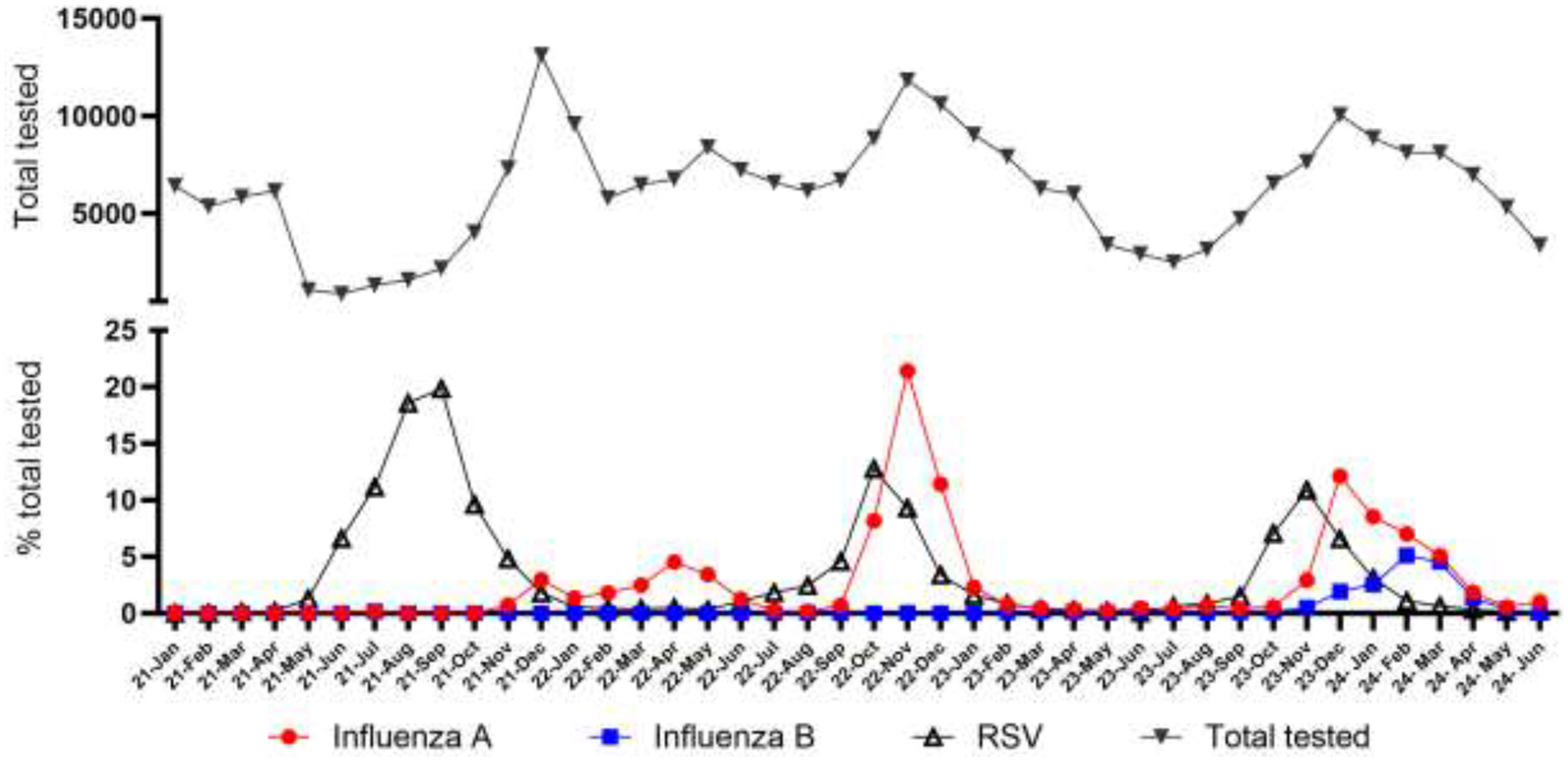
Influenza, a human disease caused by viruses in the Orthomyxoviridae family, is estimated to infect 5% -10 % of adults and 20% -30 % of children annually. Influenza A (IAV) and Influenza B (IBV) viruses accumulate amino acid substitutions (AAS) in the hemagglutinin (HA) and neuraminidase (NA) proteins seasonally. These changes, as well as the dominating viral subtypes, vary depending on geographical location, which may impact disease prevalence and the severity of the season. Genomic surveillance is crucial for capturing circulation patterns and characterizing AAS that may affect disease outcomes, vaccine efficacy, or antiviral drug activities. In this study, whole-genome sequencing of IAV and IBV was attempted on positive remnant clinical samples (587) collected from 580 patients between June 2023 and February 2024 in the Johns Hopkins Health System (JHHS). Full-length HA segments were obtained from 424 (72.2 %) samples. H1N1pdm09 (71.7 %) was the predominant IAV subtype, followed by H3N2 (16.7 %) and IBV-Victoria clade V1A.3a.2 (11.6 %). Within H1N1pdm09 HA sequences, the 6B1A.5a.2a.1 (60.5 %) clade was the most represented. Full-length NA segments were obtained from 421 (71.7 %) samples. Within H1N1pdm09 and IBV, AAS previously proposed to change susceptibility to NA inhibitors were infrequently detected. Phylogeny of HA and NA demonstrated heterogeneous HA and NA H1N1pdm09 and IBV subclades. No significant differences were observed in admission rates or use of supplemental oxygen between different subtypes or clades. Influenza virus genomic surveillance is essential for understanding the seasonal evolution of influenza viruses and their association with disease prevalence and outcomes.
Keywords: 2023/2024 season; Iav; Ibv; Influenza.
Copyright © 2024 The Author(s). Published by Elsevier B.V. All rights reserved.
Conflict of interest statement
Declaration of competing interest The authors declare the following financial interests/personal relationships which may be considered as potential competing interests: HHM reports research collaborations with Bio-Rad, Qiagen, DiaSorin, and Hologic, received honoraria from BD diagnostics and Bio-Rad, and serves on the advisory board for Seegene.
Figures


References
-
- Xu D, Chen L, Ji L, Yan W. 2024. Genetic characterization of influenza A(H1N1)pdm09 virus in 2023 in Huzhou, China. Journal of Clinical Virology Plus 4:100178.
Publication types
MeSH terms
Substances
Grants and funding
LinkOut - more resources
Full Text Sources
Medical
