. 2024 Jul 30;15(1):6203.
doi: 10.1038/s41467-024-50147-w.

Mechanical properties of rubble pile asteroids (Dimorphos, Itokawa, Ryugu, and Bennu) through surface boulder morphological analysis

Affiliations

Mechanical properties of rubble pile asteroids (Dimorphos, Itokawa, Ryugu, and Bennu) through surface boulder morphological analysis

Colas Q Robin et al. Nat Commun. .

Erratum in

Abstract

Planetary defense efforts rely on estimates of the mechanical properties of asteroids, which are difficult to constrain accurately from Earth. The mechanical properties of asteroid material are also important in the interpretation of the Double Asteroid Redirection Test (DART) impact. Here we perform a detailed morphological analysis of the surface boulders on Dimorphos using images, the primary data set available from the DART mission. We estimate the bulk angle of internal friction of the boulders to be 32.7 ± 2. 5° from our measurements of the roundness of the 34 best-resolved boulders ranging in size from 1.67-6.64 m. The elongated nature of the boulders around the DART impact site implies that they were likely formed through impact processing. Finally, we find striking similarities in the morphology of the boulders on Dimorphos with those on other rubble pile asteroids (Itokawa, Ryugu and Bennu). This leads to very similar internal friction angles across the four bodies and suggests that a common formation mechanism has shaped the boulders. Our results provide key inputs for understanding the DART impact and for improving our knowledge about the physical properties, the formation and the evolution of both near-Earth rubble-pile and binary asteroids.


Conflict of interest statement

The authors declare no competing interests.

Figures
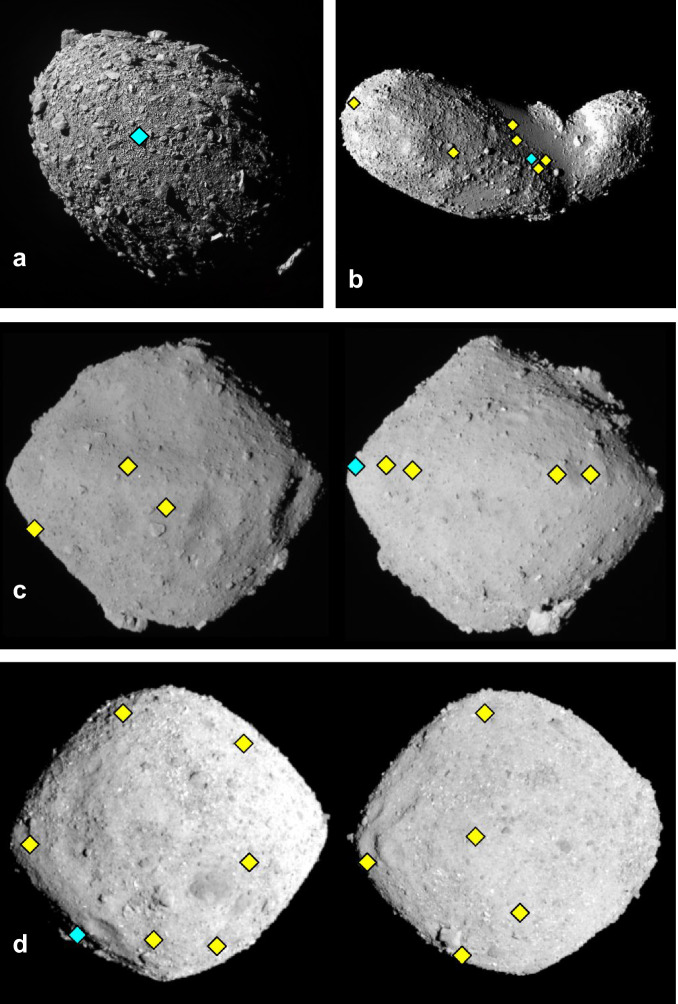
Fig. 1
Fig. 1. Rubble pile asteroids visited by space missions.
a Dimorphos (208 × 160 × 133 m), the secondary of the (65803) binary system Didymos visited by the NASA DART mission, (b) Asteroid (25143) Itokawa (607 × 287 × 264 m) visited by the JAXA Hayabusa mission, (c) Asteroid (162173) Ryugu (1040 × 1020 × 880 m) visited by the JAXA Hayabusa-2 mission, (d) Asteroid (101955) Bennu (565 × 535 × 508 m) visited by the NASA OSIRIS-REx mission. The diamonds indicates the approximate geographical locations of the images that we used of these asteroids and the blue ones are the images displayed in Fig. 2. Images are not to scale.
Fig. 2
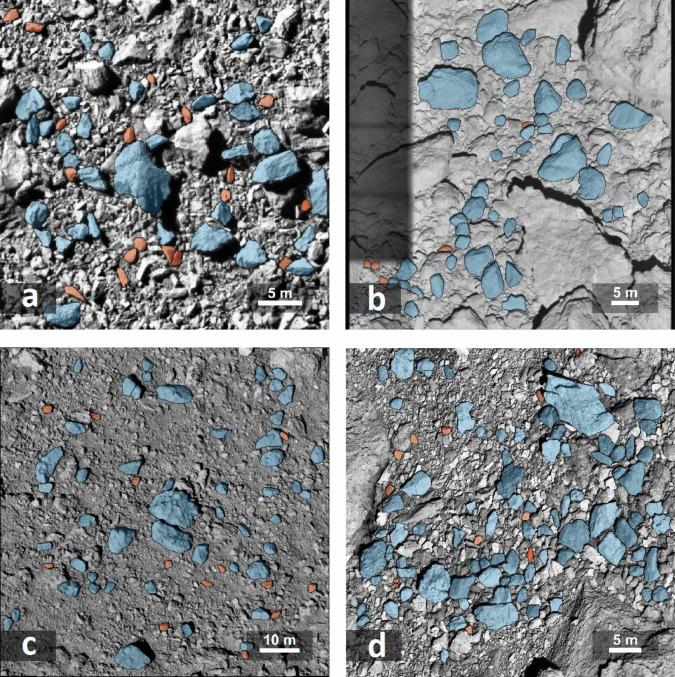
Fig. 2. Images of studied asteroids surfaces.
Examples of one of the High-resolution images for each asteroid surfaces studied. The images contrast have been enhanced with a CLAHE filtering for visualisation purposes only. a Dimorphos of the (65803) binary system Didymos taken by DRACO (dart_0401930049_43695_02_iof) (the only image analyzed for this body), (b) Asteroid (25143) Itokawa taken by AMICA (st_2539437177_v) (1 of the 7 images analyzed), (c) Asteroid (162173) Ryugu taken by ONC-T (hyb2_onc_20180921_041826_tvf) (1 of 8 images analyzed), (d) Asteroid (101955) Bennu taken by OCAMS (20210407T033629S004_pol_iofL2pan) (1 of the 12 images analyzed). All other images analyzed can be find in the supplementary information. Boulders selected and analyzed are coloured in blue and red. The red boulders indicate the smaller resolved boulders (<30 px), which haven’t been included in the analysis of the resolution dependant morphological parameters.
Fig. 3
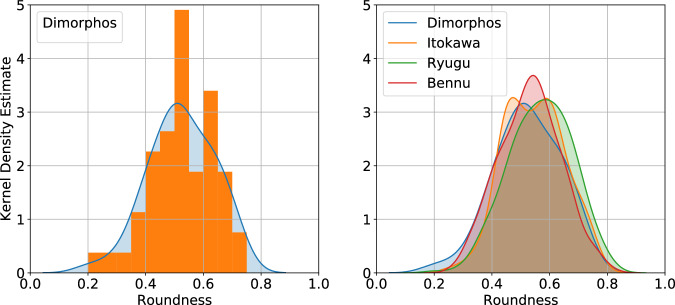
Fig. 3. Roundness distributions of the studied boulders.
(Left) Distribution of the roundness of the boulders with a diameter >30 px at the surface of Dimorphos. The orange histogram shows the distribution and the blue shaded region represents the kernel density estimate of the internal friction angle for Dimorphos. (Right) Kernel density estimates of the roundness of surface boulders with a diameter >30 px on Dimorphos (blue with 34 boulders), Itokawa (orange with 230 boulders), Ryugu (green 267 boulders) and Bennu (red with 703 boulders).
Fig. 4
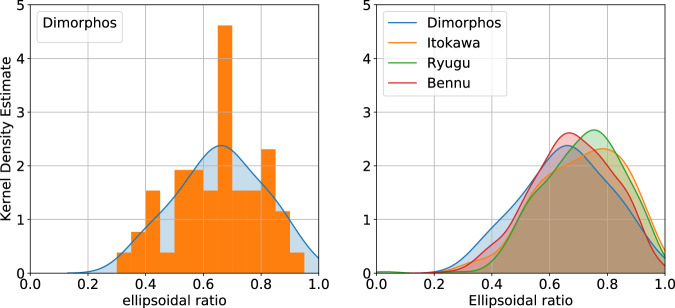
Fig. 4. Ellipsoidal ratio distributions of the studied boulders.
(Left) Distribution of the ellipsoidal ratio of the boulders at the surface of Dimorphos. The orange histogram shows the distribution and the blue shaded region represents the kernel density estimate of the internal friction angle for Dimorphos. (Right) Kernel density estimates of the ellipsoidal ratio of surface boulders on Dimorphos (blue with 53 boulders), Itokawa (orange with 277 boulers), Ryugu (green with 318 boulders) and Bennu (red with 955 boulders).
Fig. 5
Fig. 5. Internal friction angle as derived from the roundness of the studied boulders.
Boxplots of the internal friction angles values from the boulders >30 pixels analyzed on the images of Dimorphos 34 boulders, Itokawa (230 boulders), Ryugu (267 boulders) and Bennu (703 boulders), see Fig. 2. The red dotted line is the mean internal friction angle of boulders on each asteroid, the black line is the median, the limit of the boxes are the lower and upper quartiles of the distribution and the limits outside the boxes are the lower and upper extremes. The red line in the background is the average of the 4 asteroids and the shaded area lies between the propagated standard deviation between all 4 asteroids.

References

    1. Sakatani, N. et al. Anomalously porous boulders on (162173) Ryugu as primordial materials from its parent body. Nat. Astron.5, 766–774 (2021).
    1. Cheng, B. et al. Reconstructing the formation history of top-shaped asteroids from the surface boulder distribution. Nat. Astron.5, 134–138 (2021).
    1. Tatsumi, E. et al. Collisional history of Ryugu’s parent body from bright surface boulders. Nat. Astron.5, 39–45 (2021).
    1. Ballouz, R.-L. et al. Bennu’s near-earth lifetime of 1.75 million years inferred from craters on its boulders. Nature587, 205–209 (2020). - PubMed
    1. Delbo, M. et al. Alignment of fractures on Bennu’s boulders indicative of rapid asteroid surface evolution. Nat. Geosci.15, 453–457 (2022).