


Stroke-heart syndrome: Incidence and clinical outcomes of cardiac complications following intracerebral haemorrhage
- PMID: 39080982
- PMCID: PMC11569547
- DOI: 10.1177/23969873241264115
Stroke-heart syndrome: Incidence and clinical outcomes of cardiac complications following intracerebral haemorrhage
Abstract
Introduction: Newly diagnosed cardiovascular complications following an ischaemic stroke, termed stroke-heart syndrome, are common and associated with worse outcomes. Little is known regarding stroke-heart syndrome in relation to intracerebral haemorrhage (ICH). This study aimed to investigate the incidence and 5-year major adverse cardiovascular events (MACE; acute myocardial infarction, ischaemic stroke, all-cause mortality and recurrent ICH) of newly diagnosed cardiovascular complications following incident ICH, using a global federated database.
Patients and methods: A retrospective cohort study was conducted using anonymised electronic medical records. Patients aged ⩾ 18 years with non-traumatic ICH and 5-year follow-up were included. Patients with newly diagnosed cardiovascular complications within 4-weeks following the initial ICH were 1:1 propensity score-matched with patients without new-onset cardiovascular complications. Each cardiovascular complications were investigated as a composite stroke-heart syndrome cohort and separately for associated MACE. Cox hazard regression models were used to determine 5-year incidence of MACE.
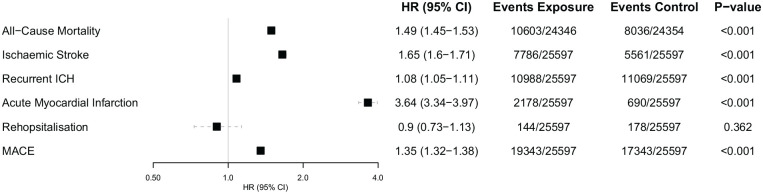
Results: Before propensity score matching, 171,489 patients with non-traumatic ICH, 15% (n = 26,449) experienced ⩾1 newly diagnosed cardiovascular complication within 4 weeks. After matching, patients with ICH and cardiovascular complications were associated with a significantly higher risk of 5-year MACE (HR 1.35 [95% CI 1.32-1.38]), and in each composite compared to matched controls. There was no significant risk of rehospitalisation over 5-year follow-up [HR 0.90 [0.73-1.13]). The risk of MACE was significantly higher in patients with newly diagnosed cardiovascular complications.
Discussion and conclusions: Newly diagnosed cardiovascular complications following ICH (i.e. stroke-heart syndrome) were common and associated with a significantly worsened 5-year prognosis.
Keywords: Stroke-heart syndrome; arrhythmias; heart failure; intracerebral haemorrhage; outcomes.
Conflict of interest statement
Declaration of conflicting interestsThe author(s) declared the following potential conflicts of interest with respect to the research, authorship, and/or publication of this article: BB has received research funding from BMS/Pfizer. GYHL is a consultant and speaker for BMS/Pfizer, Boehringer Ingelheim, Daiichi-Sankyo, Anthos. No fees are received personally. He is a National Institute for Health and Care Research (NIHR) Senior Investigator and co-PI of the AFFIRMO project on multimorbidity in AF (grant agreement No. 899871), TARGET project on digital twins for personalised management of atrial fibrillation and stroke (grant agreement No. 101136244) and ARISTOTELES project on artificial intelligence for management of chronic long term conditions (grant agreement No. 101080189), which are all funded by the EU’s Horizon Europe Research & Innovation programme.
Figures



References
-
- Kumar S, Selim MH, Caplan LR. Medical complications after stroke. Lancet Neurol 2010; 9: 105–118. - PubMed
-
- Buckley BJR, Harrison SL, Hill A, et al. Stroke-heart syndrome: incidence and clinical outcomes of cardiac complications following stroke. Stroke 2022; 53: 1759–1763. - PubMed
-
- Scheitz JF, Nolte CH, Doehner W, et al. Stroke-heart syndrome: clinical presentation and underlying mechanisms. Lancet Neurol 2018; 17: 1109–1120. - PubMed
-
- Nistor IR, Gherasim L. From neurocardiology to stroke-heart syndrome. Rom J Intern Med 2023; 61: 177–185. - PubMed
-
- Sposato LA, Hilz MJ, Aspberg S, et al. Post-stroke cardiovascular complications and neurogenic cardiac injury: JACC state-of-the-art review. J Am Coll Cardiol 2020; 76: 2768–2785. - PubMed
MeSH terms
LinkOut - more resources
Full Text Sources
Medical
