


Infertility-Related Stress, and Dyadic Coping as Predictors of Quality of Life: Gender Differences Among Couples with Infertility Issues
- PMID: 39081285
- PMCID: PMC11288320
- DOI: 10.2147/IJWH.S469513
Infertility-Related Stress, and Dyadic Coping as Predictors of Quality of Life: Gender Differences Among Couples with Infertility Issues
Abstract
Background: The purpose of this study was to explore the relationship between infertility-related stress and dyadic coping with quality of life (QoL) in couples with infertility issues, and verify gender differences and dyadic interactions in the associations between them.
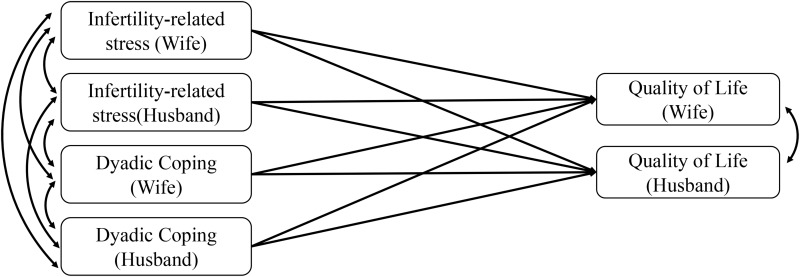
Methods: This cross-sectional study included 340 couples who were recruited from the First Affiliated Hospital of Lanzhou University between March 2022 and November 2022. The Fertility Problem Inventory, Dyadic Coping Inventory and FertiQoL were used to measure infertility-related stress, dyadic coping and QoL. The Actor-Partner Interdependence Model was used to analyze the effects of infertility-related stress and dyadic coping on the couple's own QoL (actor effect) as well as on their partner's QoL (partner effect).
Results: Female patients perceived significantly lower levels of QoL and dyadic coping than those of husbands. There was no statistically significant difference in the infertility-related stress between wives and husbands. Husbands' infertility-related stress had actor and partner effects on their own and their wives' QoL, while wives' infertility-related stress only had an actor effect on their own QoL. Husbands' dyadic coping had both actor effect and partner effects on their own and their wives' QoL, meanwhile wives' dyadic coping had both actor effect and partner effects on their own and their husbands' QoL.
Conclusion: Husbands' QoL was impacted by their own infertility-related stress, dyadic coping and their wives' dyadic coping. Whereas wives' QoL was influenced by infertility-related stress and dyadic coping from both their own and their spouses. Therefore, elevating the level of dyadic coping may contribute to improving QoL for both husbands and wives. Moreover, enhancing the ability to cope with infertility-related stress might be useful for husbands and indirectly contribute to wives' QoL.
Keywords: QoL; couple; dyadic coping; infertility; infertility-related stress.
© 2024 Tang et al.
Conflict of interest statement
The authors declare no conflicts of interest in this work.
Figures


References
-
- Sun H, Gong TT, Jiang YT, Zhang S, Zhao YH, Wu QJ. Global, regional, and national prevalence and disability-adjusted life-years for infertility in 195 countries and territories, 1990–2017: results from a global burden of disease study, 2017. Aging. 2019;11(23):10952–10991. doi:10.18632/aging.102497 - DOI - PMC - PubMed
-
- De Rose M, Melamed R, Braga D, Setti A, Iaconelli A, Borges Junior E. The role of the duration of infertility on the of quality of life and psychological health in infertile couples. Hrod Sci. 2021;14(1):3–10.
LinkOut - more resources
Full Text Sources
