The Dual Burden of Frailty and Heart Failure
- PMID: 39081645
- PMCID: PMC11284334
- DOI: 10.36628/ijhf.2023.0057
The Dual Burden of Frailty and Heart Failure
Abstract
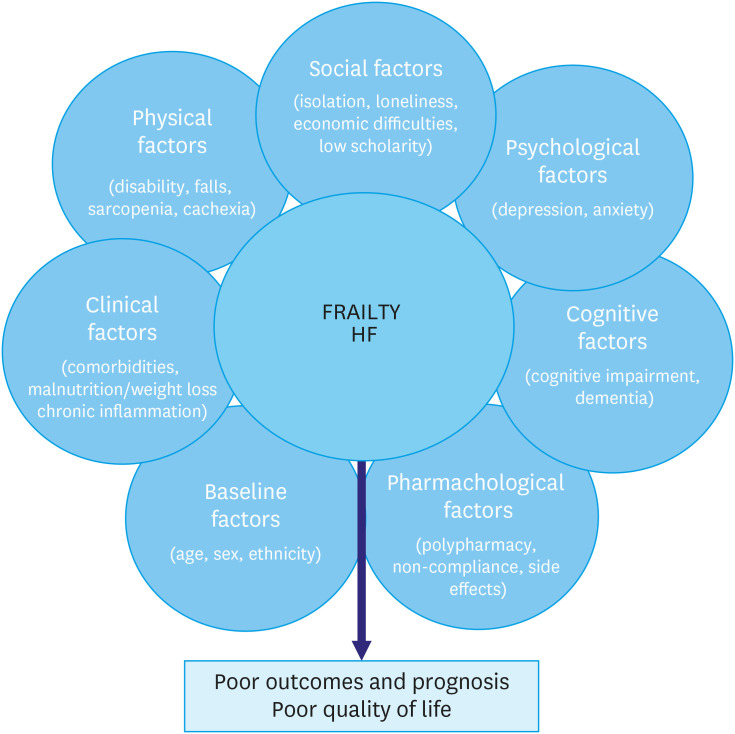
Frailty is highly prevalent among patients with heart failure (HF) and independently predicts adverse outcomes. However, optimal frailty definitions, assessments, and management in HF remain unclear. Frailty is common in HF, affecting up to 80% of patients depending on population characteristics. Even pre-frailty doubles mortality risk versus robust patients. Frailty worsens HF prognosis through systemic inflammation, neurohormonal changes, sarcopenia, and micronutrient deficiency. Simple screening tools like gait speed and grip strength predict outcomes but lack HF-specificity. Comprehensive geriatric assessment is ideal but not always feasible. Exercise, nutrition, poly-pharmacy management, and multidisciplinary care models can help stablize frailty components and improve patient-centred outcomes. Frailty frequently coexists with and exacerbates HF. Routine frailty screening should guide supportive interventions to optimize physical, cognitive, and psychosocial health. Further research on HF-specific frailty assessment tools and interventions is warranted to reduce this dual burden.
Keywords: Frailty; Heart failure; Prognosis; Rehabilitation; Therapy.
Copyright © 2024. Korean Society of Heart Failure.
Conflict of interest statement
Conflict of Interest: The authors have no financial conflicts of interest.
Figures
References
-
- Vitale C, Jankowska E, Hill L, et al. Heart Failure Association/European Society of Cardiology position paper on frailty in patients with heart failure. Eur J Heart Fail. 2019;21:1299–1305. - PubMed
Publication types
LinkOut - more resources
Full Text Sources
Research Materials
Miscellaneous