. 2023 Aug 31:2:1099059.
doi: 10.3389/frdem.2023.1099059. eCollection 2023.

Dimensions of cognitive reserve and their predictive power of cognitive performance and decline in the elderly

Affiliations

Dimensions of cognitive reserve and their predictive power of cognitive performance and decline in the elderly

Teodoro Del Ser et al. Front Dement. .

Abstract

Background: The relative importance of different components of cognitive reserve (CR), as well as their differences by gender, are poorly established.

Objective: To explore several dimensions of CR, their differences by gender, and their effects on cognitive performance and trajectory in a cohort of older people without relevant psychiatric, neurologic, or systemic conditions.

Methods: Twenty-one variables related to the education, occupation, social activities, and life habits of 1,093 home-dwelling and cognitively healthy individuals, between 68 and 86 years old, were explored using factorial analyses to delineate several dimensions of CR. These dimensions were contrasted with baseline cognitive performance, follow-up over 5 years of participants' cognitive trajectory, conversion to mild cognitive impairment (MCI), and brain volumes using regression and growth curve models, controlling for gender, age, marital status, number of medications, trait anxiety, depression, and ApoE genotype.

Results: Five highly intercorrelated dimensions of CR were identified, with some differences in their structure and effects based on gender. Three of them, education/occupation, midlife cognitive activities, and leisure activities, were significantly associated with late-life cognitive performance, accounting for more than 20% of its variance. The education/occupation had positive effect on the rate of cognitive decline during the 5-year follow up in individuals with final diagnosis of MCI but showed a reduced risk for MCI in men. None of these dimensions showed significant relationships with gray or white matter volumes.

Conclusion: Proxy markers of CR can be represented by five interrelated dimensions. Education/occupation, midlife cognitive activities, and leisure activities are associated with better cognitive performance in old age and provide a buffer against cognitive impairment. Education/occupation may delay the clinical onset of MCI and is also associated with the rate of change in cognitive performance.

Keywords: brain atrophy; brain volume; cognitive performance; cognitive reserve; dimensions; mild cognitive impairment.


Conflict of interest statement

The authors declare that the research was conducted in the absence of any commercial or financial relationships that could be construed as a potential conflict of interest.

Figures

Figure 1
Figure 1
Individuals in the survey at every yearly assessment. MCI, mild cognitive impairment.
Figure 2
Figure 2
Path diagram of conditional latent growth model fitted to cognitive reserve, adjusted by relevant covariates. 1Five dimensions of Cognitive reserve: education/occupation, midlife cognitive activities, leisure activities, cultural activities, and physical activities. Nine covariates such as age at baseline, marital status, number of medications, trait anxiety and depression scores at baseline, gender, number of ApoE-ε4 and ApoE-ε2 alleles, and atrophy. I, intercept; S, linear slope; Q, quadratic slope; CCS, cognitive composite score; bl, score at baseline; fu1, score at first follow-up; fu2, score at second follow-up; fu3, score at third follow-up; fu4, score at fourth follow-up; fu5, score at fifth follow-up. 1This diagram represents the latent growth curve model used for the group of individuals diagnosed with mild cognitive impairment. The model used in the group of cognitively healthy cases did not include the quadratic slope.
Figure 3
Figure 3
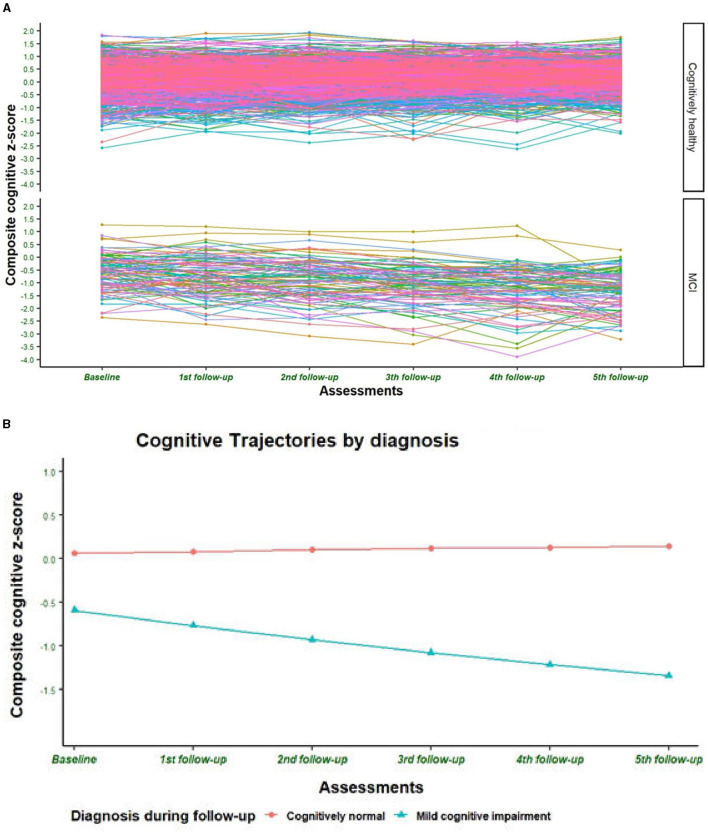
(A) Individual cognitive trajectories during follow-up by clinical diagnosis. The figure presents the trajectory of the composite cognitive z-score of randomly selected subjects. (B) Cognitive trajectory during follow-up by clinical diagnosis. The figure presents the estimated trajectory of the composite cognitive z-score according to the first unconditional latent growth curve model where only clinical diagnosis was introduced as an independent factor.
Figure 4
Figure 4
(A) Education/Occupation dimension effects on cognitive function across time by clinical diagnosis. (A) presents the estimated trajectories of composite cognitive z-score in the conditional latent growth curve model of individuals with three different levels of score in the cognitive recognition dimension Education/Occupation. The factor score is significantly and positively associated with the cognitive composite score (CCS) initial level of cognitively healthy subjects (p < 0.0001) and for subjects with a diagnosis of mild cognitive impairment (MCI) after follow-up (p = 0.045). Education/occupation factor score is also negatively associated with the rate of change of CCS (p = 0.015) in subjects with MCI diagnosis. The latter means that the higher the cognitive reserve in terms of education/occupation, the higher the acceleration of the change of rate of CCS in the group of MCI subjects. The conditional latent growth curve model was adjusted by covariates such as age at baseline (centered at 70 years old), gender (0 = men, 1 = women), marital status (0 = married, 1 = other), number of medications, trait anxiety and depression scores at baseline, and number of ApoE-ε4 and ApoE-ε2 alleles. (B) Leisure activities dimension effects on cognitive function across time by clinical diagnosis. (B) presents the estimated trajectories of composite cognitive z-score in the conditional latent growth curve model of individuals with three different levels of score in the cognitive reserve dimension leisure activities. The factor score is significantly and positively associated with the cognitive composite score initial level of cognitively healthy subjects (p < 0.0001). The conditional latent growth curve model was adjusted by covariates such as age at baseline (centered at 70 years old), gender (0 = men, 1 = women), marital status (0 = married, 1 = other), number of medications, trait anxiety and depression scores at baseline, and number of ApoE-ε4 and ApoE-ε2 alleles.

References

    1. Albert M. S., Dekosky S. T., Dickson D., Dubois B., Feldman H. H., Fox N. C., et al. . (2011). The diagnosis of mild cognitive impairment due to Alzheimer's disease: Recommendations from the national institute on aging and Alzheimer's association workgroup. Alzheimer's Dement. (2011) 7, 270–279. 10.1016/j.jalz.2011.03.008 - DOI - PMC - PubMed
    1. Anderson J. C., Gerbing D. W. (1988). Structural equation modelling in practice: a review and recommended two-step approach. Psychol. Bullet. 103, 411–423. 10.1037/0033-2909.103.3.411 - DOI
    1. Andrews S. J., Fulton-Howard B., O'Reilly P., Marcora E., Goate A. M. (2021). collaborators of the Alzheimer's disease genetics consortium. causal associations between modifiable risk factors and the Alzheimer's phenome. Ann. Neurol. 89, 54–65. 10.1002/ana.25918 - DOI - PMC - PubMed
    1. Arenaza-Urquijo E. M., Landeau B., La Joie R., Mevel K., Mézenge F., Perrotin A., et al. . (2013). Relationships between years of education and gray matter volume, metabolism and functional connectivity in healthy elders. Neuroimage. (2013) 83:450-457. 10.1016/j.neuroimage.2013.06.053 - DOI - PubMed
    1. Bozzali M., Dowling C., Serra L., Spanò B., Torso M., Marra C., et al. . (2015). The impact of cognitive reserve on brain functional connectivity in Alzheimer's disease. J. Alzheimers Dis. 44, 243–250. 10.3233/JAD-141824 - DOI - PubMed

LinkOut - more resources