


Drivers and epidemiological patterns of West Nile virus in Serbia
- PMID: 39086811
- PMCID: PMC11288825
- DOI: 10.3389/fpubh.2024.1429583
Drivers and epidemiological patterns of West Nile virus in Serbia
Abstract
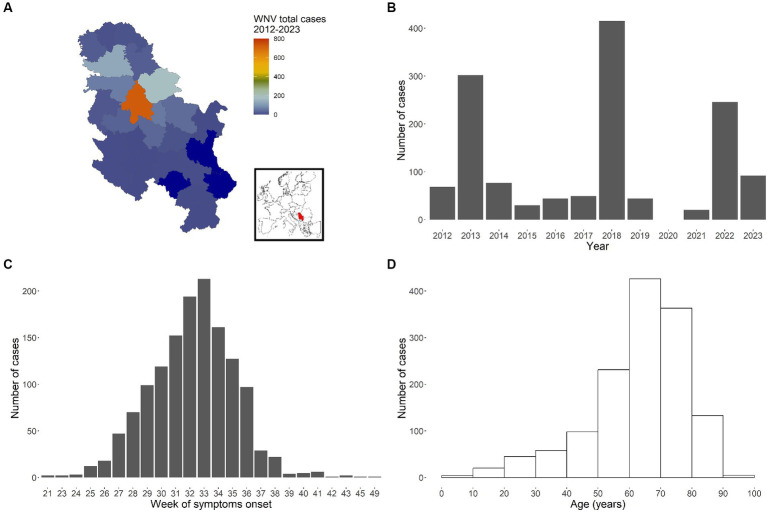
Background: West Nile virus (WNV) is an emerging mosquito-borne pathogen in Serbia, where it has been detected as a cause of infection in humans since 2012. We analyzed and modelled WNV transmission patterns in the country between 2012 and 2023.
Methods: We applied a previously developed modelling approach to quantify epidemiological parameters of interest and to identify the most important environmental drivers of the force of infection (FOI) by means of statistical analysis in the human population in the country.
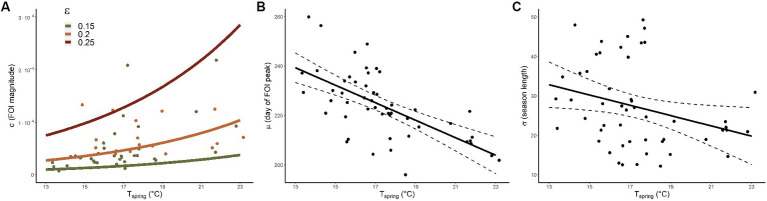
Results: During the study period, 1,387 human cases were recorded, with substantial heterogeneity across years. We found that spring temperature is of paramount importance for WNV transmission, as FOI magnitude and peak timing are positively associated with it. Furthermore, FOI is also estimated to be greater in regions with a larger fraction of older adult people, who are at higher risk to develop severe infections.
Conclusion: Our results highlight that temperature plays a key role in shaping WNV outbreak magnitude in Serbia, confirming the association between spring climatic conditions and WNV human transmission risk and thus pointing out the importance of this factor as a potential early warning predictor for timely application of preventive and control measures.
Keywords: Culex; West Nile virus; mathematical model; mosquito; vector-borne.
Copyright © 2024 Marini, Drakulovic, Jovanovic, Dagostin, Wint, Tagliapietra, Vasic and Rizzoli.
Conflict of interest statement
WW was employed by Environmental Research Group Oxford Ltd, c/o Dept Biology. The remaining authors declare that the research was conducted in the absence of any commercial or financial relationships that could be construed as a potential conflict of interest.
Figures
References
-
- Young JJ, Haussig JM, Aberle SW, Pervanidou D, Riccardo F, Sekulić N, et al. . Epidemiology of human West Nile virus infections in the European Union and European Union enlargement countries, 2010 to 2018. Eur Secur. (2021) 26:2001095. doi: 10.2807/1560-7917.ES.2021.26.19.2001095 - DOI - PMC - PubMed
-
- Barzon L, Pacenti M, Montarsi F, Fornasiero D, Gobbo F, Quaranta E, et al. . Rapid spread of a new West Nile virus lineage 1 associated with increased risk of neuroinvasive disease during a large outbreak in Italy in 2022. J Travel Med. (2022):taac125. doi: 10.1093/jtm/taac125, PMID: - DOI - PMC - PubMed
MeSH terms
LinkOut - more resources
Full Text Sources
Medical
