


AUTO-TUNE: selecting the distance threshold for inferring HIV transmission clusters
- PMID: 39086842
- PMCID: PMC11289888
- DOI: 10.3389/fbinf.2024.1400003
AUTO-TUNE: selecting the distance threshold for inferring HIV transmission clusters
Abstract
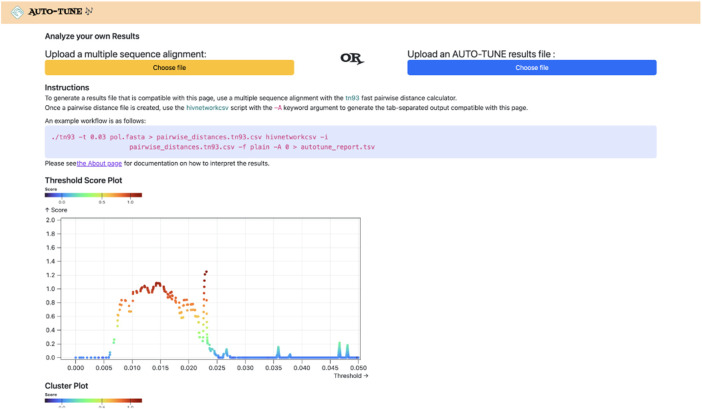
Molecular surveillance of viral pathogens and inference of transmission networks from genomic data play an increasingly important role in public health efforts, especially for HIV-1. For many methods, the genetic distance threshold used to connect sequences in the transmission network is a key parameter informing the properties of inferred networks. Using a distance threshold that is too high can result in a network with many spurious links, making it difficult to interpret. Conversely, a distance threshold that is too low can result in a network with too few links, which may not capture key insights into clusters of public health concern. Published research using the HIV-TRACE software package frequently uses the default threshold of 0.015 substitutions/site for HIV pol gene sequences, but in many cases, investigators heuristically select other threshold parameters to better capture the underlying dynamics of the epidemic they are studying. Here, we present a general heuristic scoring approach for tuning a distance threshold adaptively, which seeks to prevent the formation of giant clusters. We prioritize the ratio of the sizes of the largest and the second largest cluster, maximizing the number of clusters present in the network. We apply our scoring heuristic to outbreaks with different characteristics, such as regional or temporal variability, and demonstrate the utility of using the scoring mechanism's suggested distance threshold to identify clusters exhibiting risk factors that would have otherwise been more difficult to identify. For example, while we found that a 0.015 substitutions/site distance threshold is typical for US-like epidemics, recent outbreaks like the CRF07_BC subtype among men who have sex with men (MSM) in China have been found to have a lower optimal threshold of 0.005 to better capture the transition from injected drug use (IDU) to MSM as the primary risk factor. Alternatively, in communities surrounding Lake Victoria in Uganda, where there has been sustained heterosexual transmission for many years, we found that a larger distance threshold is necessary to capture a more risk factor-diverse population with sparse sampling over a longer period of time. Such identification may allow for more informed intervention action by respective public health officials.
Keywords: HIV; molecular epidemiology; network; surveillance; transmission cluster.
Copyright © 2024 Weaver, Dávila Conn, Ji, Verdonk, Ávila-Ríos, Leigh Brown, Wertheim and Kosakovsky Pond.
Conflict of interest statement
The authors declare that the research was conducted in the absence of any commercial or financial relationships that could be construed as a potential conflict of interest.
Figures



Update of
-
AUTO-TUNE: SELECTING THE DISTANCE THRESHOLD FOR INFERRING HIV TRANSMISSION CLUSTERS.bioRxiv [Preprint]. 2024 Mar 14:2024.03.11.584522. doi: 10.1101/2024.03.11.584522. bioRxiv. 2024. Update in: Front Bioinform. 2024 Jul 10;4:1400003. doi: 10.3389/fbinf.2024.1400003. PMID: 38559140 Free PMC article. Updated. Preprint.
References
-
- Bartlett S. R., Wertheim J. O., Bull R. A., Matthews G. V., Lamoury F. M., Scheffler K., et al. (2017). A molecular transmission network of recent hepatitis c infection in people with and without hiv: implications for targeted treatment strategies. J. viral Hepat. 24, 404–411. 10.1111/jvh.12652 - DOI - PMC - PubMed
-
- Billings E., Kijak G. H., Sanders-Buell E., Ndembi N., O’Sullivan A. M., Adebajo S., et al. (2019). New subtype b containing hiv-1 circulating recombinant of sub-saharan africa origin in nigerian men who have sex with men. J. Acquir Immune Defic. Syndr. 81, 578–584. 10.1097/QAI.0000000000002076 - DOI - PMC - PubMed
