


doi: 10.1038/s41467-024-50683-5.
Lactobacillus species do not produce 1-acetyl-β-carboline
Affiliations
- PMID: 39090105
- PMCID: PMC11294554
- DOI: 10.1038/s41467-024-50683-5
Item in Clipboard
Lactobacillus species do not produce 1-acetyl-β-carboline
Nat Commun.
.
No abstract available
Conflict of interest statement
The authors declare no competing interests.
Figures
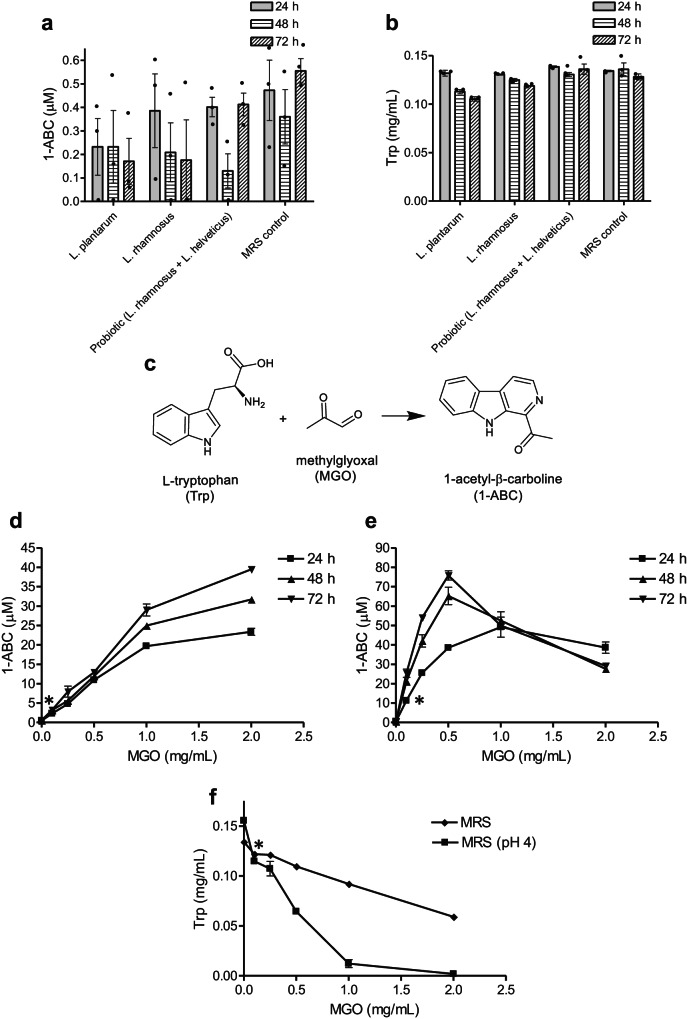
a Concentrations of 1-ABC in MRS control media and in MRS media grown with L. plantarum WCFS1, L. rhamnosus GG, and probiotic strains L. rhamnosus R0011 and L. helveticus R0052 incubated at 37 °C under anaerobic conditions for 24, 48 and 72 h. The MRS control media was incubated in the same conditions as the MRS media inoculated with lactobacilli. No significant differences (p > 0.05) were found among lactobacilli cultures and MRS control or among incubation time. b Content of L-tryptophan (Trp) in MRS and in the culture media of lactobacilli. The MRS control media was incubated in the same conditions as the MRS media inoculated with lactobacilli. No significant differences were found between cultures or time. c Reaction of L-tryptophan with methylglyoxal (MGO) to afford 1-ABC. d Formation of 1-ABC in MRS media with added MGO and incubated at 37 °C in anaerobic conditions at 24, 48 and 72 h. Significant differences (p < 0.05) were found with the addition of MGO at 0.1 mg/mL and above vs MRS control. e Formation of 1-ABC in MRS media adjusted to pH 4 with added MGO and incubated in anaerobic conditions at 37 °C for 24, 48, and 72 h. Significant differences (p < 0.05) were found with the addition of MGO at 0.1 mg/mL and above vs MRS control. f Removal of L-Trp from MRS media with the addition of MGO (37 °C for 24 h). Significant differences (p < 0.05) were found with the addition of MGO at 0.1 mg/mL and above vs MRS control. Data represent mean ± SEM (n = 3). Significance (*) was determined using unpaired Student’s t test.
References
-
- Matsubara, V. H., Wang, Y., Bandara, H. M. H. N., Mayer, M. P. A. & Samaranayake, L. P. Probiotic lactobacilli inhibit early stages of Candida albicans biofilm development by reducing their growth, cell adhesion, and filamentation. Appl. Microbiol. Biotechnol.100, 6415–6426 (2016). 10.1007/s00253-016-7527-3 - DOI - PubMed
Publication types
MeSH terms
Substances
Grants and funding
- PID-2021-127833OB-I00/Ministry of Economy and Competitiveness | Agencia Estatal de Investigación (Spanish Agencia Estatal de Investigación)
- PID2022-136438OB-I00/Ministry of Economy and Competitiveness | Agencia Estatal de Investigación (Spanish Agencia Estatal de Investigación)
- PID-2021-123291OB-I00/Ministry of Economy and Competitiveness | Agencia Estatal de Investigación (Spanish Agencia Estatal de Investigación)
LinkOut - more resources
Full Text Sources
