. 2024 Aug 1;14(1):17848.
doi: 10.1038/s41598-024-68634-x.

The public health impact of COVID-19 variants of concern on the effectiveness of contact tracing in Vermont, United States

Affiliations

The public health impact of COVID-19 variants of concern on the effectiveness of contact tracing in Vermont, United States

François M Castonguay et al. Sci Rep. .

Abstract

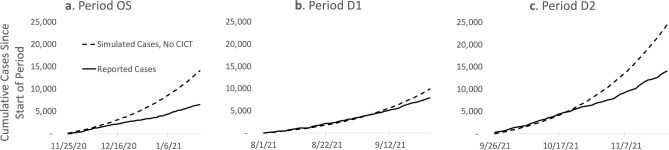
Case investigation and contact tracing (CICT) are public health measures that aim to break the chain of pathogen transmission. Changes in viral characteristics of COVID-19 variants have likely affected the effectiveness of CICT programs. We estimated and compared the cases averted in Vermont when the original COVID-19 strain circulated (Nov. 25, 2020-Jan. 19, 2021) with two periods when the Delta strain dominated (Aug. 1-Sept. 25, 2021, and Sept. 26-Nov. 20, 2021). When the original strain circulated, we estimated that CICT prevented 7180 cases (55% reduction in disease burden), compared to 1437 (15% reduction) and 9970 cases (40% reduction) when the Delta strain circulated. Despite the Delta variant being more infectious and having a shorter latency period, CICT remained an effective tool to slow spread of COVID-19; while these viral characteristics did diminish CICT effectiveness, non-viral characteristics had a much greater impact on CICT effectiveness.

Keywords: COVID-19; Case investigation; Cases averted; Contact tracing; Modeling.


Conflict of interest statement

The authors declare no competing interests.

Figures
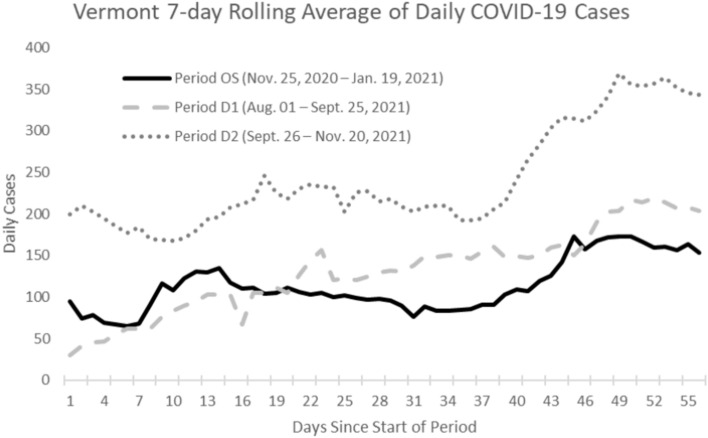
Figure 1
Figure 1
Oberved seven-day rolling average of daily COVID-19 cases in Vermont, for the three study periods (Period OS, Period D1, and Period D2), 2020–2021. Note that polymerase chain reaction (PCR) test—considered the gold standard for the detection of COVID-19—represented 86.30% of all positive lab tests in Period OS, compared to 88.68% and 91.63% for Period D1 and Period D2, respectively (Table S1). Note that these three study periods represented time periods with similar effective reproduction number. Some data outside the study periods were used to plot the beginning of the 7-day rolling average.
Figure 2
Figure 2
Comparison of case investigation and contact tracing’s (CICT) impact on the epidemic curves of various periods in Vermont, by dominating variant transmission, 2020–2021. The figure shows epidemic curves of the reported case count for the three study periods: Period OS, Period D1, and Period D2, with the case investigation and contact tracing (CICT) program in place and simulated epidemic curves to show what might have occurred had the CICT program not been implemented. The solid lines are Vermont’s reported cumulative case counts since the beginning of each study period with both CICT and other nonpharmaceutical interventions (NPIs) implemented. The dashed lines are the estimated curves illustrating the cumulative case count of what might have occurred in Vermont if CICT had not been implemented, and only other NPIs were implemented during the study period. The difference between any two lines within one panel represents the cases averted by CICT.
Figure 3
Figure 3
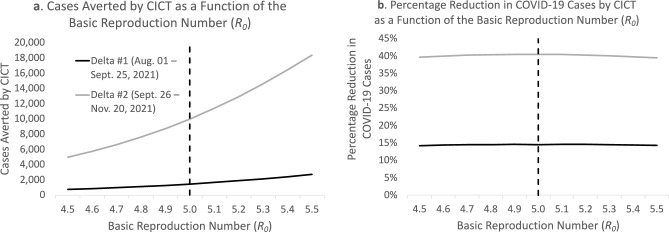
Impact of case investigation and contact tracing (CICT) during two Delta periods in Vermont, for different initial values of the basic reproduction number (R0). The results are presented in terms of Cumulative number of cases averted (Panel A) and corresponding percentage reduction in COVID-19 cases (Panel B). The results corresponding to the observed percentage of vaccinated population (Table 2) are represented by the dashed vertical line. Note that the model adjusts the R0 value on a daily basis as the pool of susceptible individuals decreases; the R0 value adjusted in the sensitivity analyses is the “starting” value. Further note the percentage reduction in COVID-19 cases (panel B) represents the number of cases averted by CICT among every 100 cases not averted by vaccine or other nonpharmaceutical interventions (NPIs; such as facemask policies, large gathering restrictions, and school/business closures).

References

    1. Eames, K. T. & Keeling, M. J. Contact tracing and disease control. Proc. Royal Soc. Lond. Series B Biol. Sci.270(1533), 2565–2571 (2003).10.1098/rspb.2003.2554 - DOI - PMC - PubMed
    1. Jeon, S. et al. Estimates of cases and hospitalizations averted by COVID-19 case investigation and contact tracing in 14 health jurisdictions in the United States. J. Public Health Manag. Pract.28(1), 16–24 (2022). 10.1097/PHH.0000000000001420 - DOI - PMC - PubMed
    1. Rainisch, G. et al. Estimated COVID-19 cases and hospitalizations averted by case investigation and contact tracing in the US. JAMA Netw. Open5(3), e224042–e224042 (2022). 10.1001/jamanetworkopen.2022.4042 - DOI - PMC - PubMed
    1. Jeon, S. et al. Adapting COVID-19 contact tracing protocols to accommodate resource constraints, Philadelphia, Pennsylvania, USA, 2021. Emerg. Infect. Dis.30(2), 333 (2024). 10.3201/eid3002.230988 - DOI - PMC - PubMed
    1. Kraemer, M. U. et al. Monitoring key epidemiological parameters of SARS-CoV-2 transmission. Nat. Med.27(11), 1854–1855 (2021). 10.1038/s41591-021-01545-w - DOI - PubMed

Supplementary concepts

LinkOut - more resources