. 2024 Nov;32(11):1456-1464.
doi: 10.1038/s41431-024-01654-3. Epub 2024 Aug 1.

Colorectal cancer risk stratification using a polygenic risk score in symptomatic primary care patients-a UK Biobank retrospective cohort study

Affiliations

Colorectal cancer risk stratification using a polygenic risk score in symptomatic primary care patients-a UK Biobank retrospective cohort study

Bethan Mallabar-Rimmer et al. Eur J Hum Genet. 2024 Nov.

Abstract

Colorectal cancer (CRC) is a leading cause of cancer mortality worldwide. Accurate cancer risk assessment approaches could increase rates of early CRC diagnosis, improve health outcomes for patients and reduce pressure on diagnostic services. The faecal immunochemical test (FIT) for blood in stool is widely used in primary care to identify symptomatic patients with likely CRC. However, there is a 6-16% noncompliance rate with FIT in clinic and ~90% of patients over the symptomatic 10 µg/g test threshold do not have CRC. A polygenic risk score (PRS) quantifies an individual's genetic risk of a condition based on many common variants. Existing PRS for CRC have so far been used to stratify asymptomatic populations. We conducted a retrospective cohort study of 50,387 UK Biobank participants with a CRC symptom in their primary care record at age 40+. A PRS based on 201 variants, 5 genetic principal components and 22 other risk factors and markers for CRC were assessed for association with CRC diagnosis within 2 years of first symptom presentation using logistic regression. Associated variables were included in an integrated risk model and trained in 80% of the cohort to predict CRC diagnosis within 2 years. An integrated risk model combining PRS, age, sex, and patient-reported symptoms was predictive of CRC development in a testing cohort (receiver operating characteristic area under the curve, ROCAUC: 0.76, 95% confidence interval: 0.71-0.81). This model has the potential to improve early diagnosis of CRC, particularly in cases of patient noncompliance with FIT.


Conflict of interest statement

Competing interests The authors declare no competing interests. Ethical approval Data from the UK Biobank Resource were accessed under Application Number 74981. UK Biobank was approved as tissue bank resource by North West Multi-centre Research Ethics Committee. All UK Biobank participants gave written informed consent for use of their data for health research. Participants who withdrew consent during this study were excluded from analysis.

Figures

Fig. 1
Fig. 1. Flowchart of study design.
Participants with a CRC symptom in their GP record at age 40+ were included in the study. Cases had a CRC diagnosis within 2 years of first symptom, whereas controls did not. Excluded participants: died within 2 years of first symptom (not from CRC), had CRC before first symptom, had non-European ancestry (excluded due to limited case numbers), were related to the first- or second-degree, had a pathogenic variant in Lynch syndrome genes MLH1, MSH2 or MSH6, or were diagnosed in primary care records with one of: familial adenomatous polyposis, Gardner syndrome, Turcot syndrome, hereditary flat adenoma syndrome, hereditary nonpolyposis CRC, hereditary mixed polyposis syndrome, or the hamartomatous polyposis syndromes. Only primary care records were used to find hereditary CRC syndrome diagnoses, as the ICD-10 codes these conditions fall under are not specific to the conditions, also encompassing any benign neoplasm of the digestive system. AFR African, AMR Admixed America, CRC colorectal cancer, EAS East Asian, EUR European, GP general practice, SAS South Asian, UKBB UK Biobank.
Fig. 2
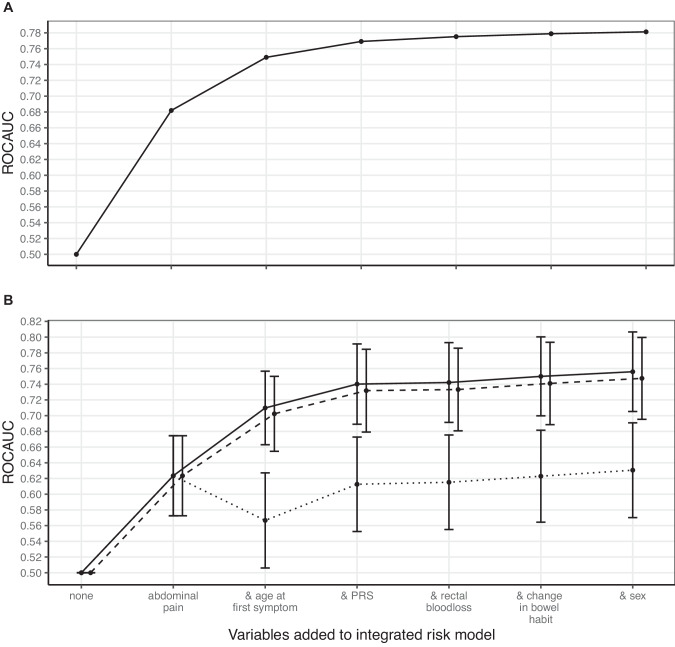
Fig. 2. Adding variables to the IRM in order of which cause the largest increase in ROCAUC in the training dataset, and replication in the testing dataset.
A As variables are added to the IRM, ROCAUC tends towards 0.78 in the training partition of the full cohort. Variables were added in order of which caused the greatest increase in ROCAUC. B Replicating the results of (A) in the testing partition of the full cohort. The same six variables had combined ROCAUC of 0.76 (CI95: 0.71–0.81) when predicting all cases of CRC (solid line), 0.75 (CI95: 0.70–0.80) when predicting left-sided CRC (dashed line), and 0.63 (CI95: 0.57–0.69) when predicting right-sided CRC (dotted line). However, using only age at first symptom, sex, and PRS to predict right-sided CRC had ROCAUC of 0.71 (CI95: 0.65–0.76). PRS polygenic risk score, ROCAUC receiver operating characteristic area under the curve.
Fig. 3
Fig. 3. Cumulative hazard plot showing participants’ risk of CRC over 2 years from date of first symptom, stratified by PRS quintile.
In the full, non-partitioned cohort, 1.45% (CI95:1.25–1.63%) of participants in the highest PRS risk quintile were diagnosed with CRC after 2 years, vs. 0.42% (CI95:0.35–0.53%) of participants in the lowest quintile. Quintile cut-offs were calculated in the entire cohort, of which 99.13% were controls. CI95 95% confidence interval, CRC colorectal cancer, PRS polygenic risk score.

References

    1. Cancer Research UK. Cancer mortality for common cancers. 2022. https://www.cancerresearchuk.org/health-professional/cancer-statistics/m....
    1. Keum N, Giovannucci E. Global burden of colorectal cancer: emerging trends, risk factors and prevention strategies. Nat Rev Gastroenterol Hepatol. 2019;16:713–32. - PubMed
    1. Cancer Research UK. Early Diagnosis Data Hub. 2022. https://crukcancerintelligence.shinyapps.io/EarlyDiagnosis/.
    1. Lawler M, Alsina D, Adams RA, Anderson AS, Brown G, Fearnhead NS, et al. Critical research gaps and recommendations to inform research prioritisation for more effective prevention and improved outcomes in colorectal cancer. Gut. 2018;67:179–93. - PMC - PubMed
    1. Cuthbert C, Nixon N, Vickers M, Samimi S, Rawson K, Ramjeesingh R, et al. Top 10 research priorities for early-stage colorectal cancer: a Canadian patient-oriented priority-setting partnership. CMAJ Open. 2022. 10.9778/cmajo.20210046. - PMC - PubMed

LinkOut - more resources