. 2024 Aug 1;13(1):73.
doi: 10.1186/s40164-024-00541-3.

1q jumping translocation as a biomarker in myeloid malignancy: frequently mutated genes associated with bad prognosis and low survival

Affiliations

1q jumping translocation as a biomarker in myeloid malignancy: frequently mutated genes associated with bad prognosis and low survival

Eitan Halper-Stromberg et al. Exp Hematol Oncol. .

Abstract

1q jumping translocation (JT) is rare and its molecular profiles in myeloid malignancies are not well-known. This study evaluated gene mutations in 1q-JT cohorts (0.38%) from hematological malignant specimens that underwent genetic analysis at the Johns Hopkins Hospital (n = 11,908) and the MD Anderson Cancer Center. 1q-JT had frequent mutations in eleven genes, most of which are associated with worse prognosis. BCOR mutations significantly co-occurred with others. Patients tended to have mutations in DNA-repair, spliceosome, and epigenetic modification pathways, though genes utilized within each of these pathways were not randomly distributed. Multi-, albeit overlapping, pathway interruptions tended to manifest in mutations of two gene sets. One gene set consisted of SF3B1 (spliceosome) and TET2 (epigenetic modification), while the other consisted of STAG2 (DNA repair), SRSF2, U2AF (spliceosome), ASXL1, KMT2D (epigenetic modification), BCOR, and GATA2 (transcription factors). An "intermediate" JT-like rearrangement may represent an early sign of occurring 1q-JT. Treatments (hypomethylating agents) and unique structures of the short arms of acrocentric chromosomes may contribute to 1q-JT formation in myeloid malignancies. The median overall survival after identification of a JT was 10 months (95% confidence interval, 5-15 months). Our cohort represents the largest number of myeloid malignancies from multi-centers with before and after the 1q-JT event analyzed to date. Overall, this study identified specific molecular profiles that are associated with 1q-JT in myeloid malignancies. 1q-JT could serve as a poor prognosis biomarker in myeloid malignancies, which could be important in making well-informed clinical decisions and treatment strategies.

Keywords: 1q jumping translocation; Gene mutation; Myeloid malignancy; Prognosis.


Conflict of interest statement

The authors declare no competing interests.

Figures
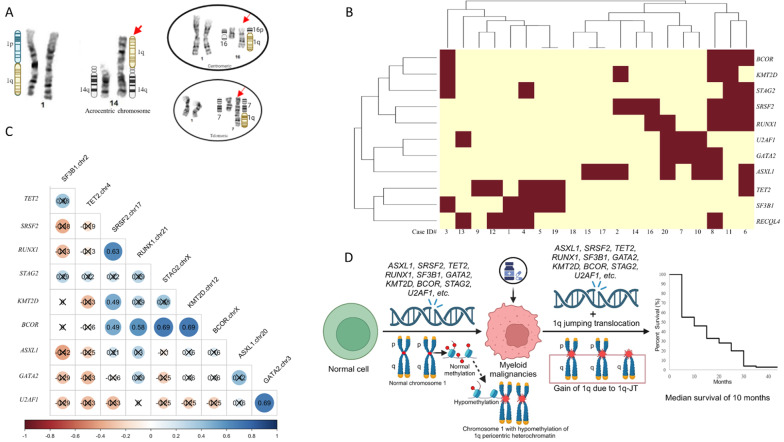
Fig. 1
Fig. 1
Genetic data and survival curve of jumping translocation (JT) cases in this study. (A) Various donor chromosome regions involved in 1q-JT formation. Short arms of acrocentric chromosomes (including 13p, 14p, 15p, 21p, and 22p) are frequently involved in 1q-JT formation, while other genomic regions (such as centromeric and telomeric regions) are infrequently involved in 1q-JT formation. Left is a partial karyogram of case #2 with 1q JT to a short arm of acrocentric chromosome 14 (red arrow). Right top insert is a partial karyogram of case #6 with 1q JT to a centromeric region of 16q and right bottom insert is a partial karyogram of case #3 with 1q JT to the telomere region of chromosome 7q (red arrows). (B) Heat map of the common mutated genes in the 1q-JT (Johns Hopkins) cohort. The most frequently mutated genes, in descending order, were ASXL1, SRSF2, TET2, RUNX1, RECQL4, SF3B1, GATA2, KMT2D, BCOR, STAG2, and U2AF1. While RECQL4 were among the most frequently mutated gene in this study, all variants in RECQL4 were of unknown clinical significance and favored germline. Cluster analysis of these genes generated two groups, one tending towards mutations in SF3B1 and TET2 (first 8 columns on the left side of Fig. 1B) and the other tending towards mutations in BCOR, KMT2D, STAG2, SRSF2, RUNX1, U2AF1, GATA2, and ASXL1 (Fig. 1B), though mutations were not mutually exclusive across groups. Specimens lacked mutation in NPM1, a frequently mutated gene in AML, associated with better prognosis. FLT3-ITD, a mutation associated with worse prognosis, was detected in one of the 20 patients. (C) Among the most frequently mutated genes, the most frequently significantly co-mutated gene (q-value < 0.05 based on Benjamini-Hochberg false discovery rate control of P-values from Pearson correlation tests) was BCOR. BCOR was significantly co-mutated with KMT2D, q-value = 0.01, and STAG2, q-value = 0.01 (numbers in circles indicate Pearson correlation coefficients, values obscured with an 'X' have P-values >=0.05). Two other pairs of genes were significantly co-mutated, U2AF1 and GATA2 q-value = 0.01, and RUNX1 and SRSF2, q-value = 0.04. (D) Diagram of potential mechanisms associated with development of 1q-JT in myeloid malignancies. Pre 1q JT patients with myeloid malignancies had these frequent mutations and may treat with hypomethylating agents (HMAs) such as azacitidine and decitabine before JT. HMAs may lead to epigenetic alteration such as hypomethylation of chromosome 1q12 pericentric heterochromatin, which may contribute to development of a double-strand break. Short arms of acrocentric chromosomes are frequently involved in 1q-JT formation because their distinctive genomic structure with centromere sequences and no coding genes makes them well-known for chromosomal rearrangements/ recombination. The presence of these pre JT mutations and gain of 1q due to JT led to a poor survival in these 1q-JT patients with myeloid malignancies. The median overall survival after JT occurrence was 10 months (95% confidence interval, 5–15 months) in this study

References

    1. Berger R, Bernard OA. Jumping translocations. Genes Chromosomes Cancer. 2007;46:717–23. 10.1002/gcc.20456 - DOI - PubMed
    1. Lee I, Gudipati MA, Waters E, Duong VH, Baer MR, Zou Y. Jumping translocations of chromosome 1q occurring by a multi-stage process in an acute myeloid leukemia progressed from myelodysplastic syndrome with a TET2 mutation. Mol Cytogenet. 2019;12:47. 10.1186/s13039-019-0460-2 - DOI - PMC - PubMed
    1. Behrens YL, Thomay K, Hagedorn M, Ebersold J, Schmidt G, Lentes J, et al. Jumping translocations: short telomeres or pathogenic TP53 variants as underlying mechanism in acute myeloid leukemia and myelodysplastic syndrome? Genes Chromosomes Cancer. 2019;58:139–48. 10.1002/gcc.22665 - DOI - PubMed
    1. Couture T, Amato K, DiAdamo A, Li P. Jumping translocations of 1q in Myelodysplastic Syndrome and Acute myeloid leukemia: report of three cases and review of literature. Case Rep Genet. 2018;2018:8296478. - PMC - PubMed
    1. Sanford D, DiNardo CD, Tang G, Cortes JE, Verstovsek S, Jabbour E, et al. Jumping translocations in myeloid malignancies Associated with Treatment Resistance and Poor Survival. Clin Lymphoma Myeloma Leuk. 2015;15:556–62. 10.1016/j.clml.2015.05.005 - DOI - PMC - PubMed

LinkOut - more resources
