


Negative association of steroids with immunotherapy efficacy in a multi-tumor cohort: time and dose-dependent
- PMID: 39093378
- PMCID: PMC11297225
- DOI: 10.1007/s00262-024-03772-9
Negative association of steroids with immunotherapy efficacy in a multi-tumor cohort: time and dose-dependent
Abstract
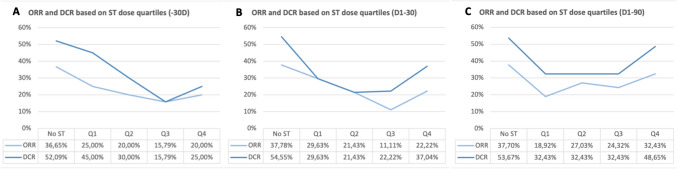
Previous studies have suggested a negative impact of steroids on the efficacy of immune checkpoint inhibitors (ICI), but how this effect is modulated by the dosage and time of administration is yet to be clarified. We have performed a retrospective analysis of 475 patients with advanced solid tumors treated with ICI as monotherapy from 2015 to 2022. Data regarding immune-related adverse events (irAEs) and clinical outcomes were collected. For each patient, the daily steroid dose (in mg/kg of prednisone) was registered until disease progression or death. The impact of cumulative doses on response rates and survival outcomes was analyzed within different periods. The objective response rate (ORR) was significantly lower among patients exposed to steroids within 30 days before the first cycle of ICI (C1) (20.3% vs. 36.7%, p < 0.01) and within the first 90 days of treatment (25.7% vs. 37.7%, p = 0.01). This negative association was confirmed by multivariable analysis. Higher mean steroid doses were observed among non-responders, and cumulative doses were inversely correlated with the disease control rate (DCR) around ICI initiation. Remarkably, poorer outcomes were observed even in patients belonging to the lowest dose quartile compared to the steroid-naïve population. The exposure to steroids after 6 months of ICI was not associated with worse survival outcomes. Our results suggest that the potential impact of steroids on ICI efficacy may be time-dependent, prevailing around ICI initiation, and dose-dependent, with modulation of neutrophil-to-lymphocyte ratio as a possible underlying mechanism.
Keywords: Dose; Immune checkpoint inhibitors; Immunotherapy; Neutrophil-to-lymphocyte ratio; Solid tumors; Steroids.
© 2024. The Author(s).
Conflict of interest statement
CS declares speakers’ fees from Novartis and AstraZeneca. AC declares speakers’ and advisory fees from GlaxoSmithKline, AstraZeneca, PharmaMar, Daiichi Sankyo, MSD, Eisai and Accord Healthcare. PG (Garrido) declares speakers’ fees from Janssen, MSD, Novartis, Medscape, Takeda, TouchTime and Medscape and advisory fees from Abbvie, Amgen, AstraZeneca, Bayer, BMS, Boehringer Ingelheim, Daiichi Sankyo, GlaxoSmithKline, Janssen, Lilly, MSD, Novartis, Pfizer, Roche, Sanofi and Takeda. PG (Gajate) declares advisory fees from BMS, Roche, Pfizer, Ipsen, MSD, Merck, Janssen, Astellas, Eisai and Novartis. The other authors declare no relevant conflicts of interest.
Figures

References
MeSH terms
Substances
LinkOut - more resources
Full Text Sources
Medical
